


Today’s Iran War post is launching hours before its normal time because I have competing obligations. I will update as needed when I return, so you will get a final version as usual by 8:00 AM EDT or so.
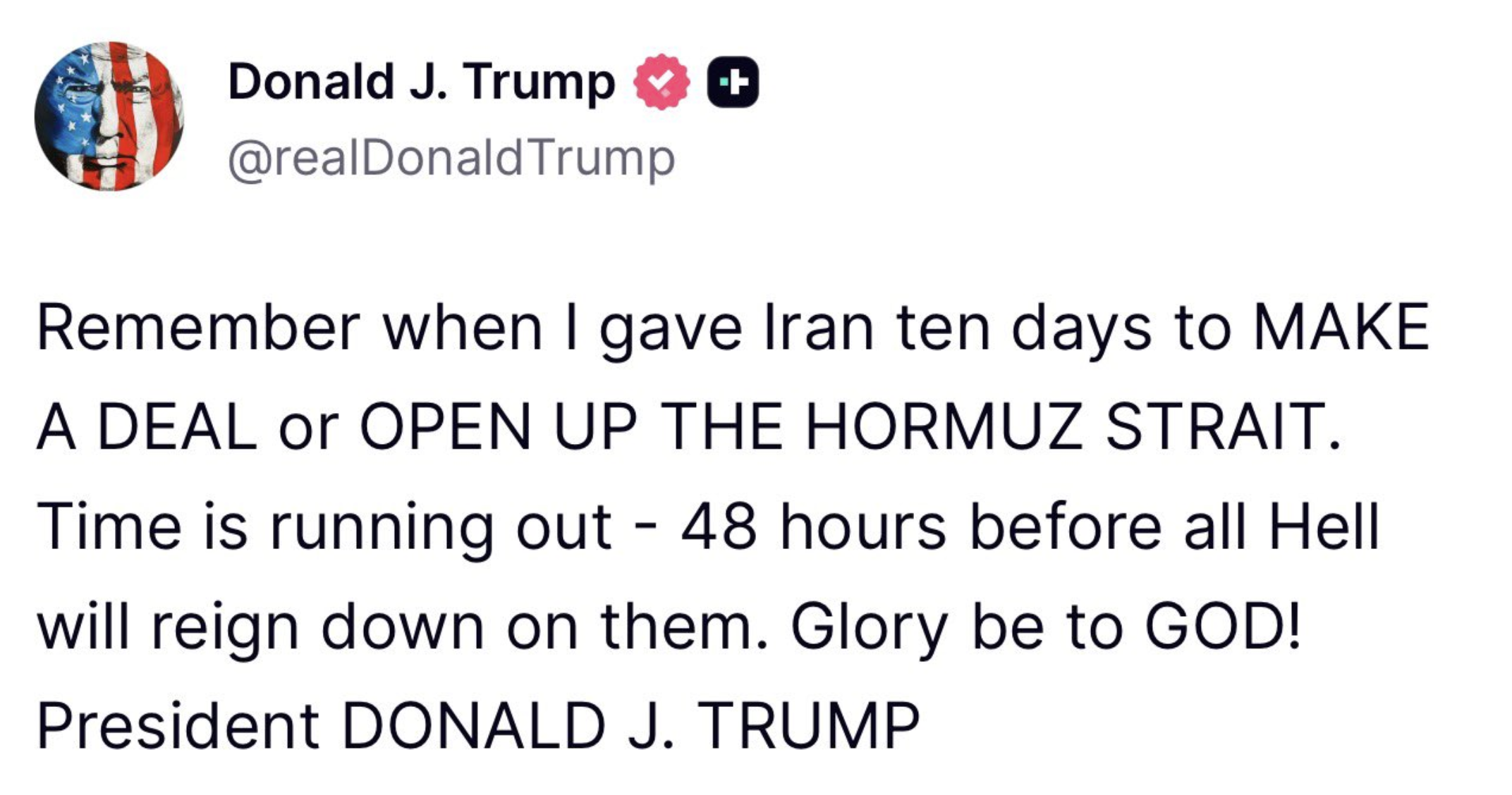
Most readers know that Trump doubled down on his April 6 deadline after the so-called Black Friday serial US military aircraft losses and damage:
Lindsey Graham dutifully amplifies Trump:
After speaking to Trump Lindsay Graham has said “A massive military operation awaits for Iran” if they do not abide by 48 hour deadline to open the Strait of Hormuz.
— WarMonitor🇺🇦🇬🇧 (@WarMonitor3) April 4, 2026
The “reign” may reflect his king complex. We’ll have a bit more on that soon. But given Trump’s sensitivity to market action and his propensity to either jump deadlines or TACO, one has to assume that if he acts, it will be before the market opening on Monday.
Trump also announced that the US had rescued the weapons operator who was missing after Iran downed an F-15. Despite the established propensity of our armed services to lie about or underplay bad events, it would be highly risky for Trump to declare success and then have Iran produce a body or a prisoner of war video. From Trump:
It looks as if this rescue operation produced real costs on both sides:
2) Update :on the US special ground operation to rescue the pilot :
On the attack, many Iran regime forces have been killed, and IRAN regime media is saying 4 US soldiers were also killed, but we have not been able to confirm this.
What we can confirm is that the local hospital… pic.twitter.com/YMikiNRZdT
— Botin Kurdistani (@kurdistannews24) April 4, 2026
BREAKING🚨 Another angle purports to show US helicopter dropping flaring as it crashes during rescue mission of missing US pilot.
Sounds of heavy clashes in the area. https://t.co/F5I40EpW12 pic.twitter.com/h9mcFIZlbj
— Syrian Girl (@Partisangirl) April 5, 2026
Regardless of the status of the pilot it would make complete sense for Iran to go what is could to extend and misdirect the very risky search and rescue operations. Not verified but does not look good:
🇮🇷🇺🇸 Footage now emerging from Dehdasht, Iran — a massive midair explosion and something crashing to earth directly in the search zone where US forces are hunting for the missing F-15E weapons systems officer.
This is no longer a rescue operation. This is a battlefield deep… https://t.co/RhQiHqLYPM pic.twitter.com/V7gHHkXRbQ
— Gerry Nolan (@RealGerryNolan) April 5, 2026
And RT does have some cred as well as contacts:
US rescue team ‘deliberately trapped’ — @said_Oedjang
‘IRGC kept captured pilot’s beacon on to lure’ https://t.co/07pKGffiRD pic.twitter.com/3QC9dp0jEs
— RT (@RT_com) April 5, 2026
Mario Nawfal’s Dunning Kruger syndrome is annoying but it does have the effect of eliciting corrections of his parroting of orthodox messaging. Larry Wilkerson explains at the top US not much or not at all gone into Iranian airspace, confirming the comments of many that the US is nearly entirely using precision standoff weapons or quasi precise ones like JDAMs. That is partly a concern about Iran still having air defense capabilities but also the distances involved, that it is not feasible for planes to go that far into Iran even if they wanted to. He further notes that the fact that the US is running out of precision missiles means the US may decide to send planes in as far as they can go to drop older-fashioned ordnance directly on targets. So the successful downing of the F-15 may set off alarm bells about the risks of that probable next step. Wilkerson also note that plane may have strayed and not been intended to go as far as it did.
Wilkerson’s assessment implies that the Trump “hit them like we never have before” is actually anther admission of weakness, that the US will send in B-2s and B-52s to drop highly destructive gravity bombs because the US is running critically low on standoff weapons. Can Iran take down many of these planes if so?
Per Reuters (hat tip Ann), Iran says new air defence system used to target US fighter jet: 1
Iran used a new air defence system on Friday to target a U.S. fighter jet, Iran’s Khatam al-Anbiya joint military command said on Saturday.
A spokesperson for the joint military command said the country would “definitely achieve full control” over its airspace, according to Iranian state media.
This is a particularly good Hindustan Times segment, on probable status of Iran missiles, with a lot of detail on how well they are bunkered:
This Janta Ka update describes how the US retaliated for the pilot downing by attacking a refinery and a hospital; usefully shows a map of the area where the F-15 crashed. Also some amazing cope in light of what Wilkerson said above:
While nearly all eyes have been on the pilot rescue drama, the belligerents have continued with ever-more dangerous escalations. From Ann in Khaleej Times, US-Israeli strike on Iran’s Bushehr nuclear plant kills 1, injures 5:
A projectile from a US-Israeli attack hit near the Bushehr nuclear power plant in southern Iran on Saturday, killing one person, state media reported.
Five people were also wounded as the strikes targeted the petrochemicals hub, Iranian media cited an official as saying.
“Following the US-Zionist criminal attacks, this Saturday morning, around 8:30 am, a projectile hit the area near the Bushehr nuclear power plant in the southwest,” said the official IRNA news agency.
It added that one of the building’s guards was killed but noted that there was no damage to the plant’s facilities.
“Explosions occurred in the Special Petrochemical Zone of Mahshahr,” said Fars news agency, citing the deputy governor for Khuzestan province, Valiollah Hayati.
Iran’s Foreign Minister Seyed Abbas Araghchi also referred to the damage to their Bushehr nuclear plant after a projectile hit nearby, warning of grave repercussions of such attacks.
“Israel and the US have bombed our Bushehr plant four times now. Radioactive fallout will end life in GCC capitals, not Tehran. Attacks on our petrochemicals also convey real objectives,” he said on X.
And:
:
Terrifying escalation. A top Russian official confirms a deadly strike just breached the Bushehr nuclear plant’s protection circuit. He warns a catastrophic nuclear incident risk is skyrocketing as mass evacuations to the border begin. pic.twitter.com/OR67ltsmLZ
— Furkan Gözükara (@FurkanGozukara) April 4, 2026
We had put this tweet in comments on yesterday’s post:
This is madness. Iran will respond, and everything will get irreparably worse and take years to unfuck. The US and Israel have isolated themselves from the rest of the world. The economic blowback will be intense. The dollar & Treasuries will soon be on life support. https://t.co/b6KVWSp5fd
— Chris Martenson (@chrismartenson) April 4, 2026
Iran continues pounding Israel as its air defenses and even warning systems are becoming frayed:
Iran launched three waves of separate missile barrages and on the Zionist entity in the the past hour.
Settlers are facing a delay in sirens and internal warning messages – indicating issues with detection (radars damaged in Iran’s operations)
— Hussein of the south (@EyesOnSouth1) April 4, 2026
Sal Mergoliano’s latest update:
Three points stood out for me: his careful explanation of how the Strait of Hormuz is still effectively closed, the transit times of ships to various ports, which determines when shortages start to show up, and that it will take not mere insurance but military escorts for ship operators feel safe transiting the Strait.
Note that Iran is getting more Gulf states on board with its transit regime. See the prize you get for kicking the Americans off their airbase?
Iran’s Khatam al-Anbiya joint military command said Iraq would be exempt from any restrictions on transit through the Strait of Hormuz.
— Iran International English (@IranIntl_En) April 4, 2026
I have not seen this development confirmed but it seems credible. Qatar has tried to be neutral:
Qatar has contacted Iran asking for a safe passage through the Straight of Hormuz in exchange for unblocking $6 billion of Iranian money, according to Iranian MP, Amir Hoseesin Sabeti.
— Hassan Mafi (@thatdayin1992) April 4, 2026
Jeff Snider on what the highly elevated near-term oil prices versus much cheaper longer-dated contracts means: demand destruction, as in at least a bad recession:
However, note that Snider focuses on oil as a macro economy predictor. The old saying is that the cure for high oil prices is high oil prices, in that if they are elevated enough, they can do something between produce a recession and kill activity stone cold dead. That in technical terms means demand for energy is pretty elastic.
By contrast, many of the real economy effects of the de facto closure of the Strait of Hormuz are in products where demand is not as elastic, such as food and medications. Here the prospect is not simply continuing high prices but shortages. And those shortages could prove very durable if manufacturers, distributors, or other key supply chain participants fail.
The shortages in many nations in Asia are a precursor to what Europe and the US will soon see. For instance:
France and the UK Are Running Out of Diesel pic.twitter.com/NlMlbyhsBa
— Jack Prandelli (@jackprandelli) April 4, 2026
We have been far from alone in highlighting the alarming complacency about coming shortages and resulting dislocations. The fact that many industries have been drawing on inventories, including materials in transit, has blinded far too many that normalcy is ending. From The Two-Week Window That Could Break Global Commodity Markets in OilPrice:
Markets appear stable on the surface, but underlying stress is building across interconnected commodity chains—oil, gas, petrochemicals, fertilizers, helium, and logistics—raising the risk of a systemic breakdown.
The key shift is from pricing risk to deliverability and access risk, with supply chains losing flexibility and physical shortages beginning to emerge beneath still-functioning paper markets.
The next two weeks are critical: if disruptions persist, cascading failures could trigger inflation, supply shortages, and a broader global economic shock…..
The coming weeks will reveal which systemic risks-such as chain desynchronization or supply chain coupling-policymakers must prioritize to prevent cascading failures, guiding targeted proactive measures.
The real situation in the market has clearly shifted from disruption to early-stage system strain. Recognizing how oil, gas, naphtha, fertilizer, and helium are interconnected will help policymakers and analysts feel the system’s fragility and the risk of a widespread shock.
This coupling of commodity chains could lead to widespread economic impacts, including inflationary pressures and supply shortages, emphasizing the urgency for stakeholders to prepare for systemic disruptions…
Until now, an illusion has been in place, holding markets together over the past weeks: cargoes in transit, delayed physical impact, and the expectation of rapid stabilization. This will be fading as refiners begin to adjust intake assumptions. LNG buyers are moving from portfolio optimization to a clear new strategy: outright procurement urgency. Strategic reserves are being discussed not only as precautionary tools but also, given the facts on the ground, as potential necessities.
The divergence between paper and physical markets is widening. Benchmarks still reflect liquidity and sentiment. When looking at physical cargoes, there is clearly scarcity and risk. This gap is a precursor to dislocation and should already be recognized.
Shipping is accelerating this transition. War-risk insurance constraints are tightening further. It has also been changing as behavioral risk is rising. Owners are not only reacting to premiums; they are also slowly but steadily reassessing their exposure entirely. The result of this change is that there is a reduction of available tonnage in practice, even where fleets exist on paper. For all, deliverability, not production anymore, is the central constraint.
Oil and gas, however, are only the entry point.
The second chain, showing early signs of stress, is naphtha. Petrochemical margins have become increasingly compressed due to feedstock uncertainty and rising costs. It is not yet a full disruption, but the shift is visible: reduced operating rates, cautious procurement, and early signs of pricing pass-through.
The naphtha situation is critical as it sits at the core of industrial transformation. Plastics, chemicals, packaging, and solvents all depend on the availability of stable feedstocks. While there will not be an immediate shock, it will create a broad, creeping constraint across manufacturing systems.
And it is beginning.
The third chain, fertilizer, has already entered its critical window as gas-linked production economics deteriorate. At the same time, producers have begun adjusting output expectations. At present, the market is not yet recognizing all of it, as it is still treating fertilizer as a secondary risk because physical shortages have not yet materialized.
That is the mistake.
The fertilizer risk is already delayed and will remain that way for weeks or months. It needs to be recognized that production decisions made now will determine availability weeks and months ahead. All signs are already on red, with tightening margins, cautious production, and early signs of reduced forward supply becoming visible by the day. Once this translates into agricultural input shortages, the system will have very limited ability to respond.
Food inflation will not start today. But the conditions for it are being set now.
Helium, the fourth chain, has already made some headlines…
Policymakers and analysts should understand that the industries that are exposed to this development, such as healthcare, semiconductors, and advanced manufacturing, are not marginal economic sectors; they are critical. And they do not have easy substitutes.
The fifth chain, logistics, has moved to the forefront; it is no longer a background variable. Its role as a primary driver of system stress should make industry leaders and policymakers aware of the urgent need for action to maintain supply flexibility and prevent disruptions.
This is the shift markets are still underestimating.
The system is not only losing supply. It is losing flexibility….
Each chain does not fail independently. Each one accelerates the stress in the others. The result is not a series of shocks, but a system that loses its ability to absorb them.
At present, markets are still anchored in linear thinking, so no pricing for this situation is evident. Recognizing the coupling of these chains and their thresholds is crucial; delays could lead to rapid, uncontrollable shifts, urging policymakers and analysts to act now rather than wait for confirmation.
Markets and policymakers should understand that waiting for confirmation is the most expensive strategy. When all five chains show clear signs of disruption, an adjustment will already be underway, as prices will have moved, availability will be constrained, and decision-making will shift from optimization to allocation.
Looking at the system at present, there are clear signs that this shift is already in place in parts of it.
Looking at the impact of this total shift, the regional implications are becoming clearer as this transition unfolds.
When looking at Europe, it is clear that the continent is entering a renewed phase of exposure. It is directly placed in the path of a multi-chain stress situation due to its reliance on global LNG markets and its industrial sensitivity to petrochemicals and fertilizers. At present, the ARA hub remains a critical buffer, but it is increasingly functioning as a balancing mechanism rather than a stabilizing one….
The next fourteen days are therefore not just another period of volatility, but a first and dangerous compression phase.
If nothing fundamental changes, such as stabilizing flows, easing logistics, and the return of confidence, the total system will move from stress into breach conditions. Not everywhere at once, but across enough chains to alter overall behavior. In such scenarios or realities, markets will soon stop clearing through price alone; they will clear through access. It is a fundamentally different system.
As I have said repeatedly in comments, I see the risk to food supplies as far more imminent. Shortages and famines are often not the result of crop failures but mal-distribution. How many food products are packaged in plastic? Go look in a store. It is pervasive. How many restaurants use plastic for carryout purchases? There is no way to move to alternative packaging quickly. How much many food items will simply not be produced due to lack of packaging? How many like meats will not get to market due to lack of adequate alternatives to assure adequate sanitation along the way?
Assume the brace position. Seriously.
______
1 From Arkady Bogdanov in comments yesterday:
Yes, I would like to flesh this out a bit more regarding Iranian AD, and share my thoughts. Admittedly, much of this is speculation, but I believe the logic is sound. We know for a fact that Iran possesses Buk, S-300, and at least a small number of S-400 systems, and that Iran produces a domestic analog of the S-300 (so they should have S-300s in quantity). I have only seen one video shared by the US that appears to have taken out an S-300 system (which could have been a decoy). So it seems logical to conclude that these systems are all or mostly all still intact.
These are all very capable systems, with the S-300 and S-400 systems being superior to anything the US has. I would also remind people that the Serbs shot down TWO F-117s, which had/has stealth capabilities superior to the F-22 or F-35, with an S-125 system, which is vastly inferior to the Buk, S-300, and S-400.
We also know that all of the aircraft struck have been on the perimeter of the Iranian AD envelope, despite the US regime’s claim of air superiority and “bombing” Iranian targets. This contradiction is explained by the likelihood that the US is only flying aircraft around the leading edge of the Iranian AD envelope, and this is supported by all of the aircraft spotters in the UK showing photos of B-52’s and B-1’s being loaded exclusively with cruise missiles. The stocks of these are very obviously dwindling-many have discussed this, so this is forcing the US to use other means of delivery, and that likely why we are suddenly seeing more aircraft being hit- they are likely trying to lob guided, gliding JDAM bombs into the border regions of Iran from the edge of the Iranian AD envelope. The pesky thing about AD envelopes is that they are hard to map, shift as AD is moved tactically to prevent targeting, and is also affected by atmospheric conditions.
Now I would point out several things. The better AD systems are vastly more valuable, and given their longer ranges, are likely to be sited farther into the Iranian interior. It is also well known that, while not impossible, it is more difficult to intercept missiles, so given the value and limited number of these AD systems plus their lower effectiveness against missiles, they are likely keeping them hidden, in reserve. Remember that we (and Iran) know that the US has a very limited stockpile of standoff weapons (which again, are difficult to intercept), so it makes logical sense for Iran to keep its most expensive, most limited, and most effective AD systems in reserve for higher value targets that Iran has greater confidence that they can bring down with these systems to become available – When the US depletes it’s stockpile of standoff weapons, it will be forced to use high-value aircraft, and if they want to penetrate deeply into Iran, the US will have to use it’s highest value aircraft- B-1’s and B-2’s, as these are the only aircraft that have the range for that.
So logically, if you are Iran and believe that once you reveal your best AD to American ISR, it is likely to be targeted and destroyed, it makes sense to hide it until you have targets that are a worthy trade for the loss of these systems. Iranians have shown us that they are very shrewd and capable thinkers, so I believe that they are keeping these systems hidden. I think that the evidence that we have available plus the above logic suggests that these systems are lying in wait for a time when they will be most effective, and when high value targets become available (and when it comes to value, a bomber far-outstrips the value of a fighter or ground attack aircraft- even an F-35).
Oh, and speaking of F-35’s, it looks like Iran may (I stress the “may”) have gotten one. There are photos of aircraft debris in Iran that some people have identified as components that only exist on the F-35, along with insignia for a unit that was recently created which has only ever flown F-35’s. I’m not an expert on those matters by any means, but they appear to make a pretty good case (this discussion is all occurring on twitter).
And an extra: If you have a Twitter account, please follow this poster, if nothing else on general principles:
There is a large group of pro-war Pahlavists trying to have my account shut down because I am anti-war.
If I disappear, that is the reason. pic.twitter.com/kAXIgVHdQK
— Narjes Rahmati 🟩☫🟥 نرجس رحمتی (@Narjes_Rahmati) April 3, 2026
