


[This Iran war update launched before finished. Please return at 8:00 AM EDT or refresh your browser then for a final version]
Trump gave another rambling, unhinged speech repeating old and obviously false tropes, that the Iranian military was defeated yet the US still needed to spend a few more weeks bombing them into the Stone Age (“where they belong”) since Iran has somehow not gotten the memo and are still able to hold the mighty US off with spears and slingshots.
So one might assume that the Trump Unit is another three to four weeks, since after the initial, supposedly quick and easy assault on Iran failed, the most commonly messaged official timetable for victory was in another two to four weeks, which has now come and gone. But unlike the rolling Friedman Unit, the US has only at most three to four weeks of serious firepower left. What happens then?
Even though Trump did not mention it in his speech, the plan to send ground forces into Iran is still moving forward as more ground forces move into the theater.
And in the meantime, as we’ll soon discuss, even if Iran has taken blows, it seems to be more of civilian infrastructure than military assets. Or to put it another way, even if Iran’s fighting power has been degraded somewhat, the attrition on the belligerents’ side is worse. That is demonstrated by fresh attacks by Iran, notably a huge missile barrage on Israel.
Finally, in a must-listen talk, escalation expert Richard Pape argues what most have worked out, that Iran will never give up control of the Strait of Hormuz. And confirming that, Foreign Minister Abbas Araghchi threw down the internal low marker: the Strait of Hormuz is not international waters but internal to Iran and Oman.1 That is consistent I ran this by a diplomatic contact who agreed that was a valid reading.
First to the Trump speech. You can find a transcript here, or if you are a glutton for punishment, view it here. Mr. Market did not like the belligerence. This matters more than it might appear, since Trump heretofore has rung the changes on “Oh, negotiations are going just great” mixed with threats of and actual further military action. This prime-time speech may have considerably blunted Trump’s ability to engage in market-sophorific happy talk. And Mr. Market remains the force with the best prospects of checking him sooner rather than later. He has repeatedly demonstrated that suffering of real people does not move him.
From the Financial Times in Trump threatens to hit Iran ‘extremely hard’ in coming weeks:
Oil prices jumped as Trump offered little clarity on when and how the war would end, with Brent, the international benchmark, rising about 5 per cent in early Asia trading to $106 a barrel.
Stocks slid with Japan’s Topix share index falling roughly 1.2 per cent while South Korea’s Kospi dropped 3.8 per cent and futures tracking Wall Street’s S&P 500 declined 1 per cent.
John Woods, chief investment officer for Asia at Lombard Odier, said: “The market was hoping for new news around the end of the conflict and sold off when his speech failed to provide a clear sense of closure”….
US forces would strike “each and every one of their electric-generating plants very hard and probably simultaneously” if there was no deal, he said, adding Washington could target oil facilities as well.
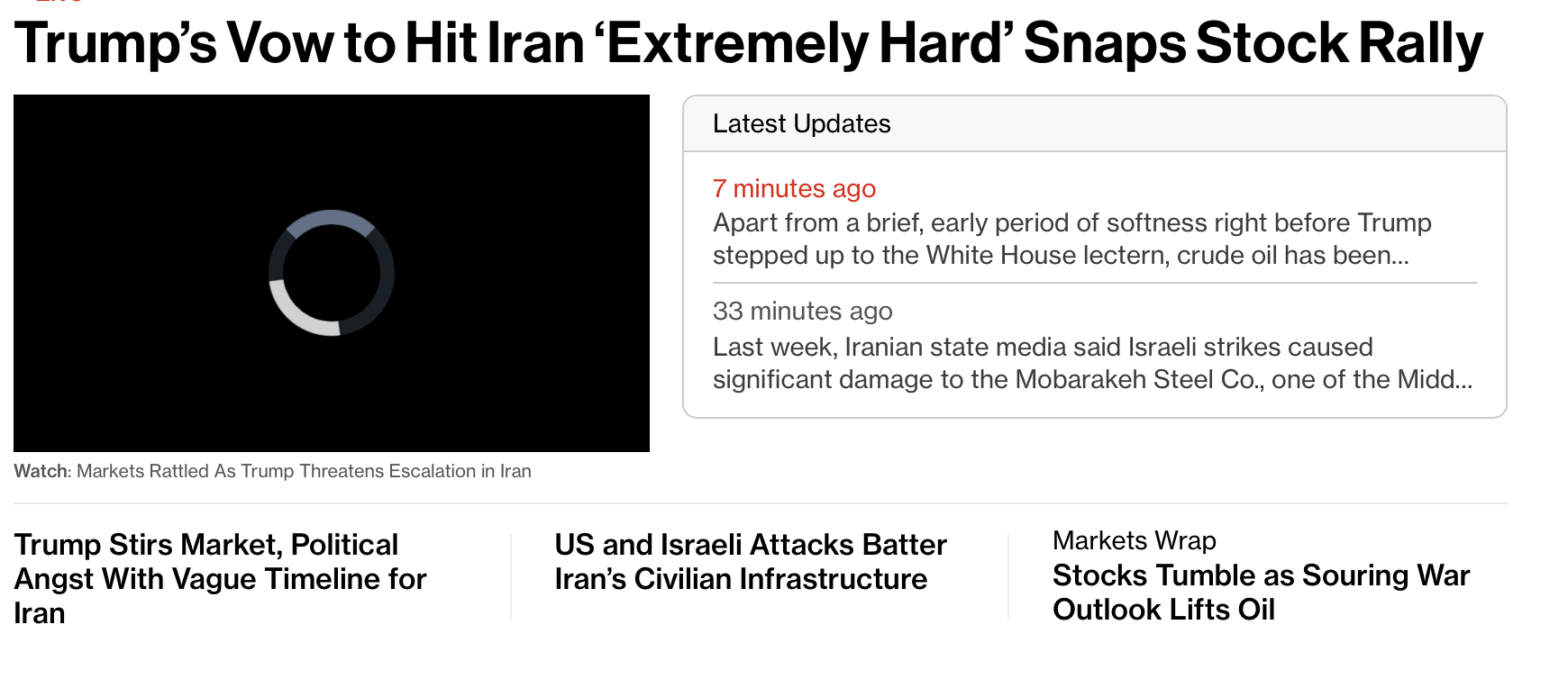
And the Bloomberg landing page as of 6:00 AM EDT:
Notice that Bloomberg registers that the war-makers attacks are hitting Iranian civilian targets, which aside from being war crimes, are an admission of sorts that the US and Israel are not having much luck with military assets.
The first items in its live feed update:
• After US President Trump last night pledged more aggressive attacks in coming weeks, Iran’s army chief ramped up threats, saying that “if the enemy attempts a ground operation, not a single person should survive,” as the US ordered thousands of troops to the region.
• Brent crude jumped to $108 per barrel, while European gas prices rose as much as 7%. Europe’s diesel futures benchmark hit the highest level since 2022.
• Iranian missile attacks at Tel Aviv and Jerusalem forced many inside bomb shelters, with Israel reporting five sets of launches between midnight and 10am local time on Thursday. Israel said it hit 400 targets in Iran in two days.
However, it appears that investors are still not fully facing the music. Even though the Financial Times today ran an the above-the-fold story, The global wave of energy rationing, it depicted emerging and export-led economies as more exposed, explicitly arguing that energy is more important to them per unit of GDP. James Currie, in The Crude Awakening, debunked that by arguing that not just petroleum-based energy but petroleum-based inputs were actually more essential in linchpin activities than in the 1970s, so naive invocation of energy’s contribution to GDP greatly understated the exposures and the impact. We featured a related factor today in Beyond Oil: The Macroeconomic Impact of Commodity Supply Disturbances, that economists and therefore also investors fixate on oil shocks and largely ignore the effect of related commodity shocks, which this case look set to create even more inflation in and of themselves than the energy shortages.
Next to hot takes that focus more on kinetic and geopolitical implications. First from Colonel Macgregor:
Some key points:
Macgregor gave new reasons to be skeptical about a ground operation. Even the US succeeds in any of the dimly viable paths, none of them will have a strategic impact. He is skeptical of air-dropped special forces,2 since they are enormously risky to begin with and depend on a bigger force to punch through and secure to what amounts to a beachhead. Macgregor also alluded to an issue others like Larry Wilkerson have mentioned, that death rates will be high due to the inability to properly treat seriously wounded service-members in the so-called critical “golden hour”.
Macgregor also described economic exposure in the US. He claimed that California’s oil is imported and mentioned that the US depends on 47 critical inputs that are petroleum-related. He also emphasized that this war was undoing the Green Revolution and mass hunger would result. He observed that if the war were to end soon, we might merely have a few months of harm but would claw back, but another month plus would result in years of severe damage.
Paul Krugman is very good when in the opposition. From Trump Doesn’t Even Have the Courage to Run Away:
It turns out that the speech was sort of an anticlimax, although not in a good way. Many people expected Trump to pull the mother of all TACOs, to declare victory and surrender. He did not do that. He declared victory, of course, but he did not actually announce an end to hostilities. On the contrary, he said we’re going to bomb Iran into the Stone Age. So add massive war crimes to your schedule.
There is clearly no strategy here. There’s no endgame. There’s nothing. It’s hard to tell, as always, whether Trump is delusional or just completely unable to admit something that he actually knows.
One of the moments that really struck me in the speech was him declaring that the whole world was extremely impressed by what happened…
What it’s seeing is that the world’s greatest military power took on a fourth-rate power. Again, as I said the other day, Iran’s military budget is a rounding error in our military budget. And we lost….
But Trump has to believe or has to claim that he believes that the whole world is extremely impressed. You might say, why do we care? Well, he cares, obviously. His whole thing is about dominance and believing that we’ve got the world awed by our strength.
I have to keep hammering on the point that the US despite its huge military spending is not the world’s greatest military power. Russia is. Not only are vast swathes of our spending wasteful to unproductive (we actually tout the terrible F-35!) but our military is optimize for short wars against insurgents. And even then, the Houthis bested us. Can we please drop the bogus chest-beating about our Wizard of Oz military show?
And from Larry Johnson in Donald Trump’s Addled Speech on Iran:
Wow! That was awful. Was Trump sedated? His monotone, delusional delivery reminded me of the character Dustin Hoffman played in Rainman. Trump plowed no new territory. Instead, he provided a Reader’s Digest summary of his recent Truth Social posts… i.e., Iran is defeated, the Iranian Navy and Air Force are destroyed, victory is ours, but we’re going to bomb the hell out of them over the next three weeks….
During the next three weeks, Iran will continue to degrade and demolish the US bases and equipment that is in Saudi Arabia, Kuwait, Bahrain and the United Arab Emirates. As long as Qatar does not allow combat aircraft to take off from Al Udeid, Iran will ignore it….
Trump did not back down from his previous threat to attack Iran’s power grid. If he does that, along with Israel, Iran will turn off the lights in Israel, Saudi Arabia, the UAE, Bahrain and Kuwait. Iran’s ability to do this is a direct consequence of the depletion of the US air defense systems — i.e., the Patriot missile batteries and the THAAD. Iran also will retain its choke hold on the Strait of Hormuz — even if the US decides to put troops on Kharg Island or some other piece of Iranian territory.
Contrast Trump’s bluster with a Janta Ka update, Iran displays missile power as Trump addresses nation; Fox News taken aback:
Another kinetic war update from NO1:
• Iran struck digital infrastructure before its own deadline — Iranian missiles hit Batelco HQ in Hamala, Bahrain (country’s largest telecom, hosting Amazon Web Services infrastructure) — before the April 6 IRGC deadline for 18 US companies expired. Also struck: Kuwait Airport fuel tanks, US Fifth Fleet HQ in Bahrain, and a ballistic missile impacted east of Terminal 2 at Dubai International Airport with UAE censorship imposed. Batelco confirmed.
• Axis of Resistance operating as single military body — For the first time, Yemen announced a missile attack on Israel in explicit coordination with Iran AND Hezbollah simultaneously. Iran launched its “largest continuous attack in 3 weeks” on April 1: 312 simultaneous rocket alerts covering 5.6M+ Israelis, cluster-warhead ballistic missiles impacting Tel Aviv and Bnei Brak. Axis coordination
• 470,000 containers and 20,000 seafarers trapped inside Persian Gulf — 65 vessels of the top 5 container lines stranded. Jebel Ali port approaching idle (normally 15M containers/year). 3,000 ships at anchor, fresh food exhausted 2 weeks ago, water rationed. 22 commercial vessels struck since Feb 28. Insurance premiums up 1,000% — actuarial sorting now prices crude oil through and everything else out.
Israel is also landing punches. From the Guardian in Israel hits Iran with waves of attacks and says it killed top Hezbollah commander:
Israel unleashed two waves of attacks on Tehran and said it had killed a senior Hezbollah commander on Wednesday with little sign of the war easing up despite Donald Trump repeating a claim that Iran’s leadership was seeking a ceasefire.
And as for Trump’s heretofore market-cheering negotiations patter (we argued above that his speech considerable blunted his ability to keep up that charade), Iran’s Foreign Minister Abbas Araghchi spoke to Aljazeera before the Trump speech.
Araghchi demonstrates amazing patience in having to say a zillion different ways that there are no negotiations underway and no present plans to have any. Iran won’t consider them until officials have given authorization and defined their scope and objectives. He also says the Strait of Hormuz is not international waters but is internal to Iran and Oman. It is “closed” only to those at war with Iran. Others are not transiting due to insurance costs.
Forgive us for failing to discuss Pezeshkian’s letter to Americans (you can read it here) because it will not have an impact on the direction of travel.
University of Chicago professor and escalation expert Richard Pape appeared on Breaking Points as Trump was starting his speech:
Pape made a number of important observations. Iran is a new global power and will not give up the influence it has obtained over its control of the Strait of Hormuz even if there was a government change. There are three groups among the Gulf States: Iraq which is joining Iran, Oman and Qatar, who want to stay out of the fray, and the Saudis, UAE, Bahrain and other Gulf states. Iran wants to end current governments in UAE and Saudi, and Pape contends Iran let a drop of their oil out. Pape also stressed the need to watch force deployments, that any de-escalatory talk was empty in the absence of actual withdrawals. He also pointed out that the US was driving allies away, such as with Turkiye via talk of arming the Kurds. And finally, he stressed that things are not remotely going back to normal economically even if the war were to end now.
We are also a bit late to another important talk, here between Larry Wilkerson and Nima:
Late in this conversation, Wilkerson says Israel would need to fire at least 50 nukes to make a strategic difference. That could lead to retaliation by more than one country. Wilkerson had heard that Russia was sending S-500s “in quantity” with operators. Their radars have a 600 mile range which would “put everything at risk,” making it very hard to deploy F-35s, B-2s and B-52s safely.
______
1 The latest on that point that I could find in the draft legislation in Iran on the management of the Strait of Hormuz, per World Cargo News: “The proposal also envisages cooperation with Oman on managing traffic through the strait, although the toll regime itself would be led by Tehran.”
2 If IRGC claims are correct, Iran has seriously dented the US ability to move forces in by water. From Economic Times on March 28:
Iran’s Islamic Revolution Guards Corps (IRGC) has claimed the targeting of six tactical vessels operated by the US military in the Persian Gulf waters. The IRGC claimed that a large number of American forces had been killed in the process…
The statement claimed that six US landing craft utility (LCU) were struck in the operation, which was carried out using home-grown ballistic missiles, such as Qadr 380 cruise missiles.
“Given field reports, three of the combat vessels sank after the (retaliatory) strikes, whilst the rest are aflame,” the IRGC said.
IRGC further claimed that it has successfully destroyed a number of refuelling vehicles and the logistical support fleet belonging to the “terrorist” US military at the Al-Kharj base. It said that Kamikaze drones were employed to launch operations against the gathering centres of the US drone unit personnel on the coasts and one of the hotels in Dubai.
