


Missile defense has long been presented as a technological solution to one of the oldest problems in war: vulnerability to attack. From early Cold War concepts to modern multilayered systems, the promise of intercepting incoming missiles to achieve a degree of strategic invincibility has been consistent. But that promise was always fraught with contradictions. Although missile defense is probabilistic in nature, failure is not an option in the context of the threats it seeks to address, especially nuclear.
In a conventional war, partial success may be sufficient. Not so in nuclear war. Even if a single warhead penetrates a defense system, it is not the slightest failure. That’s a devastating result. In such situations, even very high interception rates cannot fulfill the fundamental protection promise. A defense that cannot guarantee interception cannot guarantee survival. This is the first failure in missile defense logic. Critics such as Theodore Postol have long argued that missile defense tests systematically underestimate the difficulty of real-world interception, especially in situations involving decoys and hostile countermeasures. These criticisms highlight the persistent gap between controlled demonstrations and operational reality.
.
The dynamics of recent conflicts in the Middle East reinforce this point. Even advanced, multi-layered air and missile defense systems could be subject to leaks in the face of sustained combined threats such as ballistic missiles, cruise missiles, and unmanned aerial vehicles. Although the defense system had some capacity, it was not impervious. These operated under constraints. This meant a limited inventory of interceptor weapons and the operational realities of tracking and targeting multiple simultaneous threats that posed different interception problems. As the number of defensive missiles decreased, the number of offensive missiles attacking targets increased. Sophisticated defenses in depth against Iranian missile attacks have failed to protect many high-value targets.
The reality of this partial vulnerability reveals a deeper problem of economic size. The cost of missile defense does not increase linearly with the threat. They grow with uncertainty, coverage requirements, and adversary adaptation. Multiple interceptors may be required for each incoming missile. Each new threat vector requires new sensors, new integrations, and new response layers. Global coverage requires extensive radar networks, space-based detection systems, and continuous preparedness. Integrating these systems adds further complexity, increasing both cost and vulnerability to failure. In such a system, like President Trump’s Golden Dome, $1 trillion in spending is not an outlier but a plausible outcome of its internal logic.
Sky High funding requirements
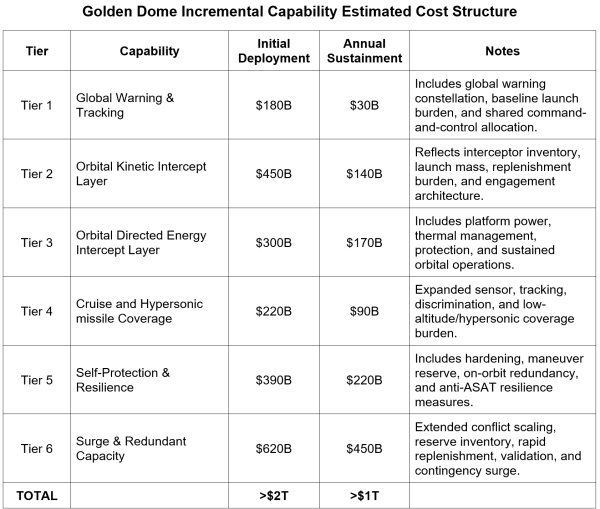
Assessing whether a missile defense system has economic limits requires evaluating the price of a fully realized architecture that incorporates all the capabilities needed for a comprehensive and survivable defense, rather than the price of a piece of the system. These requirements, when structured in sequence, form a ladder of capabilities into which a credible claim of missile invincibility must ultimately be built. The table below provides a rough estimate of the initial and maintenance costs for a conceptual Golden Dome missile defense system.
Functional layers are not an alternative design choice. Each is a requirement imposed by the restrictions of the previous layer. A system that can intercept ballistic missiles but cannot deal with cruise or hypersonic threats is incomplete. A system that cannot withstand hostile attacks will not function. A system that cannot sustain operation in saturation cannot claim protection. Architecture is scaled by necessity, not ambition. Adding up the enormous costs of these capabilities, the resulting economic burden exceeds the entire current U.S. defense budget.
The cost dynamics described here are not driven solely by a definitive short-term nuclear attack scenario, but by sustained non-nuclear missile defense operations. A comprehensive defense architecture is not only designed to thwart a nuclear attack, but must also function against conventional missile attacks that may precede or replace it. In these situations, the system is not tested once, but continuously. Interceptors will be deployed on a large scale. The sensor is degraded or there is a conflict. And assets in orbit are continually exposed to wear and tear. Replacement cycles must occur at a sustained tempo, with launch capabilities moving from planned deployment to rapid regeneration. Redundancies latent during peacetime must be fully activated and maintained. The system is therefore no longer an electrostatic shield, but an industrial process operating continuously under hostile pressure. It is under these conditions of repeated engagement, consumption, and resupply that the full economic burden of a comprehensive missile defense architecture becomes apparent.
It is important to distinguish between initial costs and operating costs. The feasibility of a system is determined not only by its implementation but also by its maintenance. Under conservative assumptions, the cumulative cost of building and maintaining such a system would exceed existing large-scale defense programs and reach the trillion-dollar range. This is the result of a never-ending quest for complete protection. The closer a system gets to that elusive goal, the more its requirements and costs grow. The evolution of missile defense is thus moving toward an insurmountable affordability boundary. Technical limitations can be deferred to future innovations, but economic limitations become immovable obstacles.
Even with extraordinary levels of spending and deployment, a comprehensive orbital missile defense architecture would not be able to provide reliable protection against unacceptable levels of destruction from nuclear attack. The strategic question is not whether a system can intercept many incoming weapons, but whether it can intercept all important weapons. Nuclear deterrence has always been based on the premise that a small fraction of retaliatory force is sufficient to cause catastrophic damage. That premise remains in place. The enemy does not need to defeat the entire system. All that is needed is to ensure that enough warheads penetrate to destroy a small number of major population centers and critical infrastructure nodes. Under conditions of saturation, deception, and system degradation, such intrusions cannot be reliably prevented.
mission cannot be tested
Missile defense puts engineering operations in a different position. Testing requires high assurance against adversarial conditions that cannot be fully reproduced. As a result, verification is necessarily partial. Controlled demonstrations replace end-to-end proofs, and key assumptions about scale, deception, and adaptation cannot be tampered with in advance. In this environment, the integrity of the design and test loops is strained as the system demands conclusions that the available evidence cannot conclusively support. The risk is not incompetence but overconfidence. This creates a logical gap. Confidence in missile defense must go beyond what can be empirically verified. This system operates in the realm of demonstrations instead of verifications, where assumptions fill gaps created by untestable conditions. In this gap, rationality begins to be abandoned. What started as risk management becomes something else. That’s a demand for guarantees in the system, which we can’t provide.
escape from rationality
This change can be called an escape from rationality. When faced with catastrophic risks, decision makers seek certainty rather than probabilistic mitigation. Advances in technology create a plausible narrative of eventual success. When the limitations of existing systems become apparent, the response is not to abandon the premise of protection, but to defer its realization to the next generation of technology. Confidence moves over time from current performance to future ability. This power relationship is reinforced by a convergence of perverse incentives. Contractors benefit from programs that expand rather than end. Political leaders benefit from a visible commitment to defense that is difficult to oppose. Adversaries will increase their offensive capabilities as their defenses improve, ensuring that the threat environment continues to evolve. Together these forces form a self-reinforcing loop. Evidence of limitations such as leakage, saturation, or uncertainty does not constrain the system. it supports it. In missile defense, failure is not a mistake. It’s generative.
This logic is similar to well-known engineering failure modes. As Bill Gates once criticized rival software development, the project risked becoming an attempt to build the world’s heaviest airplane. Each addition addressed a local problem, but the system as a whole moved further away from survivability. Missile defense risks following a similar trajectory. When faced with structural limitations, the response is to pile on more layers of sensors, interceptors, and integration, making systems more complex and expensive, but falling far short of delivering the promised certainty. The “Golden Dome” project will also follow this process. Expanded coverage, space-based assets, and integrated multi-tier architectures are expected to overcome current limitations. However, this system will face the same fundamental problems, including cost economics, adversary adaptation, and the inability to fully verify. Rather than solving problems, trust in the program carries over into the future.
The deeper irony is that the worse a missile’s defensive performance is under realistic conditions, the more compelling it is to scale it up. Since the assumption of protection cannot be waived, the evidence of restriction is reinterpreted as insufficient. The system is not malfunctioning. It’s not finished yet. Each shortfall justifies further investment, further development, and more complexity. The strategic implications are significant. While resources flow to systems that promise tangible protection, investments in resilience, dispersion, and recovery receive less attention. Adversaries take advantage of cost asymmetries to expand their offensive capabilities more cheaply than defensive systems can accommodate. The result is not stability, but an evolving competition in which the attacker maintains a permanent advantage.
conclusion
Promises for missile defense face an unavoidable reality. The protective effect it is designed to achieve cannot be guaranteed or tested under the conditions that determine its success. But it persists, sustained by perverse incentives, perceived necessity, and the human need for certainty in the face of catastrophic risk. A system that cannot be tested, cannot accept its own limitations, cannot abandon its assumptions, provides a different kind of protection, not against incoming missiles but against evidence to the contrary. It is this escape from rationality that makes the Golden Dome project invincible, even in the face of permanent limits that it cannot overcome.
