


This Iran war update will be skeletal due again to Links and competing obligations. The final version should be done by 8:00 AM EDT so please refresh your page then.
Despite the Trump Big Lie of being engaged in negotiations with Iran, Israel and the US are escalating against Iran. Keep in mind that these attacks again show the utter untrustrworthiness of the belligerents. After the first attack near the Iran nuclear site at Beshear, Trump said he told Israel not to do it again. The US could easily cut off satellite and other ISR data to Israel to enforce compliance. We are now up to not one but two more Israel attacks near Iran nuclear sites.
💢 BREAKING: Coordinated strikes have hit all three of Iran’s largest steel plants simultaneously – Mobarakeh, Esfahan, and Khuzestan – the backbone of the country’s non-oil economy.
Together they produce roughly 70% of Iran’s steel output. Iron and steel is Iran’s… https://t.co/DwA8et5VjG
— Drop Site (@DropSiteNews) March 27, 2026
☢️🇮🇷❗️Atomic Energy Organization: Based on the conducted investigations; the attack on the Khondab Heavy Water Complex did not result in any human casualties, and given the safety measures previously taken, there is no risk of contamination to the local population.
_______…
— dana (@dana916) March 27, 2026
As with the Iran retaliation after the strike on its North Pars gas field, which included the Qatar Ras Laffan LNG facility, pretty much talking out all of the Gulf-sourced LNG for years, Iran is striking back ferociously for the attack on critical productive capacity:
Tehran has announced that it will attack and completely destroy production sites of the Israeli arms industry (including steelworks) this very evening and/or during the night (TurkishTV). This is intended to unequivocally destroy the entire Zionist weapons and ammunition… https://t.co/IR1kPZTNkE
— Ignis Rex (@Ignis_Rex) March 28, 2026
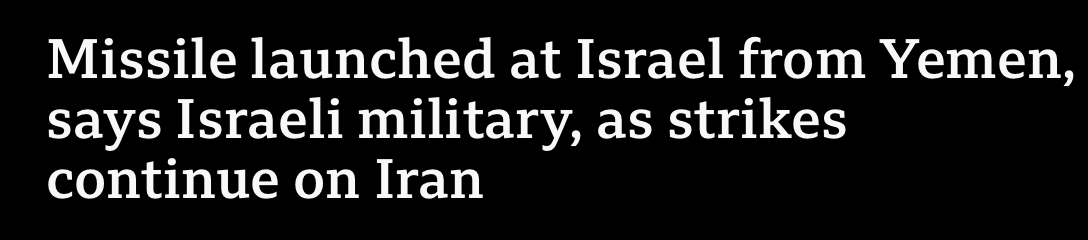
The BBC live blog headline show Yemen has quickly gone to work:
More detail from Aljazeera:
And providing more evidence of the escalation dynamics taking hold in a worrisome way, in a new talk with Daniel Davis, Alastair Crooke makes some key new points.
One is that Iranians culturally are sensitive to the need for a counterparty to save face. But they are so enraged by the murder of 175 girls and their teachers at the Minab school and the ongoing assassinations, most of al of the Supreme Leader, Ali Khamenei, that they are outraged and no way, no how will make anything easy for the US. Second is if the US attacks Kharg Island, it won’t give them control of Iranian oil. They can cut transmission from the shore. Third is that many Shia clerics have declared fatwas calling for support of Iran.
See for instance:
Sistani fatwa declares supporting Iran a ‘collective duty’
——
On Sunday, 8 March, Iraq’s top Shia cleric, Ali al-Sistani, issued a fatwa (religious ruling) declaring that supporting and showing solidarity with Iran is a “collective duty”, amid the escalating US–Israeli war on… pic.twitter.com/gbT3iBTU40
— The Cradle (@TheCradleMedia) March 10, 2026
Reader Ann provides some links showing that the Gulf States, which could press the US to moderate, are instead all-in with the fantasy that they can vanquish Iran. See:
Saudi Arabia urging US to ramp up Iran attacks, intelligence source confirms Guardian. Subhead: Crown Prince Mohammed bin Salman is said to view US-Israeli war as ‘historic opportunity’ to remake Middle East
Gulf States increasing support of US escalation, yet Iran hitting airports, refinery ports; note at end locals want war over:
Alon Mizrahi has an important new talk. I find him to be a low-bitrate transmitter, but he also provides a transcript. He has a very important discussion at the opening, where he discusses the temperament, faith, quiet dignity (even in the face of incredible abuse) and tenacity of Muslims. Because he encountered it as an IDF soldier, he initially found it to be incomprehensible but now understands how it is not just an impressive sign of character, but a source of great power.
Day 28: The War Must Go On by Alon Mizrahi
Things are heating up, not cooling down
Read on Substack
His discussion of the Gulf states comes towards the end:
…the Houthis…. only today announced that they will join the war. They are probably because also today we’ve seen news of Iran targeting some potential landing ships that the US was intending to invade some parts of Iran with in Saudi Arabia….this was my forecast from a couple of weeks ago, that the next set stage of escalation is going to be against Gulf monarchies and not Israel…
Netanyahu is the last prime minister of Israel. There’s going to be no one else..He prefers actual apocalypse…
And the U.S. at this moment, in this moment in history, the U.S. doesn’t want to stop this war….And if it doesn’t secure something that looks like victory, they feel like they will be humiliated. They can’t stop this war.
They have to have some kind of a feeling, something that they can market as victory. And Iran is not going to give them anything like this. Ever. They don’t have the resources. They don’t have the power. They don’t have the manpower. They don’t have the will, the focus, the energy. the heritage, the depth to really challenge Iran…
Iran is not waging a defensive war anymore. But again, this is hard for us to see, and I’m going to repeat this many times until we get this. It is hard for us to see for all our racist stereotypes. Iran is now actively working to reshape West Asia and recreate itin its image, in the image of freedom and independence and decolonization. And what this means is Iran has a plan in place to get rid, listen to what I’m telling you, to get rid of the House of Saud. to get rid of the Gulf monarchies of the UAE and Bahrain and Kuwait.
And Iran’s plan, they will exist not much longer. Iran is not going to stop the war. When these countries, these regimes, which are owned and run and controlled by the US, by Iran’s enemies Iran is not going to be patient and allow them to exist anymore…ordan will also not be allowed to continue existing. This is it. The age of treachery is ending.
…what happened today was critical because Iran attacked boats that were docked in Saudi Arabia and airplanes that were parked in Saudi Arabia…and the US and Israel are on the retreat, this is going to work on the psychology of people in this region, like a lightning strike. This is going to be electrifying….And I expect this war to escalate a lot and not end in any agreement soon
If Israel which has been a militarized/terroristic society since its birth, has finally bitten off more than it can chew, that goes double for the US armed services. Stanislav Krapivnik, either in the talk on The Dura embedded further below, or with Glenn Diesen, discusses how most of the US armed forces are not combat ready, as in are obviously too fat and out of shape. This History Legends gives a long-form discussion of a point we had raised earlier, how US ground forces could be readily hunted down by Iranian drones:
Hindustan Times reports that Iran hit Prince Sultan airbase, targeting US refueling tankers, wounding 12 soldiers:
And on the not-much discussed Lebanon front, where things are not going at all well for Israel. Hindustan Times describes how Hezbollah is engaging in a Merkava massacre:
:
And from the Mizrahi presentation above:
So two weeks into the war with Hezbollah, the Israeli chief of staff is already talking about potential collapse. This is something we should make a note of. Because when Eyal Zamir, that’s his name, when he talks about the IDF potentially collapsing, it is because of Hezbollah. It’s because…of the war that is waiting for the IDF in southern Lebanon. It’s not because of Iran. It’s not because of the West Bank or Gaza. The kind of manpower they need to go into Lebanon and the potential of damage that Radoan forces and other Hezbollah forces can inflict on the IDF, on IDF forces, is immense, immense, immense.
Already they have casualties now every day, and this has only begun. When they amass forces on the northern border, and try to ready them to go into Lebanon, to start this invasion, they are going to be exposed to drones, motors, missiles, stinger missiles, anti-tank missiles, any kind of… of catastrophe, basically, that foot soldiers can encounter foot soldiers and tanks and armored vehicles can encounter in modern warfare. Israel is looking at potentially an actual bloodbath. in Lebanon with an organization it told its people and the world was finished after the Pager attack and after Nasrallah was murdered, assassinated.
So when the IDF chief of staff is warning the Israeli government that the IDF may collapse and you have to understand It’s almost mathematical. There’s a certain percent of any fighting force that if you eliminate, the structure collapses. Now, Israel doesn’t have a professional military. Its fighters are amateurs, basically.
Some of the more elite units have better training, but most of the fighters are just amateurs. People who, civilians, who go once a year into reserve service, they do some basic, basic training. They are not in great physical shape, and they are not soldiers. They are civilians who wear uniform and go into battle. And Israeli…
The normal, most IDF soldiers are between 18 and 19 and 20 years of age. So a little more than children. So you have an army of little more than children and the big chunk, the largest part of the IDF is those civilians. were uniform and go into battle in Lebanon, into Gaza, into the West Bank, wherever they are sent. And in this war, they are fighting an enemy that can and is bombing their homes. They are in Lebanon or on the Lebanese border, but their family in Haifa or in Tel Aviv or in Hadera or wherever, it’s not safe because Iran is firing missiles and Hezbollah is also firing missiles and rockets.
And after two and a half years, they lost France. Maybe they witnessed some terrible incidents themselves. And if they saved in Gaza, they definitely did. So many of them are hardly fit mentally, physically, psychologically. This is too much of a strain. This is too much…..
They [Hezbollah] know how you drive your tanks. They know where you stop. They know every drill and every routine that the IDF has. Hezbollah knows. They know. They watch. They listen. They see. And they have so much firepower and precise weapons and drones that this is going to be crazy.
In a country like Israel, in 2026, they don’t need to suffer 100,000 casualties for the society and the military to break. They need a tenth of this. And it is totally my expectation that if they pursue this, and I think that they will, and I’m going to talk about why in a second, why no one is backing out of this war.
In two or three months, they may actually be in a state of collapse.
Two or three months mean thousands of casualties, thousands. It’s going to mean every unit, every company, every battalion is going to lose some people. It could be one or two or five or 10 or 20 or 50. And this is why the Israeli chief of staff is talking about the idea of potentially risking or facing collapse.
And then on Iran’s impact:
They are breaking the wheel of the Israelis because Israelis basically operate on a COVID level. Children don’t go to school. almost anywhere in Israel for four weeks. It means many parents can go to work and can’t work normally. It’s very hard to work when you have to go somewhere safe every hour, when you don’t sleep at night, when it’s not safe to drive, when it’s not safe to be on a bus or on a train. This has become very stressful and difficult, and this is only the beginning of this. This is the soft beginning that Iran has prepared. This is not the peak. Far from it.
So Iran is breaking the wheel and breaking Israelis psychologically, and it is breaking Israel. It is breaking infrastructure. It is breaking streets and roads and homes and… factories, and so on. And Hezbollah is taking care of the IDF. And the result for Israel in two or three months, and this is the timeframe now.
On the economy front, this is a must-watch video. Stanislav Krapivnik provides a lot of granular detail, particularly on the impediments to rebuilding damaged energy facilities:
Iran is moving forward with its plans to charge tolls for transit through the Strait of Hormuz. Even though some officials mentioned this idea, legislation is now being drafted and is expected to be presented to parliament next week, per CNBC in Iran plans to charge ships for safe passage through Strait of Hormuz, report says
Reader Sibiriak helpfully cited an article in The Hill which quoted Secretary of State Rubio having a mini meltdown. Key bits:
Secretary of State Marco Rubio on Friday warned European allies that Iran could set up a “tolling system” in the Strait of Hormuz after the U.S.-Israeli conflict with Iran ends…
“I did describe to our allies, however, that immediately after this thing ends, and we’re done with our objectives, the immediate challenge we’re going to face is an Iran that may decide that they want to set up a tolling system in the Strait of Hormuz ,” he said. “Not only is this illegal, it’s unacceptable, it’s dangerous for the world. And it’s important that the world have a plan to confront it.”
Many in crude-short countries like Pakistan, Spain, and Thailand have taken cheer from their governments securing agreements that their carriers will have safe transit. But that won’t result in meaningful oil and supplies to them. There are still too many impediments, starting will ship owners and crew being unwilling to operate in a war zone, and insurers not being willing to extend coverage. At best, this means that ships stuck in the Gulf will be allowed to depart. That will provide only an itty bit of supplies relative to the ever-escalating shortfall.
Lloyd’s List confirms that just about no Western-insured ships have exited the Strait of Hormuz, and none have entered:
Marathi is just the 10th non-shadow fleet* tanker tracked to have made an outbound voyage through the Strait of Hormuz since March 8, illustrating how transits have plummeted amid Iran’s attacks on shipping.
The only energy flows relatively unimpacted by the war are Iran’s own exports, with shadow fleet oil and gas carriers dominating transits through the strait.
Kevin Walmsley is way out over his skis again in claiming that Chinese insurers could step into the breech. That is many many years away from happening if ever.
Keep in mind that insurance merely is the right to go to court to get your claim paid. Insurers are in the business of denying or at best underpaying claims.
Yes, Chinese insurers do extend cover to Chinese ships….which already operate in a Chinese legal system, where companies understand norms for contracts, their rights in courts if things get ugly, and presumably already have competent counsel.
Do you think non-Chinese will have much faith in claims payment or fair treatment of foreigners in Chinese courts? Pretty much no no-Chinese vessel owner will go there until there is plenty of court precedent.
An analogy: before the 2013 Cyprus banking crash (which we only stoopidly and years later realized was an early move in the Western escalation against Russia) inbound investment into Russia was virtually all via Cyprus with the contracts under English law and adjudicated in what were effectively English law courts in Cyprus. No US multinational woulld trust Russian law and Russian courts.
On top of that, if you have to fight, you will be severely disadvantaged in getting decent counsel (unless you already do business in China at a firm with a good litigation team) by virtue of being a one-off client.
And stories like this are misleading once you get past the headline: Iran war restores King Dollar’s crown, for now Asia Times.
If you read the opener, you would think Thailand was about to go tits up:
News of currency troubles in Thailand has a way of raising blood pressure amongst even the most battle-tested Asian investors.
The baht’s dubious honor of being Asia’s worst-performing currency amid surging oil prices is making headlines and triggering more than a little PDST. It was Bangkok’s devaluation in July 1997 that set in motion the Asian financial crisis. The baht’s 6% drop in March has investors scrambling to connect the dots to where things are heading.
The threats, of course, come from abroad. As the US-Israeli war in Iran drags on, surging oil is becoming more of a feature than a bug. In Thailand’s case, a heavy dependence on imported crude has traders betting on the implications of additional commodity swings and capital outflows.
Yet exacerbating that is the surging US dollar, which once again threatens to suffocate Asian currencies. This double whammy of risk has governments across the region scrambling to sandbag financial systems as best they can. Back in 1997, the rallying dollar also played an outsized role in the crisis.
Does this five year chart of baht to USD look like the baht is in crisis? Higher levels on this chart = stronger baht.
The baht has been overvalued to the degree that it has hurt tourism and foreign buys of real estate. Even YouTube videos on “life in Thailand” for the last year plus have been complaining about it. My contacts say the central bank rejected many calls from the business community the lower the baht (if you look at its daily movements, it is clearly managed) because prestige (I am not making that up).
Now could the baht go into crisis? Absolutely. Thailand has a very high level of private debt for a late-stage developing economy. So does pretty much all of Southeast Asia but Thailand is a tad worse. But the recent fall from an elevated level to ]] well within recent norms does not prove a crisis is imminent. The 1997 crisis included food riots. We may get there but so far, the stress in most other Asian countries is more acute:
Starting at 2:10, a commentator echoes a point we made earlier: so for, the Iranian transit scheme is just an exit scheme. Save perhaps Iranian tankers, no new vessels have entered the Gulf.
Must stop now! See you tomorrow!
