


[This Iran war post launched before complete because yet more real-world tasks. Please return at 8:00 AM EDT for the final version]
Trump’s well-established habit of deferring decisions and trying to whipsaw counterparties by radical shifts in position risks not just blowing up his Presidency but what remains of US dominance and the over-optimized, fragile global economy. And he’s surrounded himself with bootlickers who reinforce his fantasy that his serial failures are successes.1 One of the reasons for his insistence that the US is winning in the Iran war and Iran must capitulate is that his information diet about the conflict consists heavily of a daily two-minute video showing the US blowing things up.2 He refuses to read, so even short memos from the intelligence community are ignored.
So how long can Trump stay in his denial bubble, even as relentless timetables are working against him? Iran has successfully trapped the US in not even a long war. The military capabilities of the US and Israel are already fraying, with the situation set to become critical in a month at the outside. That is also the timeframe for real economy damage on multiple fronts to become undeniable. So what happens when they reach a crisis level? Or will Mr. Market awaken from his relative stupor to force some sort of state change on the belligerents’ side?
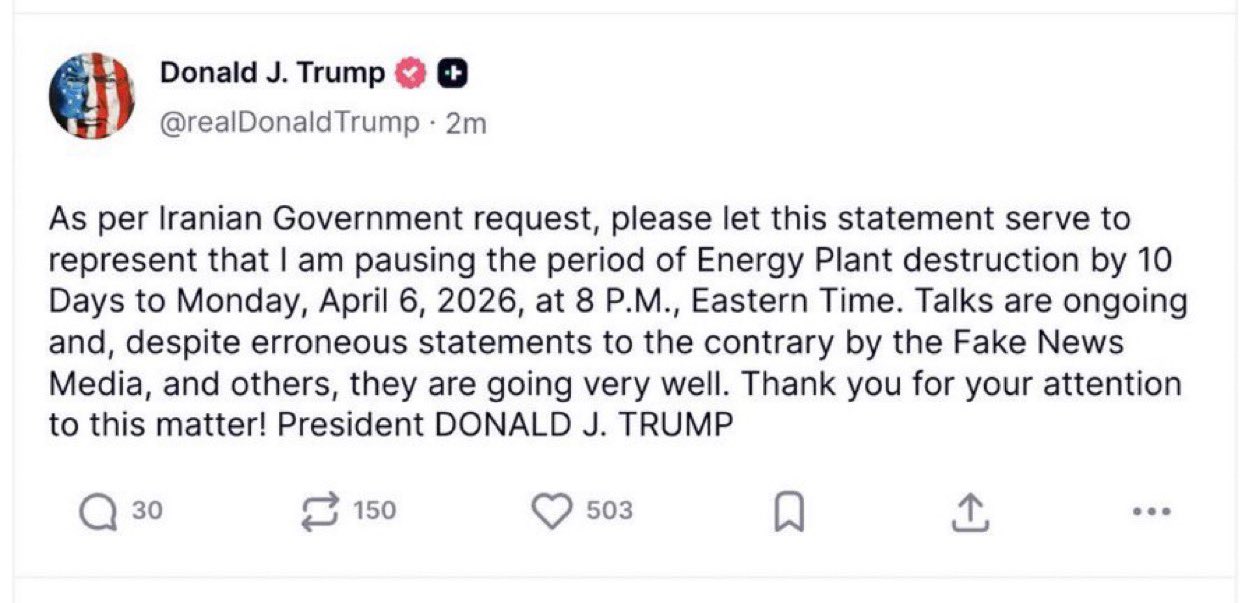
To Trump’s latest channeling of Nero:
The Guardian added:
Later Trump told Fox News: “I gave them a 10-day period, they asked for seven.”
He also continued to declare victory in the war, adding: “In a certain sense, we have already won.”…
Trump’s new threat was among a series of statements made by the US president in Washington and on social media on Thursday in which he again criticised Nato allies, described Iran as producing “great negotiators” but “lousy fighters”, and repeated his claim that the war he launched last month had already been won.
“They now have the chance, that is, to permanently abandon their nuclear ambitions and to join a new path forward,” Trump said during a cabinet meeting at the White House. “We’ll see if they want to do it. If they don’t, we’re their worst nightmare.”
We’ll turn later in the post to the latest speculation on what the US might do if it actually Does Something before April 6. A new article by Ken Klippenstein contends that the idea of a ground assault or raid is fakery, that some of the forces supposedly in or en route to the Middle East have not budged. Larry Johnson disagrees with this reading.
In the meantime, Iran is letting a few more ship of different nations traverse the Strait….far too few to have any economic impact. As of now, this is yet another marker that Iran controls the Strait of Hormuz, but also points to how they might operate a much higher volume passage and toll system.
To the increasingly visible damage the US is suffering: many sites have described how Iran has done colossal damage to US bases across the region; Richard Medhurst gave a detailed early account. A new article by Simplicius gives an update, keying off an astonishing article, both in substance and framing from the New York Times,Iran’s Attacks Force U.S. Troops to Work Remotely
Yes, sports fans, US servicemembers being forced off bases is “working remotely”. By that standard, an amputation is a”body trim”. Simplicius piles on in NYT Admits Iran Rendered Virtually All US Gulf Bases Uninhabitable. Key points (emphasis his):
NY Times admits that Iran’s strikes have driven US forces from most of their bases in the Middle East:
Iran has bombed U.S. bases across the Middle East in retaliation for the U.S.-Israeli war, forcing many American troops to relocate to hotels and office spaces throughout the region, according to military personnel and American officials.
So now much of the land-based military is, in essence, fighting the war while working remotely, with the exception of fighter pilots and crews operating and maintaining warplanes and conducting strikes….
As we have seen, the USS Gerald R Ford has flunked out of the Middle East, US bases are in ruins or deserted, and US strategic air defense radar installations have gone up in smoke. As others have noted, no adversary in history can be said to have achieved such an effect against the US—except maybe the Japanese at Pearl Harbor.
And the damage is ongoing, as weapons stock depletion is getting close to critical levels.
The Payne Institute’s recent disclosure regarding the first 16 days of ‘Operation Epic Fury’ confirms that the conflict evolved into a terminal industrial trial that the Western coalition is fundamentally incapable of winning.
By expending over 11,200 advanced munitions at a… pic.twitter.com/b2IWHXmc6m
— Thomas Keith (@iwasnevrhere_) March 27, 2026
From the underlying article at the Royal United Services institute, Over 11,000 munitions in 16 Days of the Iran War: ‘Command of the Reload’ Governs Endurance:
While American and Israeli forces achieve some tactical success by striking thousands of targets, the wider coalition is also downing drones and intercepting missiles by expending multi-million-dollar missiles that cost a fraction of the price…
This asymmetry is rapidly depleting high-end stockpiles. As shown in Table 1, our Payne Institute proprietary ledger tool tracked Iran war munition expenditures, which shows coalition forces expending 11,294 munitions in the first 16 days of the conflict, at a cost of approximately $26 billion.
The article includes two essential tables that are too large to screenshot. The first is Munition Count for US, Israel, and Allies in the 2026 Iran War, which itemizes the weapons use. The second, and arguably more important, shows depletion rates. The key section of that tally:
From the commentary:
As Table 2 shows, over a dozen munition types have been expended by the coalition at a rate that appears to be unsustainable. Already, Rheinmetall CEO Armin Papperger noted on 19 March that global stockpiles are ‘empty or nearly empty’ and that if the war continues another month ‘we nearly have no missiles available’.
And the biggie, and again this is only the top section of the table due to its size:
The authors drily note:
As seen in Table 3, our analysis shows the magazine abyss for the coalition is coming soon.
What stands out most about Table 3 is that the US military is approximately a month, or less, away from running out of ATACMS/PrSM ground-attack missiles and THAAD interceptors. Israel is in an even more precarious spot, with its Arrow interceptor missiles likely to be completely expended by the end of March. While the war could proceed with other munitions, this implies accepting greater risk for aircraft and tolerating more missile and drone ‘leakers’ damaging forces and infrastructure. The precariousness of this ‘empty bins’ issue could possibly explain why President Trump is already suggesting the ‘winding down‘ of the Iran war; it could take years to replace what was expended in only 16 days.
While the defence industrial base is producing most of these munitions at present, they are incredibly complex and difficult to surge, meaning it will likely take at least 5 years to replenish the 500 plus Tomahawk missiles already fired in the war. Worse, sourcing critical defence minerals, rare earths, and materials to make the weapons and munitions is complicated by China. China controls most of the world’s gallium and germanium, and Beijing has imposed numerous mineral export controls since 2023, to prevent the US and its allies from acquiring these necessary inputs for the defence industrial base.
So the point is soon approaching where limited US and Israel effectiveness, save perhaps terrorism and nukes, will plunge dramatically.
From the start of this conflict, we have cited experts who have described the ever-intensifying real economy effects of the near-total halt of traffic through the Persian Gulf, not just energy supplies but urea for fertilizer, sulphur, helium, medications and plastic. The damage to Qatar’s Ras Laffan LNG facilities and other energy assets has made this bad situation only worse.
We had also warned that evidence that various essential inputs were under serious stress or even becoming critically low would become hard to deny starting at the of March, which is also the time when key inventories, such as LNG and oil shipments in transit, are depleted.
The Payne Institute’s recent disclosure regarding the first 16 days of ‘Operation Epic Fury’ confirms that the conflict evolved into a terminal industrial trial that the Western coalition is fundamentally incapable of winning.
By expending over 11,200 advanced munitions at a… pic.twitter.com/b2IWHXmc6m
— Thomas Keith (@iwasnevrhere_) March 27, 2026
And Israel’s supposedly superior military is also starting to crack. From Aljazeera’s live feed:
Israeli chief of staff warns military will ‘collapse in on itself’ due to soldier shortage
The chief of staff of the Israeli military has warned that it will “collapse in on itself” due to growing demand and a shortfall of manpower as it fights multiple fronts.
“I am raising 10 red flags before you,” Eyal Zamir told a security cabinet meeting on Wednesday, according to Israeli media reports. He said that it wouldn’t be long before the military was unable to perform routine missions.
He said the military needs a “conscription law, a reserve duty law, and a law to extend mandatory service”.
Friendly reminder, he worked as Secretary of Defense in the 1st Trump administration lol https://t.co/81hwhkWhil
— J. Strand (@DJ_Ajaxx) March 25, 2026
And most of the world is sleepwalking into a monster real economy crisis, which is sure to exact a huge toll on financial markets and national budgets. What sectors will get some support? Which ones will be gored?
Consider warnings that not only are shortages coming, but are imminent:
From the UK’s The Times yesterday:
The Telegraph’s Ambrose Evans-Pritchard (hat tip reader Ben Panga) describes the increasingly dire state of food supplies. From The longer Trump’s war drags on, the worse the coming global food crisis:
The war in the Gulf has hit the epicentre of global fertiliser production. It has shut off the supply of urea, ammonia and sulphur for 27 critical days in the agricultural calendar.
China, Russia and Turkey have now greatly compounded the shortage by imposing their own curbs on fertiliser exports in recent days. Close to 45pc of globally traded nitrogen is cut off, disrupted or at risk.
The crunch is happening just as the big farming belts of the northern hemisphere near the spring planting season and just as Australia approaches winter planting. It is the blackest of black swans.
Abdolreza Abbassian, the former head of commodities at the United Nations’ Food and Agriculture Organization, said the markets did not yet seem to grasp the full gravity of what was already in the pipeline.
“It will be bad enough even if the Strait of Hormuz is reopened tomorrow but if the war goes on for another month or more, it is going to be a really horrifying crisis unlike anything any of us have ever seen before,” he said.
A second crisis is building up in parallel. The two risk colliding in 2027. Atmospheric scientists expect an El Niño pattern in the South Pacific this year and next, leading to hotter weather, longer droughts and lower crop yields.
A team at Columbia University has warned the world could hit 1.7 degrees above pre-modern levels in 2027, a “regime shift” that smashes through the heat thresholds of wheat and corn, and increases the risk of multiple breadbasket failures. Could it go non-linear? We will find out.
Jean-Marie Paugam, from the World Trade Organization, said the fertiliser shock is a greater immediate threat than the oil and gas shock….
China is the world’s biggest producer of fertilisers by far, accounting for 15pc of global urea exports and 30pc of phosphate fertilisers. It tightened export curbs on most of its output last week, hitting the market at the worst possible moment.
Russia is the second largest. It followed suit this week, imposing a one-month ban (for now) on shipments of ammonium nitrate in order to meet “the needs of the domestic market during the spring field work period”.
Turkey has joined the stampede, even blocking the transport of urea.
We had warned early on about sulfuric acid as a key input where supply would come up short if the Iran war did not end pronto:
🌐⛽️ Sulfuric acid shortage from the Iran war is now hitting commodity production hard.
Sulfuric acid is vital for extracting metals from ore. The market was already tight—prices up 500% pre-conflict. The Middle East supplies 24% of global sulfur, and stockpiles last just weeks… pic.twitter.com/VPLysPhKmJ
— Vitamvivere (@Vitamvivere) March 25, 2026
If everything reopened tomorrow it would take 6 months for the energy supply chain to rebalance
This will be the shock of a generation and few are paying attention
— Don Johnson (@DonMiami3) March 26, 2026
Note that even this seemingly urgent language minimizes what is set to happen. Shortages and sudden price hikes across a vast swathe of key inputs does not translate into a 1970 stagflationary shock. It means widespread business failures. That means job losses, plus knock-on damage to their customers, which will trigger further cutbacks and closures. And when those ventures die, it’s not as if new companies will suddenly spring up when the epic struggle over control of the Strait of Hormuz ends.
Even if Trump’s media skills, honed with 14 years on reality TV, are keeping oil price below where they ought to be, given the reality of continued Iran choking of traffic of the Strait of Hormuz, with no relief in sight, and a long normalization period can’t be held in abeyance for much longer, and I doubt to the end of his new deadline of April 6.
The landing page at Bloomberg signals only rising investor unease:
While the anxiety signals are stronger at the Financial Times:
The pink paper gives pride of place to Iran’s traffic management in the Strait of Hormuz. The article has an overtly Iran hostile tone (erm, who started this war?) and much of it will be old news to readers who have been following war development closely. It does underscore early on that Iran plans to discriminate among carriers based on the posture towards Iran of the nations contracting for the cargoes:
Tehran’s foreign ministry this week said “non-hostile” vessels would be allowed to pass through “in co-ordination with the competent Iranian authorities” — but that US, Israeli or any other “participants in the aggression” would not.
Foreign minister Abbas Araghchi said Iran would impose a new order in the strait after the war, insisting that the country exercises sovereignty over it “even if some might like to view it as international waters”.
As we said, possession is 9/10th of the law. From later in the article:
Prior to the conflict about 135 ships passed through the waterway each day. But since the first US-Israeli strikes on Iran, traffic has dropped to a trickle. Between March 1 and 25, there were just 116 transits, down 97 per cent compared with the same period in February, according to S&P Global.
Ships that have made the passage have been largely linked to Chinese, Indian or Gulf state owners. Several were dark fleet vessels sanctioned by western powers for trading Iranian oil.
The failure to mention other nations that have secured passage is noteworthy:
BREAKING: Thai oil tanker transits Hormuz Strait after talks with Iran
🔴 LIVE updates: https://t.co/Gdioc4YUk8 pic.twitter.com/hyuLGLLzzd
— Al Jazeera Breaking News (@AJENews) March 25, 2026
BREAKING: Thai oil tanker transits Hormuz Strait after talks with Iran
🔴 LIVE updates: https://t.co/Gdioc4YUk8 pic.twitter.com/hyuLGLLzzd
— Al Jazeera Breaking News (@AJENews) March 25, 2026
JUST IN : Massive diplomatic victory for Spanish 🇪🇸 PM Pedro Sánchez
Iran 🇮🇷 embassy in Spain has said that they are receptive to any demands by Sánchez regarding Strait of Hormuz 🔥
This came after the embassy agreed that Spain stood for Iran and was committed to… pic.twitter.com/stcAy1swLf
— Times of Iran News (@Timesofiraan) March 26, 2026
Due again to being tardy, we will be brief about what Team Trump might be up to, if anything, regarding a ground operation in Iran. Ken Klippenstein says it is fake news:
Military sources tell me that for weeks, the Pentagon has exaggerated the readiness and potency of the Marines, setting in motion a media frenzy that is part stupidity, part disinformation to spook Tehran, and part manipulation to please Donald Trump.
“We got two Marine expeditionary units sailing to this island [Kharg],” Sen. Lindsey Graham told Fox News Sunday. “We did Iwo Jima. We can do this.”
Sounds scary, right? Here’s the reality.
On March 13, headlines blared that the “three-ship” USS Tripoli Amphibious Ready Group, carrying the 31st Marine Expeditionary Unit, was ordered from Japan to the Middle East. Over the next week, news outlets across the globe literally tracked the supposed 2,200 Marines making their way moving west through the Strait of Malacca into the Indian Ocean.
In actuality, one of the three ships, the USS San Diego, never left Japan and is still there. And the other two ships, carrying just 1,500 fighters, are sitting at Diego Garcia, roughly 4,260 kilometers from Iran’s coastline.
And that second Marine Expeditionary Unit? Contrary to some reporting that said that the USS Boxer Group left Hawaii on March 19, it departed San Diego. It will have to cover approximately 22,200 kilometers to reach the region and wouldn’t be able to arrive until mid-April at the earliest. Navy sources in San Diego say it is still unclear to the unit itself whether it is headed for the Gulf or just moving to the Pacific to cover the departing Tripoli group.
Not exactly imminent!
I e-mailed Larry Johnson, who had not yet seen the article. I expect him to say more along these lines either in a new post and/or on YouTube appearances. His reply:
Everything is in place with the exception of the 11th MEU. They arrive next week. But, you don’t deploy the Special Ops units just to have them sitting around. The Marines are irrelevant. It was the massive movement of Special OPs forces. That is confirmed.
Reader ThirtyOne found this tidbit arguing that a Chabahar landing seemed the most likely measure if an assault was on:
More kinetic updates IRGC’s Wave #83: Iran Deploys Full Arsenal of Drones, Missiles in Assault on US, Israel Strongholds Hindustan Times
Iran is target Lockheed Martin engineers in Israel. Recall that they by contract provide maintenance on their systems. Note the second part of this video is Trump blathering3:
Stopping here for today. See you tomorrow!
_____
1 To list only a few: Ukraine, where he had an opportunity to cut losses and make the conflict look like a Biden failure but is now being forced to by events and has cemented Russian distrust of the US. Tariffs, where Trump’s love of the exercise of power has alienated allies like India and quietly Southeast Asia, and still showed China to be the dominant economic pawer merely by wielding a rare-earths-denial threat. And that was just one of many leverage points China has to exploit. The EU, where at the Munich Security Conference in 2025, US officials dressed down European leaders with the only plausible reason for this conduct to be for them to bear more of the costs of their defense…when even what is nominally their own kit is dependent on critical US parts and we can’t ramp up production to a meaningful degree.
2
⚡️🇺🇸 NBC: U.S. President Donald Trump receives a daily video montage of the biggest US strikes on Iran, typically lasting about two minutes and described as “stuff blowing up.”
The highlight reel is part of his briefings, but allies have expressed concern that he may not be… pic.twitter.com/M6YuY49TUy
— War Monitor (@monitor11616) March 25, 2026
3 From the Centre for International Governance Innovation in 2025:
The key issue for the F-35s is that the US manufacturer, Lockheed Martin, controls aircraft software updates, restricting even trained military personnel from making most repairs, which means that the military often must ship the equipment back to the manufacturer or authorized repair depots. In 2023, the US Government Accountability Office (GAO) criticized the US military’s heavy reliance on contractors for F-35 repair and maintenance, which has resulted in lengthy and costly delays, with repair times averaging 141 days. The GAO concluded that US military repairers often lacked the training and hands-on experience to repair the aircraft. This is largely because the primary manufacturer, Lockheed Martin, along with other military contractors, provides inadequate training materials, limits the repairs that military technicians can undertake and restricts access to the aircraft technical data, which the contractors regard as unique and valuable proprietary data.
The case of the F-35s highlights that even the US military does not have the right to repair its equipment, as manufacturers set restrictive warranty provisions that limit repair by military personnel.
