


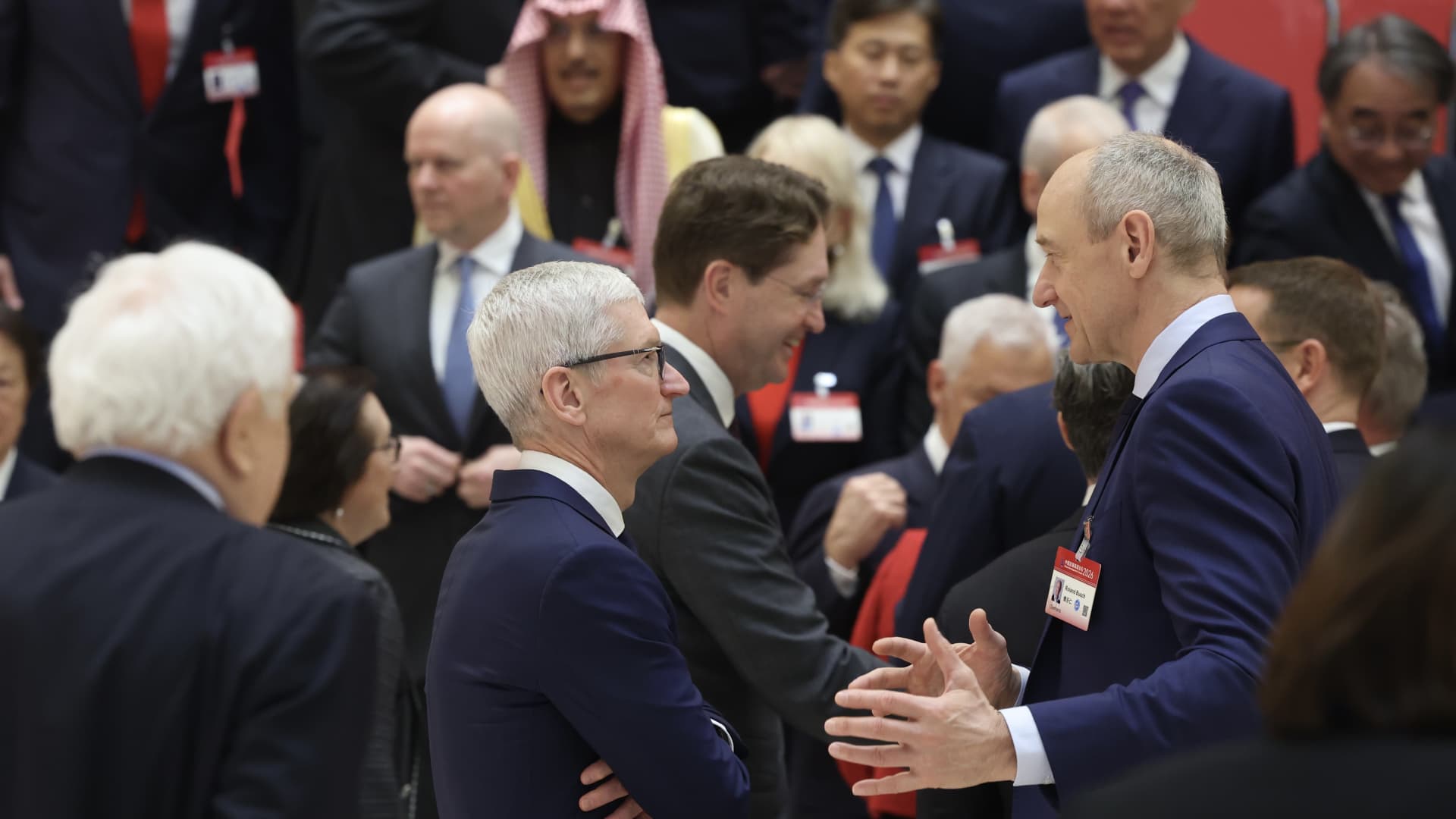
Apple CEO Tim Cook (left) stands with Siemens CEO Roland Busch before the opening ceremony of the China Development Forum 2026 held at the Diaoyutai State Guesthouse in Beijing, China on March 22, 2026.
China News Service | China News Service | Getty Images
BEIJING — More than 80 global executives from Apple to Eli Lilly traveled to Beijing this weekend to attend the country’s annual China Development Forum, as major companies navigate the U.S.-China tensions.
The executives’ comments reflect a renewed interest in winning over Chinese consumers after years of uncertainty due to the coronavirus pandemic, slowing growth and U.S. trade tensions.
Apple’s iPhone sales have just rebounded in China, and Apple CEO Tim Cook joined Chinese Premier Li Qiang on stage on Sunday to praise the country’s “extraordinary” pace of technological progress, including factory automation.
“We are proud to be part of that progress and are committed to working with our supplier partners to take it further.” He added that more than 90% of Apple’s production in China is powered by clean energy.
Apple still makes the majority of its iPhones in China, which accounted for nearly 18% of Apple’s sales in the December quarter. Thanks to the release of the iPhone 17, Apple smartphone sales rose 23% year over year in the first nine weeks of this year, countering a 4% decline in China’s overall smartphone market, according to Counterpoint Research.
On his way to Beijing, Cook also visited Chengdu, China, where Apple is under pressure to cut fees for its Chinese app store.
Attendees included more than 30 executives from U.S. companies including McDonald’s, Coach’s parent company Tapestry and Mastercard, as well as representatives from British, Korean and German companies, according to an official list of delegates obtained by CNBC.
Their visit to Beijing came after the United States and China agreed in October to a trade ceasefire that would reduce effective tariff rates to less than 50% for one year. It remains unclear whether the two countries will be able to extend the ceasefire and whether Beijing will agree to allow more important rare earths to leave the country.
US President Donald Trump was scheduled to visit Beijing later this month for trade talks, but the Iran war has postponed his plans for at least several weeks.
U.S. companies are moving forward with plans to invest in China, even as the White House seeks to encourage more Chinese spending to be brought home.
In March, pharmaceutical giant Eli Lilly announced plans to invest $3 billion in China over the next 10 years. The company reported that just under 3% of its revenue last year came from China.
CEO David A. Rix told CNBC’s Eunice Yun that he sees “huge” potential for the company’s GLP-1 obesity drug in China, given a better reimbursement system.
The Chinese government has gradually improved access for foreigners.
Eli Lilly’s weight loss drug Munjaro was added to China’s state-run health insurance reimbursement list this year.
Chinese Premier Li said on Sunday that the Chinese government would make it easier for foreign companies to access the country’s services sector. He added that China will also buy more healthcare products and digital technology products from abroad.
He also rejected the idea that state subsidies drove China’s technological development, but said China never pursued a trade surplus. Li pointed out that many products manufactured in China by foreign companies are exported to the domestic market, generating profits for investors.
China has reported that it will achieve a record trade surplus in 2025. This year, China launched its 15th Five-Year Development Plan, which focuses on increasing technology self-sufficiency and domestic demand. Consumption support measures focus on increasing trade-in subsidies and social welfare benefits.
However, the high-level China Development Forum did not reflect all opinions. Economist Stephen Roach, a senior fellow at Yale Law School, said he has been attending the event for 25 years but was not invited this year.
“My focus on consumer-driven rebalancing has always been presented as constructive criticism,” he told CNBC via email. “Ironically, it was ultimately incorporated into the 15th Five-Year Plan, although the policy was inadequate.”
Weekly analysis and insights from Asia’s largest economy delivered to your inbox
Subscribe now
But executives who are still invited have their business at risk. Volkswagen CEO Oliver Bloom has visited Beijing twice in just four weeks. He accompanied German Chancellor Friedrich Merz on a state visit in late February.
“Our long-standing partnership also provides an opportunity for the China Development Forum to clearly address challenges such as unstable supply chains, supply and demand imbalances, and high price pressures in the market,” Blume said in a statement distributed to the media.
“As China’s largest foreign investor, we rely on stable framework conditions,” he said. “We therefore welcome measures to sustainably improve domestic demand and fair competition, and to stabilize supply chains.”
“This is going to be a very important year,” Bloom told CNBC’s Eunice Yun on the sidelines of the forum on Sunday.
After three years of efforts to build local manufacturing and technology capabilities, Volkswagen will launch 20 new models in China this year. The company reported that passenger car sales in China fell by 8% last year.
Never miss the most trusted news moments in business news when you choose CNBC as your preferred source on Google.
Source link
