


In a move that’s flown a bit under the radar amid all the other madness in the war of aggression against Iran, Israel attacked the Iranian Navy fleet in the Caspian Sea last week claiming it struck dozens of targets, “including missile boats, a corvette, a shipyard used to build and repair vessels, and a command centre.”
Iran has already been striking Israel’s Haifa port, and the most recent hits there could be viewed as a response to the Caspian attack.
Israel attacked the port of Bandar Anzali, a key Caspian logistics hub between Russia and Iran.
The trans-Caspian link of the North-South route passes through the port: cargo from Russian ports travels to northern Iran, and then on to Persian Gulf ports and South Asian markets.…
— Victor vicktop55 commentary (@vick55top) March 19, 2026
But is a larger response coming? As we noted back in February, it was already looking likely that Russia and/or Iran were going to need to intervene more strongly to “restore order in the Caucasus.”
While the Israeli strikes in the Caspian do little to change the dynamics of the conflict, they do increase the odds of drawing other nations into the conflict. Perhaps that’s the point.
Is Israel using a base in Azerbaijan to attack Iran again?
In the last few hours, the Israeli Air Force released footage showing attacks on Iranian ships and an installation on the Caspian Sea.
This brings us right back to the strong suspicion that these flights are taking off… pic.twitter.com/RF1xX49XxJ
— Patricia Marins (@pati_marins64) March 19, 2026
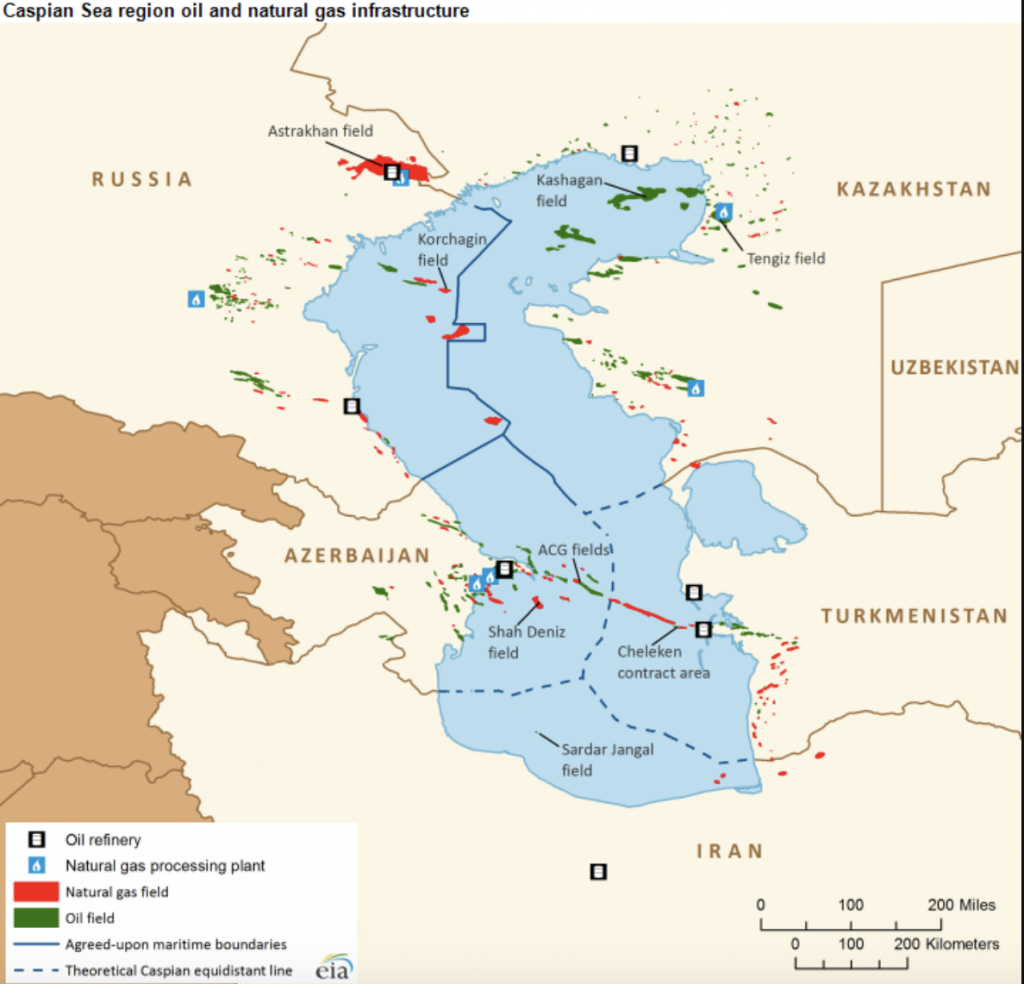
The Caspian, which was shaping up to be the energy and trade corridor that bypassed the sanctions and conflict zones, but the shared maritime space (the Caspian isn’t classified as a lake or sea) of Azerbaijan, Iran, Kazakhstan, Russia, and Turkmenistan is now a combat zone with risks for the natural gas fields of Kashagan in Kazakhstan and Shah Deniz in Azerbaijan.
Source: eia.gov
Baku, which had taken a belligerent tone at the beginning of the US-Israel attacks on Iran, has recently changed its tune.
De-escalation complete? Azerbaijan sends 30 tons of food products and medical supplies to Iran https://t.co/Byy9gDTdo6
— Hov Nazaretyan (@HovhanNaz) March 10, 2026
Azerbajan is showing an uncharacteristic humanitarian streak since its oil stopped shipping to Israel after the destruction of the port at Haifa and shut down of the Bazan refinery with heavy damage.
First it shipped its own aid to Iran, and now it transships Russian aid to… https://t.co/bIqsihMKtw
— Kathleen Tyson (@Kathleen_Tyson_) March 12, 2026
This humanitarian turn comes after Azerbaijan President Ilham Aliyev was fanning the flames of Azeri separatism in Iran, and Baku was making claims about Iranian sleeper cells in Azerbaijan plotting to blow up pipelines and “Jewish targets.” There was also the alleged Iranian drone attack on Azerbaijan, which Tehran denied.
What that suggests is that Azerbaijan—and potentially its top ally Türkiye with its designs for a buffer zone inside Iran—were told war would be fast, the government in Tehran would collapse and then they could move in and take a piece under the cover of preventing refugee flows and/or protecting ethnic Turks in Iran. When it became obvious that wasn’t going to happen and they risked becoming cannon fodder, they quickly backed off.
They might get dragged in regardless. Why?
1.The Baku-Tbilisi-Ceyhan (BTC) pipeline not only supplies nearly 30 percent of Israel’s oil, but it is increasingly critical for European markets due to the destruction in the Persian Gulf. Tehran said in the first week of the conflict that it would hit the “enemy’s oil supply lines,” but that has not included the BTC pipeline—yet. Iran can simply continue to target Haifa refineries if it wants to stop the oil from fueling Israel.
2. If Tehran wants to cause more pain for the global economy, Azerbaijan is a logical choice. It could shut down the last remaining air corridor through the region:
For those wondering why Iran might strike Azerbaijan, take a look at this image from 3 days ago showing how air traffic to Asia has been rerouted from Iranian to Azerbaijani airspace – a corridor only 170 miles (270 km) wide. Most Asia-bound aircraft no longer overfly Russia, and… https://t.co/xuq7zZaYTH pic.twitter.com/sqkTP6vAIs
— ChrisO_wiki (@ChrisO_wiki) March 5, 2026
The loss of Azeri gas would further decimate Europe as Azerbaijan provides roughly five percent of the EU’s total gas imports (eight percent of its pipeline imports).
And Baku is currently a major beneficiary of the war on Iran, as its oil and gas-dependent economy expects a windfall from higher prices.
3. Azerbaijan and Türkiye are the main beneficiaries of the Trump Route for International Peace and Prosperity (TRIPP), ostensibly an internationally-financed rail and energy infrastructure project cutting across 43 kilometers (27 miles) of southern Armenia that would connect Azerbaijan to its autonomous Nakhchivan exclave bordered by Armenia, Türkiye, and Iran. In reality the US weaseling its way into the project, which originally arose out of a 2020 Armenia-Azerbaijan peace brokered by Moscow and called for Russian involvement in such a corridor, has always been more about Iran encirclement and pushing CIA-backed Turkish influence across the Caucasus and into Central Asia. Iran has always been strongly opposed to what has come to be known as TRIPP, and could be an opportunity to put an end to it.
4. Türkiye President Recep Erdogan and Aliyev are weasels. As this Turkish author points out the obvious: Türkiye is—passively—on the side of the US and Israel. Despite all the rhetoric between Ankara and Tel Aviv and predictions that “Türkiye is next,” Ankara has continued to send oil and critical minerals to Israel and its bases are used to help protect the Zionists. From Omer Murat:
…it is possible that some facilities in Türkiye will become the target of Iran in the future. At this point, the most striking facility is the Kürecik Radar Base in Malatya.
The AN/TPY-2 radar system stationed here is an important part of NATO’s ballistic missile defense network. The system can detect missiles launched from Iran in the early stage of their flights and provide critical data to NATO’s defense chain. Although the Erdogan government rejects it, it is clear that these data indirectly contribute to Israel’s Arrow missile defense system. It would be naive to think that the US army will not share the radar data with Tel Aviv in a war between the USA and Israel.
But any large-scale Iranian attack on Azerbaijan could draw a response from Türkiye as it currently relies on its neighbor to the East for roughly 16 percent of its natural gas imports and is planning on much more as the two increase cooperation on their Turkic trade corridor between Central Asia and Europe. Ankara would view strikes on Azerbaijan as an attack on its neo-Ottoman project.
5. The US and/or Israel, as their desperation mounts, will want to draw them in. And despite Azerbaijan’s recent friendly gestures and Türkiye’s criticism of US/Israel, they’re also on board with the “Iranian agressions” framing:
It appears Egypt, Saudi Arabia, Türkiye, UAE, Azerbaijan, Pakistan, Qatar, Kuwait, Lebanon, Jordan, Syria convened in Riyadh to condemn Iran, and they only briefly mentioned about Israel to criticize its actions in Lebanon, not in Tehran. pic.twitter.com/giHhlq8v5z
— Ragıp Soylu (@ragipsoylu) March 19, 2026
6. It’s surprising that Iran has not hit Azerbaijan yet, what with it being a well-known secret that Israel operates from there. In what seems like a century ago, Iran President Pezeshkian apologized to neighbouring countries for unintended harm caused by Iranian strikes, the Islamic Revolutionary Guard Corps also warned Baku to “expel the Zionists.” The Israeli attacks in the Caspian demonstrate that has almost certainly not taken place.
So what’s Tehran waiting for?
It’s possible that Iran is weary of overextending itself and potentially drawing the Turks into the fight. Or perhaps they need to get their ducks in a row with Moscow?
Official Spokeswoman of the Russian Foreign Ministry Maria Zakharova tersely noted Kremlin displeasure with the Israeli attacks in the Caspian. From TASS on March 20:
“The Iranian port of Anzali on the Caspian Sea was bombed on March 18. This largest Caspian harbor is an important trade and logistics center, which is proactively used to support Russian-Iranian trade, including in foods,” she said.
“Economic interests of Russia and other Caspian countries keeping transport communications with Iran via this port were affected,” the diplomat added.
With more, here’s a Radio Free Europe/Radio Liberty with the “scoop” that Russia and Iran have the audacity to continue trading via the Caspian despite US sanctions and the wars launched by Washington against both:
Throughout Operation ‘Epic Fury’/’Lion’s Roar,’ Iran–Russia trade via the Caspian Sea has continued as usual, with dozens of vessels shuttling between the two countries every week. pic.twitter.com/XLqkJ17xIZ
— Mark Krutov (@kromark) March 20, 2026
Moscow might not want to see the Azeri gas infrastructure demolished, however. Here’s Crude Accountability:
Russia’s Lukoil — a major private oil and gas firm with close ties to the Kremlin — holds a 19.99% stake in the Shah Deniz gas field, Azerbaijan’s flagship energy project and the cornerstone of the EU-bound Southern Gas Corridor (SGC). Lukoil is also involved in multiple segments of Azerbaijan’s gas value chain, including the Shallow Water Absheron Peninsula (SWAP) exploration project, the South Caucasus Pipeline, and the Azerbaijan Gas Supply Company.4 Through these stakes, Lukoil stands to gain an estimated US$ 7 billion in profits over the next decade from gas exports that, on the surface, appear to be purely Azerbaijani.
Beijing, too, has an interest in seeing the Middle Corridor through Azerbaijan and Türkiye remain open as northern and southern routes are shut down due to conflict and sanctions. From the South China Morning Post:
The upheaval has sparked interest in alternative trade corridors. As companies sought new ways to reach Europe, a customs brokerage manager specialising in Central Asia and Russia said inquiries about those routes had surged about fivefold over the past week.
Routes from China’s western border through Central Asian countries such as Turkmenistan, or via Azerbaijan in the Caucasus and then through Türkiye to Europe, were rapidly gaining popularity, he added.
Oddly enough, China is a major investor in the expansion of Azerbaijan’s Alat International Sea Trade Port, which handles Caspian cargo as a key hub in the Middle Corridor, which overlaps/collides with TRIPP. Here’s ThinkChina on how TRIPP affects Beijing:
The new route neatly plugs into the Middle Corridor (the Trans-Caspian International Transport Route, TITR): freight runs from China through Kazakhstan to the Caspian, is ferried to Azerbaijan, traverses the South Caucasus (Baku–Tbilisi–Kars rail) to Türkiye, and onward to Europe. The Middle Corridor has been the fastest-growing overland alternative to the northern route via Russia and to longer maritime legs.
Its pronounced growth is impressive: container flows have risen severalfold since 2022 and container volumes on the route reached tens of thousands of TEUs in 2024, with total tonnage in the low millions; multilateral forecasts from the World Bank and OECD say freight could at least triple by 2030 with infrastructure investment. Those projections, however, assume improved transshipment efficiency and regulatory coordination.
…If the corridor operates on purely commercial, non-discriminatory terms, Chinese logistics and industrial firms stand to gain. But if the route becomes securitised or if Washington leverages its control for geopolitical influence, Beijing faces two difficult choices: either accept higher operational costs or navigate a complex balancing act by engaging commercially with corridor operators while deepening political ties with alternative regional players such as Russia, Türkiye or Georgia.
The Middle Corridor from China currently has two routes (TRIPP offers a potential third) once crossing the Caspian and reaching Azerbaijan. Both go through Georgia with one reaching the Black Sea and onto European ports from there while the other continues by land through Türkiye.
The US and Europe continue their pressure campaigns against Georgia, however, with a group of US senators currently calling for the Trump administration to use sanctions and “other measures” against the government in Tbilisi.
And so the Middle Corridor is increasingly under fire like its northern and southern options, and that highlights the fact that the longer the war against Iran goes on, the more likely it is the war spreads to Türkiye and the Caucasus.
