


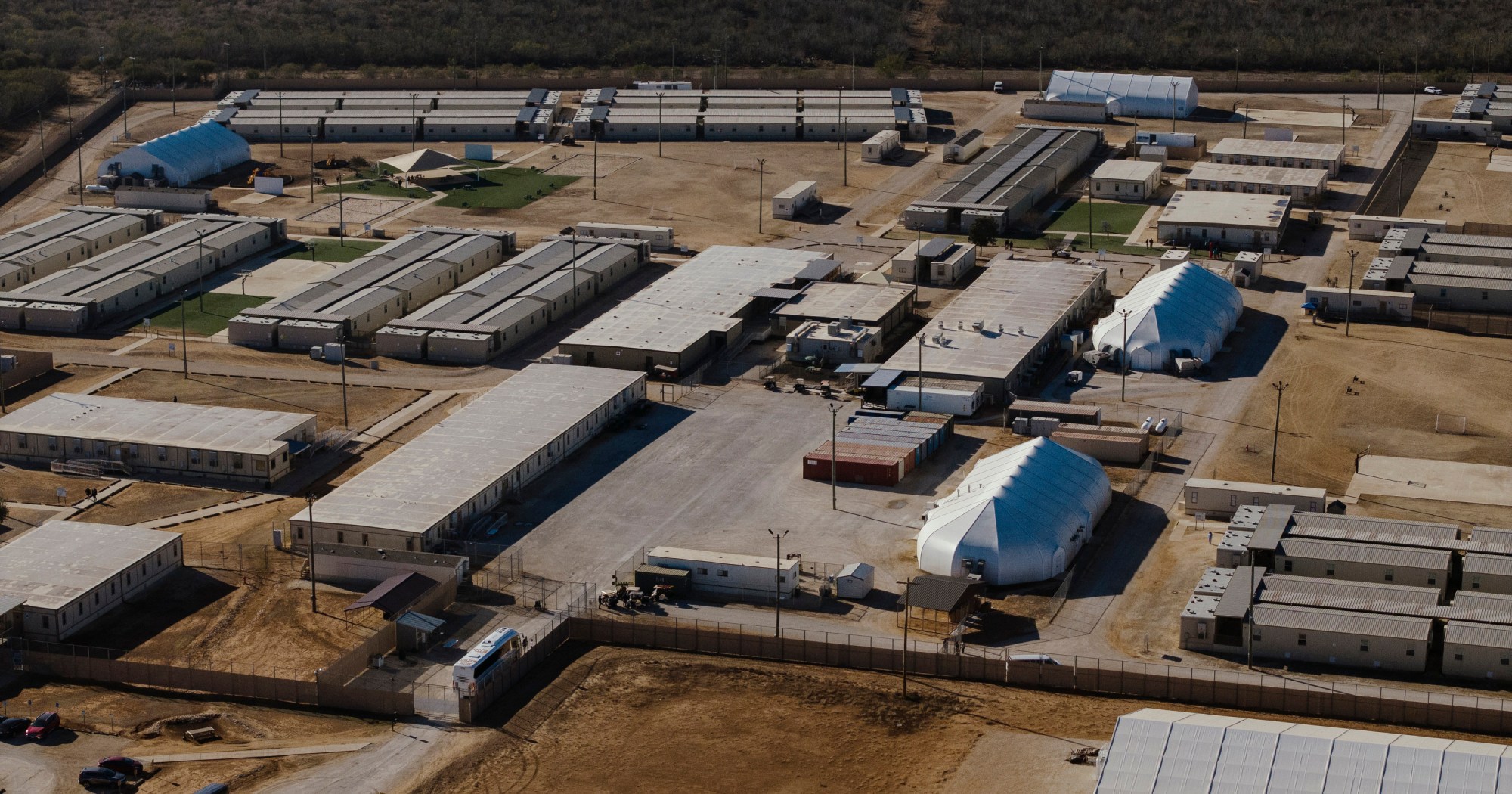
The number of parents and children booked into the nation’s only immigrant family detention facility in Dilley, Texas, plummeted more than 75% in February from the previous month, according to Immigration and Customs Enforcement data obtained by ProPublica.
From April 2025, when President Donald Trump began sending families there, to January of this year, the average number of people detained with their families was about 600 per month. In February, so-called book-ins fell to 133, but as of mid-March they had fallen again to just 54.
Only about 100 people were in family detention in Dilley this week, compared to an average daily population of more than 900 in January, according to the data.
Lawyers for Dilley’s current and former ICE employees and clients said they could not explain the sudden decline. But they said the change followed weeks of increased public pressure, in part due to widely publicized letters written by several detained children describing conditions inside Dilley and their despair at being removed from their homes and schools.
ProPublica published some of those letters on Feb. 9 after visiting the facility, about an hour south of San Antonio, in mid-January. The letter sparked a storm of outrage in Washington and across the nation. They were featured in Congressional hearings and plastered on posters at anti-ICE protests.
Democratic Rep. James Walkinshaw of Virginia read a letter to Acting ICE Director Todd Lyons during a Feb. 10 Congressional hearing, demanding answers about whether detaining children can have a negative psychological impact. He pointed to a drawing made by his family, a 5-year-old Venezuelan girl named Luisani Toloza.
“My son is five years old. He can’t write much, but he can communicate through pictures like this,” Walkinshaw said, paying special attention to the expressions on the family’s faces. “None of the faces are smiling.”
It was another 5-year-old who first brought public attention to the children detained at Dilley. Liam Conejo Ramos was picked up in Minnesota on January 20 and sent to the facility with his father. A photo of him in custody wearing a blue bunny hat went viral.
Emboldened by the attention, detainees organized a protest in the facility’s garden, which was photographed aerially and widely published on social media. Lawmakers requested multiple visits to demand the release of Ramos and others. Approximately 4,000 doctors, nurses, and medical professionals have written a letter to the Trump administration calling for the immediate release of all children currently in immigration custody. This month, social media personality Rachel Acaso, an educator known as Teacher Rachel who produces a popular children’s show, posted a video conversation with one of the children detained at Dilley to her 4.9 million Instagram followers, garnering more than 3,700 comments.
Representative Joaquin Castro, a Democrat from Texas, has been at the forefront of efforts by his own party to shut down Dilley and find alternatives to family detention for the administration. When told about the decreasing number of families being held in Dilley, he said, “Those trailer jails are no place for children. I’m glad to hear that number continues to decrease,” adding, “It’s a reminder that people can make a difference by speaking out.”
The Department of Homeland Security, which oversees ICE, said in a statement that custody decisions are made “on a case-by-case basis, day-by-day,” adding: “The administration does not make immigration decisions based on public opinion. We follow the rule of law.” The agency has said in the past that Dilley provides families with a safe environment with educational materials, child care essentials and access to 24-hour medical and mental health care. Meanwhile, CoreCivic, the private prison company that operates the facility, said in a statement that it “has no say” in whether detainees are deported or released. The government has said in previous statements that the health and safety of detainees is its “top priority”.
Dilley first opened in 2014 under former President Barack Obama as a family detention facility, primarily for people who had recently crossed the border. President Trump continued to operate the facilities during his first term, but President Joe Biden stopped detaining families in 2021, arguing that the United States should not be in the business of detaining children.
Shortly after taking office for the second time, Trump reinstated family detention in Dilley. As the number of border crossings dwindles to record lows, many families detained in the U.S. are staying longer in the country, putting down roots and building networks of relatives and friends. The children detained there range in age from newborns to teenagers. The majority of adults detained in Dilley had no criminal history in the United States.
Detainees and attorneys interviewed by ProPublica in the wake of the protests and publication of the children’s letters said guards removed crayons, colored pencils and drawing paper during recent room searches. This week, ProPublica learned that the facility had cut off access to video calls in common areas.
The Trump administration said in a recent court filing that no personal property was destroyed at Dilley and that items seized during the search were “limited to items identified as related to the protests and not permitted under facility rules.” CoreCivic “strongly” denied that its staff confiscated or destroyed children’s personal art and supplies. DHS said the restrictions on video calls were put in place after recorded calls were livestreamed online, “resulting in the unauthorized dissemination of sensitive law enforcement information.” The agency added that video calls will continue to be available in private rooms, as well as face-to-face meetings and telephone calls.
A long-standing legal settlement known as the Flores Agreement states that children should generally not be held for more than 20 days, but data obtained by ProPublica shows that the average length of detention has been longer than the average number of days in each month since family detention resumed at the facility last year. In each month from November to February, the average length of stay in family detention exceeded 50 days.
DHS has argued in the past that the Flores Agreement, which has been in place since the 1990s, is outdated and that the new regulations address the needs of children in custody and should be repealed.
An Egyptian family, Hayam El Gamal, and their five children, ranging from 18 years old to 5-year-old twins, have been in Diree for nine months. They were taken into custody after their father, Mohamed Soliman, was charged in connection with an anti-Semitic attack that left one person dead and 13 injured in Boulder, Colorado. His family said they knew nothing about his plans. DHS said it is still investigating.
A 13-year-old Guatemalan boy named Edison was released from Dilley this week along with his mother. During his 92 days in custody, Edison cried during a video call with his father in Chicago, saying he felt like he was being treated like a criminal. (The father asked that his son’s last name not be used.) Then, early Wednesday morning, a security guard came to their sleeping quarters and told him and his mother to start packing their belongings. By that night, they were on a plane to Chicago to reunite with Edison’s father. “We don’t understand why they were released,” the father said. “All I can say is it was a miracle of God.”
As soon as they landed, the family went home and enjoyed a seafood dinner, one of Edison’s favorites.
