


Trump Administration officials besides Trump are starting to behave erratically, a sign the fact that the Iran war is not developing necessarily to US advantage is beginning to penetrate their embubblement and belief in American superiority. However, even if the reality that the US has put the global economy at risk of a potential depression and is on track to having its military largely if not entirely run out of the Middle East is still likely beyond what key figures in the Administration can accept, cognitively and practically. Admittedly, it seems likely that some, perhaps many, top members of the armed services are better able to grasp what is happening and could help Administration leaders work through what will come at an epic shock.
Today we will focus on the kinetic war.
The US is still trying to project the false impression that it has escalatory dominance via attacking Kharg Island, which is on the northern end of the Persian Gulf and a major processing/production center for Iran’s oil exports. Keep in mind that none other than Ukraine war diehard hawk, Keith Kellogg, had told Fox News that the US could still end the war quickly and easily by taking Kharg island, since per him, it accounted for 80% to 90% of Iran’s oil exports. A mere look at a map shows what a batshit idea this was; we had assumed that this was messaging directed at chumps, intended to convey that the US was far from bereft of options. But apparently this Administration is of the “No idea is too misguided to be rejected” school of operation.
Even so, the Administration had to admit that it hit only “military” targets and did not touch oil infrastructure. Team Trump has worked out that attacking any Iranian oil facilities would lead Iran to bomb oil infrastructure all over the Middle East.
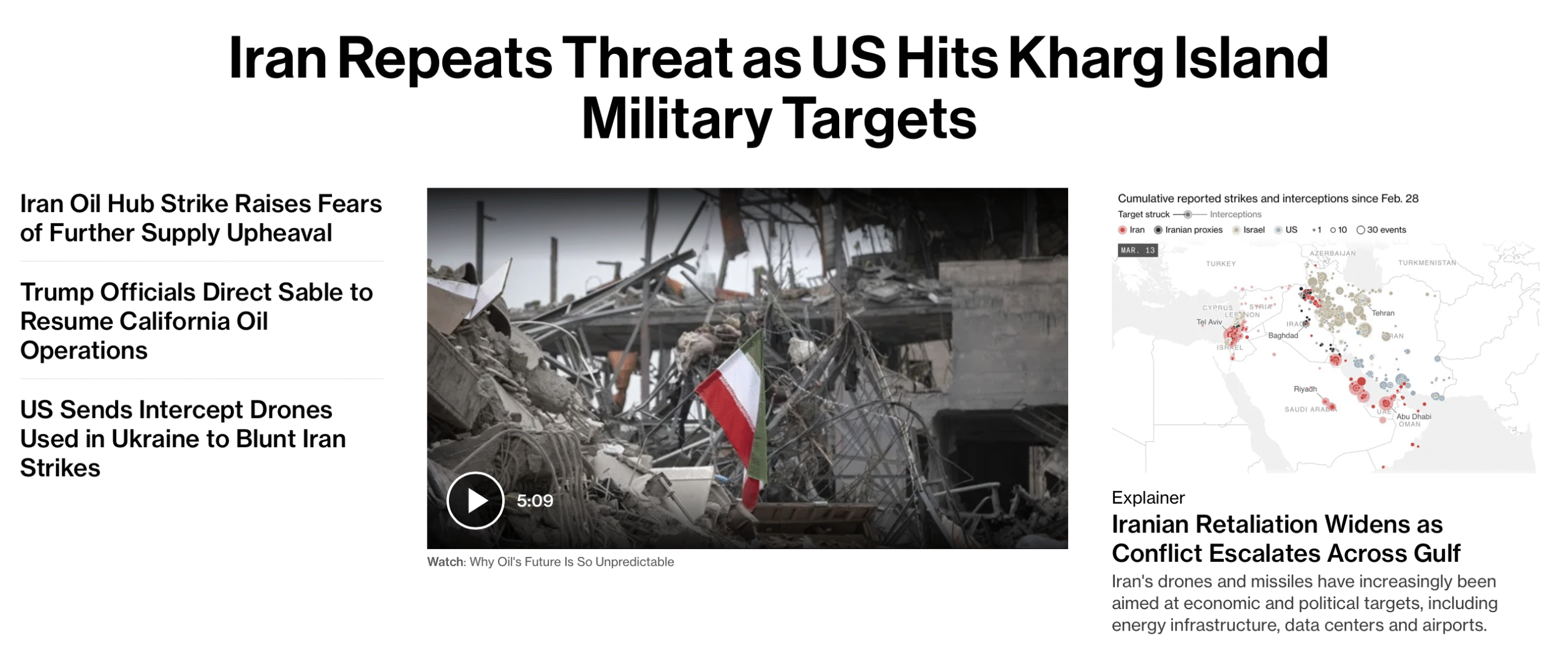
Turning to Bloomberg’s account first, due to it having good live reporting and out of our view that investor reactions can constrain the Administration faster than battlefield losses and real economy damage. The landing page as of 6:00 AM EDT:
If you have been following the mainstream media, you can see the shift in confidence level from this image alone. Headlines earlier gave the impression of the US and Israel being the moving forces, showcasing their strikes and plans to intensify attacks.
But this is pale compared to the Wall Street Journal landing page, which smells of defeat:
Now to Bloomberg’s Kharg Island report. Notice that the headline at the story proper (via the link from the current banner headline), Trump Strikes Iran’s Kharg Oil Hub and Urges Reopening of Hormuz, has not been updated to reflect Iran’s saber-rattling back. From its body:
The US struck military sites on Kharg Island, from which Iran exports almost all its oil, for the first time overnight, upping the ante in a Middle East war that’s raged for more than two weeks and shows little sign of easing.
President Donald Trump said military facilities on the Persian Gulf island had been “obliterated,” adding that he chose not to hit oil infrastructure “for reasons of decency.” He threatened to do just that should Iran “do anything to interfere with the Free and Safe Passage of Ships through the Strait of Hormuz.”
Iran reacted on Saturday morning by warning it will target American-linked oil and energy facilities in the Middle East if its own petroleum infrastructure is attacked. Iranian media said all oil-industry workers on the island, which sits about 25 kilometers (16 miles) off the mainland, are safe and unharmed.
Readers no doubt took note of Trump’s admission against interest in using the word “obliterated”. Or was he trying to signal, as with the pre-agreed strike on Fordow, that this attack was meant to be performative and it was time for Iran to back off, having made its point? I doubt it but it is hard to fathom what Trump thinks he is doing, aside from desperately needing to convey that he and only he is driving events.
However, Kharg Island may not be as essential to Iran’s oil exports as the Administration’s messaging posits:
Not really. Iran did not export oil from Kharg Island between 2019 and 2022. How was Iran able to export oil?
The fact is, Iran, with the help of China, built a large number of ports to circumvent sanctions. Iran has a pipeline that runs north to South to circumvent the…
— Anas Alhajji (@anasalhajji) March 14, 2026
Larry Johnson gives a long form takedown in Trump’s Kharg Island Fantasy… All Bark, No Bite. Key sections:
Late on Friday Donald Trump claimed in a social media post that military facilities on Kharg Island were targeted. Read his Truth carefully:
Trump is deep into fantasy land. Yes, I think he has lost touch with reality. He admits that the oil terminals were not attacked, just some unidentified military targets…
If you don’t know it now, only one of Iran’s 5 operational oil export terminals is located on Kharg Island. According to data from the international company Kepler, the amount of oil loaded from the tanks installed on Kharg increased by 1.5 times in the past month. This suggests that Iran, by quickly emptying Kharg’s tanks, was prepared for this attack.
If Iran’s oil terminal on Kharg had been destroyed, Iran would have launched missiles at identified the oil terminals in all the countries bordering the Persian Gulf. Here’s the list:
Saudi Arabia
Ras Tanura: The largest marine oil loading center in the world; capacity: 6 million barrels per day.
Ras Al-Ju’aymah: The second most important terminal; capacity 3 to 3.6 million barrels per day.
United Arab Emirates
Fujairah: Has multiple docks and is the largest fueling center in the region.
Jebel Ali: Site for crude oil and petrochemical exports.
Qatar
Ras Laffan: The largest LNG export facility in the world.
Kuwait
Mina Al-Ahmadi: Central crude oil export terminal with deep docks and high capacity.
Bahrain
Sitra Terminal: Exports refined…
There are a couple of ways to look at this. Perhaps Trump’s lie about devastating Kharg Island is the start of his PR campaign to gaslight the American public into believing Iran is defeated, which would allow Trump to declare victory and start withdrawing US forces. That’s one possibility. Alternatively, he really believes the lie and is convinced that this latest strike will convince the Iranians to surrender.
Having said that, it is not impossible that some sort of barmy scheme is in motion:
There is information suggesting that the Israeli regime is trying to persuade Trump to carry out a ground attack on Khark Island. From a strategic standpoint, the presence of U.S. military forces on the ground would give Iran the most historic opportunity to defeat the United…
— Iran Military Media (@IRMilitaryMedia) March 14, 2026
Perhaps the clever Israeli plan is if the US loses enough men in trying to take Kharg Island, it will commit to sending even more troops and treasure into this burn pit? From the Wall Street Journal in More Marines and Warships Head to Middle East as Hormuz Mission Intensifies:
The Pentagon is moving additional Marines and warships to the Middle East, as Iran steps up its attacks on the Strait of Hormuz and the U.S. prepares to escort tankers through the waterway.
Defense Secretary Pete Hegseth has approved a request from U.S. Central Command, responsible for American forces in the Middle East, for an element of an amphibious-ready group and attached Marine expeditionary unit to head to the region, according to U.S. officials.
Two ships from the Japan-based USS Tripoli Amphibious Ready Group and the 31st Marine Expeditionary Unit are now headed for the Middle East…
A Pentagon spokesperson declined to comment. One of the officials said the additional assets would initially be involved in strike operations on Iran. The USS Tripoli is equipped with F-35B jump-jet fighters.
An amphibious-ready group is a fast-response unit used to conduct sea-based amphibious assaults, humanitarian aid missions and special operations. The group’s embarked Marine expeditionary unit includes more than 2,000 Marines.
In addition to the Marine unit, the Pentagon is also weighing Centcom’s request for two additional destroyers to help escort commercial ships through the strait, one of the officials said.
The New York Times reported:
About 2,500 Marines aboard as many as three warships are heading to the Middle East from the Indo-Pacific region, as Iran increases its attacks on the Strait of Hormuz, two U.S. officials said.
Click through for this reality check:
The deployment of a MEU looks good on paper, but your traditional Marine Corps, the one that perfected forced entry and was perhaps the only military force in the world capable of doing so, no longer exists.
Why? In Trump’s first term, the service changed its doctrine to Force… https://t.co/TnlavMILMi
— James R. Webb (@JamesWebb_16) March 13, 2026
Now this new attempts at escalation may appear confident. Contrast this with signs of Administration officials, other than Trump, looking as if they are coming unglued. The triggers seem to be continued pounding by Iran. Larry Johnson maintains, forcefully, that the refueler that crashed in Iraq, resulting in six deaths, was the result of a strike. Shortly after that (as we will show below), Iran dropped what is purported to be a 2,000 pound bomb on the US base in Saudi Arabia. We have accounts that military and five more refuelers were severely damaged. Note more missiles may have gotten through than the one carrying the 2,000 pound munition.
The video clips in this must-watch Janta Ka update are telling, and not in a good way. It includes Pete Hegseth going full Baghdad Bob:
However, I suspect a if mot the reason for the freakout was the above-shown Wall Street Journal banner article, Trump Knew the Risk of Iran Blocking the Strait of Hormuz. He Still Went to War. The fact checking process would have made clear something like this was about to drop. IPutting this in the face of the right-leaning investor classes is clearly not welcome. I will not quote from the article since pretty much all of it familiar to readers but will update the link with an archived version for the inquisitive when one becomes available.
Some of these kinetic war updates overlap but together they present Iran inflicting even more punishment.
This Aljazeera report, from a bit earlier than the Hindustan Times videos, confirms a France 24 account from yesterday, of Israeli government messaging that war could last another year, but adding here bizarre expectation that Iran war will end first, Lebanon later. Erm, if Iran war the ends sooner it will not be via a US/Israel victory but the US being run out of most if not all of its Middle East bases.
This is also not a good sign:
Iran’s Khatam al‑Anbiya Air Defense Headquarters has called on residents of the United Arab Emirates to evacuate ports, ship docks, and locations used by US Armed Forces, warning that civilians should stay away to avoid harm.
— The Cradle (@TheCradleMedia) March 14, 2026
For some broader takes, Larry Wilkerson and Larry Johnson weighed in on Nima:
If you did not read the Richard Pape article we linked to earlier, this is a very good recap of his views. He discusses how Iran is inducing a system shock and we have lost control of escalation. He also believes that the US will still try to escalate further:
France 24 turns its attention to the US propaganda war:
Turning briefly to the economic front. Oil closed the trading week at just below $100. There was brief price relief from a false report that an Indian tanker had been allowed to transit the Strait of Hormuz:
Debunked: Viral claims of Iran opening the Strait of Hormuz for India are fake. 🚫🚢
Rajesh Kumar Sinha (GoI) confirmed:
The tanker in Mumbai never crossed the Strait.
It was in the Gulf of Oman; fuel was meant for Africa.
Diplomacy What a Shame 🙂#StraitOfHormuz #IranWar #crude pic.twitter.com/k6haw2iNYN
— Sanket Gunge (@sdgunge) March 14, 2026
Market heavyweights weighed in strongly against the idea of the Treasury trying to intervene in oil futures markets. From the Financial Times in US intervention in oil futures would be ‘biblical disaster’, CME warns:
Terry Duffy, the chief executive of CME Group, which runs the exchange where US oil futures trade, told a conference this week that it would erode market confidence if the US government stepped into the futures market in a bid to curb the rise in crude.
“Markets do not like it when governments intervene in pricing,” Duffy told the conference in Boca Raton, Florida. Such a move would risk a “biblical disaster” if investors lost confidence in markets to set the price of critical commodities, he said.
Gillian Tett, who did phenomenal reporting in the runup to the crisis and is now editor-in-chief for the Financial Times in the US, sounded a reassuring note in Should investors worry about a 2008-style shock? However, Tett has become badly diminished in her elevation to the US top slot. She typically offers leading-edge conventional wisdom. Her take is marred by focusing only on private credit risk. Both the US and China have extremely high levels of private debt to GDP, which is the best predictor of financial crises. However, unlike the financial crisis, the exposures are not concentrated in systemically important, overleveraged financial firms. That in theory means any threat to the critical payments system is no doubt lower. But the broader distribution of risk is likely to result in greater difficulty in any intervention, which means the end game may be deflation and zombification a la Japan, as opposed to a cataclysm. From her article:
Meanwhile, bad news is also tumbling out from the non-banking world, this time from private credit funds. Never mind that regulators have repeatedly warned that the private credit sector seems overheated; or that banks like JPMorgan are reducing exposures to this sphere, which contains “cockroaches” (ie troubled loans) to cite Jamie Dimon, head of JPMorgan.
What is most unnerving is that multiple funds — ranging from those run by behemoths like Morgan Stanley and BlackRock to specialists such as Blue Owl and Cliffwater — report that investors are trying to flee the funds. That reflects fears that AI will undermine the business model of software companies backed by private credit, even as the sector faces a $40bn redemption wall in 2028. However, the risks go well beyond AI, as the recent failure of UK lender MFS shows.
And while most private credit funds have rules that limit quarterly redemptions to 5 per cent of assets — enabling them to “gate” (ie prevent) excess outflows — the exodus echoes 2008. Hence why Kunal Shah, a top Goldman Sachs executive, told clients that some financiers were “just glad there’s something to talk about that isn’t software exposures and private credit” — ie the Iran war.
Or, even more bluntly, it is not just US President Donald Trump who might relish the focus on the war (a good distraction from the debate around the Epstein files). Some financiers also have reason to avoid the spotlight. Doubly so, given that retail investors have flooded into private credit, with White House backing.
So should investors worry about a 2008-style systemic shock? Probably not in the short term. One reason is that private credit is around $2tn in size, so fairly small for the system as a whole. Another is that the wider financial system seems better prepared for shocks — like surging oil prices — as Pablo Hernández de Cos, head of the Bank for International Settlements, recently noted in a thoughtful speech.
Mind you, this is an unverified set of reports on Twitter, but some are sounding alarms…or maybe oil shorts trying to talk their book?
Bessent had to call comex to place giant orders to suppress a calamity on Monday. https://t.co/oHPRJQHfgK
— World of Fiat Fraud 🌎 (@VanAccy) March 14, 2026
Consider additionally from Paul R (the article does not add much to the headline save that the statement was made on CNN): Iran considering limited tanker passage through Strait of Hormuz if cargo paid in yuan: Report Anadolu Agency.
All for today! Back tomorrow!
