


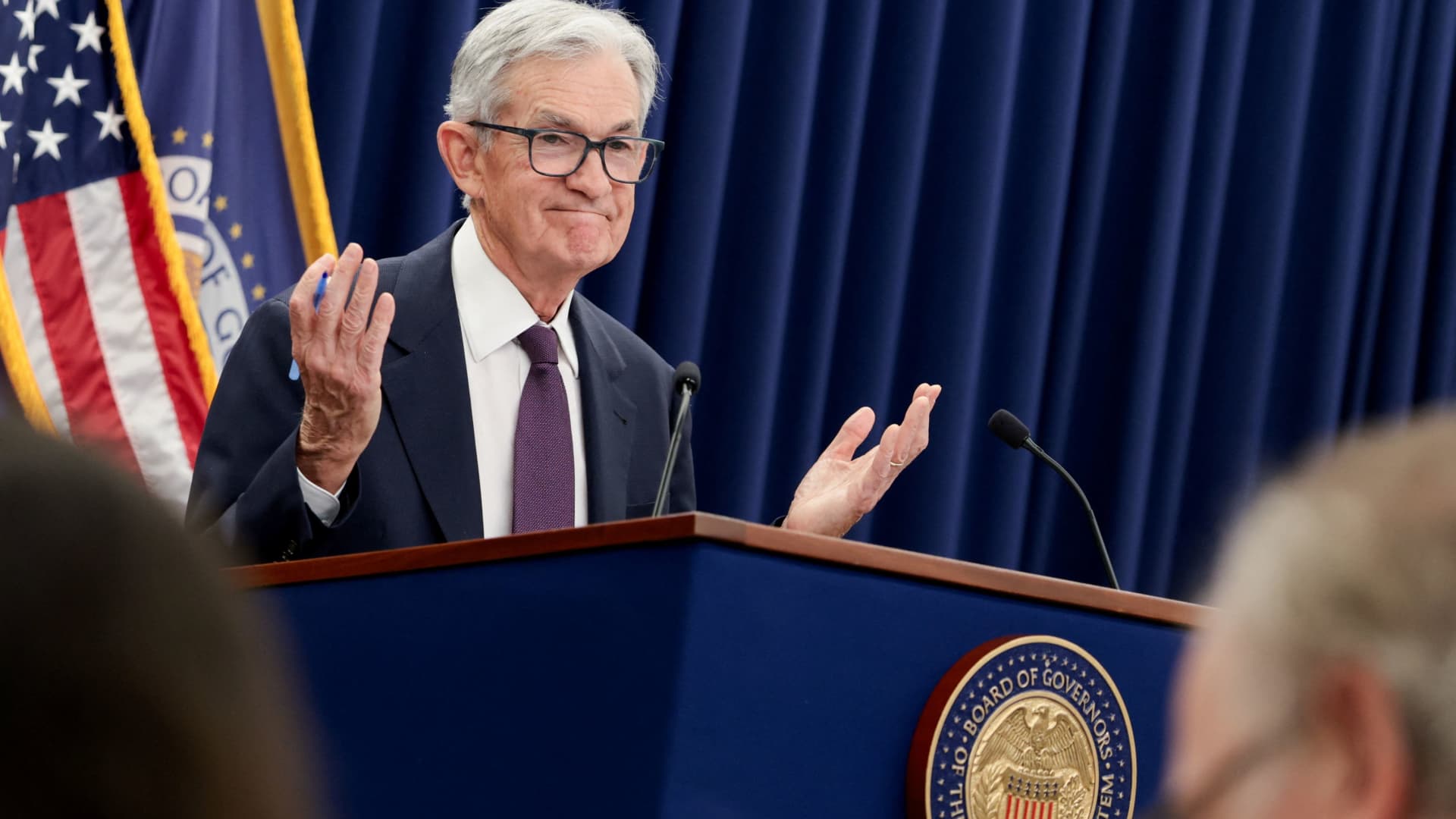
Jerome Powell, Chairman of the Federal Reserve System, reacts during a press conference after the two-day Federal Open Market Committee (FOMC) meeting on interest rate policy held in Washington, DC, on January 28, 2026.
Jonathan Ernst | Reuters
Expectations for the Federal Reserve to cut interest rates have waned as both energy prices and inflation concerns emerge.
Traders in recent days have given up hopes of early summer monetary easing from the central bank, a shift in thinking that coincided with the U.S. and Israeli attack on Iran and the sudden rise in oil prices to near $100 a barrel.
Before the dispute, market expectations were for a quarter-point rate cut in June, with another cut likely in September, and potentially three cuts depending on economic conditions, according to calculations by CME Group’s FedWatch.
Much of the thinking behind this approach was that a softening labor market, easing inflation, and the appointment of a new dovish chairman in May would move the Fed toward an accommodative stance. But fighting inflation will remain a top priority, at least as long as the Iranian drama plays out as currently expected.
“A higher inflation path would make it difficult for the Fed to begin cutting rates soon,” Goldman Sachs economists said in a note Wednesday.
The company formally adjusted its interest rate outlook and postponed the next rate cut from June to September. But Goldman economists still think the Fed could cut rates again by the end of 2026.
“If the labor market weakens more quickly and significantly than we expect, we do not think concerns about the impact of higher oil prices on inflation or inflation expectations will be an impediment to an early rate cut.”
The elusive second cut
Other market participants are less convinced.
Traders in the federal funds futures market have ignored even the September deadline and now only see the December deadline, according to the CME gauge.
Despite the presence of a new chairman, Kevin Warsh, who was appointed by President Donald Trump ostensibly for his willingness to ease, further cuts are not priced in until well into 2027 or even early 2028. Current chairman Jerome Powell will resign in May.
Whether this outlook holds true will depend on the situation in the Middle East. If the situation improves, a sense of normalcy may return to the market and there may be renewed expectations for further easing.
President Trump again called on Chairman Powell to cut interest rates, even though Brent crude oil prices have settled above $100.
“Where is Fed Chairman Jerome “Too Late” Powell today? He should lower interest rates immediately, without waiting for the next meeting!” President Trump posted on Truth Social.
The Fed is scheduled to revisit the inflation statistics on Friday morning when the Commerce Department releases personal consumption expenditure price index data for January. Economists surveyed by Dow Jones expect core PCE, which is the focus of Fed officials, to rise to 3.1% annual inflation.
Such a number would represent a 0.1 percentage point increase from December and a step away from the Fed’s 2% target. It also shows that inflationary pressures were creeping in well before the Iran attack, and could give officials more pause on the prospect of cutting rates.
Bank of America economist Stephen Juneau said in a note that while some key components, particularly housing, are showing signs of stabilizing or reversing, other inflation “remains range-bound and remains above levels consistent with core PCE of 2%.”
“The bottom line is the Fed should not be in a hurry to cut rates further,” Juneau said.
The Federal Open Market Committee, which sets interest rates, will announce its next interest rate decision on March 18th. Traders say there is a nearly 100% chance the commission will be put on hold.
Never miss the most trusted news moments in business news when you choose CNBC as your preferred source on Google.
Source link
