


The U.S. official laid out the operational challenge of securing Iran’s uranium: “The first question is, where is it? The second question is, how do we get to it and how do we get physical control?”
What they’re saying: Trump told reporters aboard Air Force One on Saturday that ground troops were possible — but only “for a very good reason.”
“If we ever did that, [the Iranians] would be so decimated that they wouldn’t be able to fight on the ground level,” he said.
Asked specifically whether troops might go in to secure nuclear material, Trump didn’t rule it out. “At some point maybe we will. We haven’t gone after it. We wouldn’t do it now. Maybe we will do it later….”
The intrigue: Beyond the uranium, administration officials tell Axios there has also been discussion of seizing Kharg Island, a strategic terminal responsible for roughly 90% of Iran’s crude oil exports.
We discussed earlier what a nutty idea the idea of taking Kharg Island, first voiced publicly by Keith Kellogg, is. Look at a map. It is in the north end of the Persian Gulf. Daniel Davis and others have discussed long form that sending a convoy open the Strait of Hormuz was asking for a turkey shoot of US vessels. This sort of operation would be that, cubed.
Nevertheless, there are more signs of force mobilization:
Spoke to a family member tonight, a Marine stationed in California. He said half the troops on base have disappeared in the past couple days and that the situation is chaos with those still remaining.
We have a duty as responsible Americans to do whatever we can to stop this.
— joe blank (@therevjoeblank) March 7, 2026
Danny Haiphong had a very informative talk with Stanislav Krapivnik which provides many details about the progress of the war and its progress, like the destruction of THAAD radars (we has not highlighted the successful strike on an additional one, in Jordan, in our recap yesterday), how US high end weapons are so expensive because they are significantly hand-assembled, and how the US has been caught bombing chalk drawings:
In a similar spirit, Simplicius debunks the idea that the US is living up to its screechy claims of success, starting with a point we and other made earlier, that the reduction in Iranian firing rates does not mean they are starting to run short. From his article, Iran War Shifts to Cynical Plan ‘B’ After US Fails to Fracture ‘Regime’
The entire discussion around the Iran war has now turned to Iran’s “diminishing” scale of strikes, with pro-Western commentators claiming that this means Iran is losing and will eventually succumb to the US-Israeli juggernaut….
I wrote on X why the decline in Iran’s missile salvos is not what it’s being made out to be:
Wrong.
This uses the false assumption that Iran’s opening salvo represents some kind of “normal” daily usage which is then sophistically straw-manned to assert that subsequent days are falling “below average”. In reality, the opening salvos are always meant as an anomalously high barrage that is not ever meant to be sustainable.
Iran is merely switching to normal sustainable long term salvo volumes.
One of the ways we can determine this is by considering that in the last exchange, Iranian missile capabilities were said to be heavily attrited (with various 70-90% figures being given) which was supposed to explain the low salvo counts.
Yet if Iran’s total ballistic capabilities were really that attrited, there’s no way it would have been able to rebuild them just in the past year alone to the point of being able to fire the same massive opening salvos as in the first war.
This leads us to conclude that the opening salvo count merely represents a doctrinal opening barrage, with an attendant ‘regression to the mean’ of regular sustainable salvo volumes.
In short, Iran is merely operating within its normal doctrinal strike procedures. The lower salvo counts should actually scare you, because it represents the base volume that Iran can sustain indefinitely while regenerating stocks 1:1.
They may scoff at this now, but wait 8 months down the line when Iran is still comfortably sending a couple dozen non-interceptable hypersonics with cluster munitions per day like clockwork and you’ll see what kind of systematic attrition that brings to the region.
That’s not to even mention that this relates only to ballistic missiles and doesn’t even address the fact that drone launches have increased, which now strike with increased effectiveness due to the regional AD attrition. It won’t be a laughing matter 8 months down the line when a 1-2 dozen ballistics and 100+ drones are launched daily at exhausted “allied” bases.
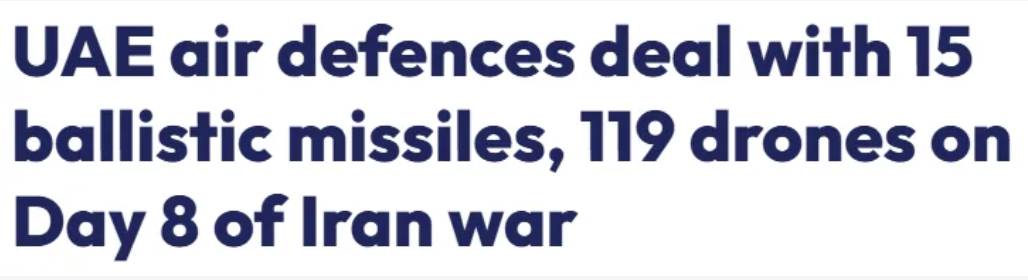
As stated, the statistics being presented about Iran’s missile launches are from hasbara sources, particularly the IDF. For instance, Iran’s missile and drone salvos were said to have dropped to almost nothing in the past two days as in the earlier graph, yet UAE has independently reported that the number of attacks it has defended against Iran just today alone is vastly higher than the stated counts:
Link 1
Link 2
https://www.khaleejtimes.com/uae/uae-deals-with-15-missiles-119-drones-day-8-iran-war
As can be seen, UAE alone reports 15 ballistics and nearly 120 drones launched just at them today, whereas some “official” statistics are showing roughly that amount as total fired by Iran into every direction. If the disparity is true, we’re looking at several orders of magnitude of potential discrepancies between “official” statistics and real launches.
Keep in mind, US’s strikes have likewise fallen off from nearly 1,000 on the first day to an estimated 200-300 per day or less since then—and many if not most of those strikes are hitting superficial targets to “fluff up the score”, like a plane boneyard which surely added a couple dozen “points” to the “impressive” strike list:
We cited Chas Freeman and Scott Ritter making the point that Simplicius turns to next, that the US claimed kills of Iranian missile launchers are sure to be exaggerated. Freeman returns to that argument and also warns Iran may have held back air defense weapons in a new discussion below:
And there is reason to think that Iran has ramped up its weapons production substantially:
Iranian general claims that between the 12 Day War and today Iran ramped up missile production and produced several years worth. Given that they were preparing for war with the US in these weeks this is possible and should be factored in. 🇺🇸🇮🇷 pic.twitter.com/R1ekULsbd6
— Philip Pilkington (@philippilk) March 8, 2026
Note as readers pointed out yesterday in comments, that Freeman has unfortunately taken up the aggressively promoted mainstream take on the “apology” by Iranian president Pezeshkian to its neighbors over its attacks. His statement was admittedly not as clear as it could have been, but it was referring to literal neighbors, as in those sharing a border, as in Azerbaijan, and not Gulf States. As Ben Panga pointed out:
A longer version of his [Pezeshkian’s] comments seem very much like an indirect acknowledgement & apology to Azerbaijan.
Translation “oops, our bad, let’s not escalate plz”
Via Tasnim
Pezeshkian further conveyed his apologies to neighboring countries that have been attacked by Iran. He explained that Leader of the Islamic Revolution Ayatollah Seyed Ali Khamenei as well as many military commanders and ordinary people have been martyred due to the brutal aggression of enemies, noting that when commanders are absent, the brave Armed Forces act decisively to defend the homeland with honor.
Pezeshkian clarified that Iran has no intention of invading neighboring countries, reiterating that they are considered brothers.
He called for collaboration with the neighboring nations to establish peace and tranquility in the region.
Pointing to a decision made during a recent meeting of the temporary leadership council, Pezeshkian reported that the Armed Forces of Iran have been instructed not to attack the neighboring countries or launch missiles unless the enemies intend to attack Iran from those countries.
He also emphasized the importance of resolving issues through diplomacy rather than conflict with neighboring states.
And from Safety First:
Russian state-adjacent television this morning is expounding the theory that Pezeshkian was NOT talking at the Arab Gulf States when he said “I apologize to neighboring countries”. Rather, this was aimed squarely at Azerbaijan, which has been making warlike noises since two Iranian drones hit the airfield in the Nahichevan exclave a day or two ago…
There is a bit of a translation issue, but the Russian TV interpretation is that “neighboring countries” refers to countries with a physical land border – i.e. Azerbaijan (and, to a lesser extent, Iraq, Armenia and Turkey). Basically, the last thing Teheran wants is a land war on with one of these on top of the air/missile war with the US and Israel. Especially with Azerbaijan and Armenia, since Iran’s remaining supply and trade routes for the moment are basically north-to-south either across the Caspian or through Armenia and Azerbaijan.
Some recent kinetic war updates. An attack on US airbase in Erbil from Aljazeera:
Huge blasts in Beirut as Israel says it was targeting Hezbollah command centres via Associated Press:
Some evidence of damage in Israel:
This gives us an idea of the sheer scale of the chaos unleashed by the Iranian attacks, which have been occurring multiple times a day for over a week now. The strikes have already led to 2,000 Israelis being hospitalized, a number similar to the number of Iranians hospitalized.… https://t.co/po9TI6FF2L
— Patricia Marins (@pati_marins64) March 8, 2026
Not quite a fatwa against opponents of Iran by Sunni Grand Mufti al-Sumayda’i
, but awfully close:
Iraq’s Grand Mufti Mahdi ibn Ahmad al-Sumayda’i delivered one of the bluntest Sunni positions so far, declaring that the war between Iran and the zionist entity is an ideological confrontation over the future of Islam. He said Muslims are obligated to stand behind any state that… pic.twitter.com/L4pd8fUPVr
— Thomas Keith (@iwasnevrhere_) March 8, 2026
Via print media: Chaos at Dubai airport after flights suspended following drone attack Independent. Note the flights resumed pretty quickly.
Larry Johnson has some important tidbits in his latest article, US Intelligence Community is Covering its Ass… What is Really Going On with the US War on Iran?, which includes a reader Q&A. Note:
5) is the Iranian Air Force destroyed?
No. The strikes on Iranian combat planes have been largely confined to the Western part of Iran. They still have ample capability in the East. Iran maintains 17 Tactical Fighter Bases (TFBs), and in recent years several new airfields have been constructed in central and eastern Iran, with at least two becoming permanent TFBs — the first established since 1979. One known eastern base is TFB.14 near Mashhad, in the far northeast. To protect assets from preemptive strikes, Iran has moved much of its air power underground. The “Eagle 44” (Oghab 44) airbase, unveiled in 2023, is a massive facility carved into the Zagros Mountains, designed to withstand bunker-buster bombs and housing fighter jets, drones, and command facilities. As of February 28, 2026, reports indicate MiG-29s flying over Tehran and Su-24 strike aircraft being repositioned, suggesting active defensive preparations.
We also must correct a line of thought we propagated from a very detailed and credible-seeming analysis, that the major maritime insurers would not resume writing war coverage and time soon because their reserves were too thin. In fact, they have resumed providing war risk riders, albeit on what sounds like a limited basis. From the Financial Times:
While insurance policies for shipping in the region remain active, very large war-risk premiums are being added. Several commercial vessels in the Gulf or just outside the Strait of Hormuz have been targeted with drones. The threat of attack by weaponised Iranian speedboats remains…
This article later notes:
This does not mean that the current disruption is only an Asian problem. Global oil and gas markets are grappling with the crisis. As of Friday morning, the Brent crude oil benchmark was up about 50 per cent from where it was before the US military build-up began in the Gulf. Meanwhile Asian buyers deprived of Qatari cargoes are bidding up the price on the Asian spot market to pull mainly US cargoes away from Europe. Asian spot LNG prices have almost doubled since the war began and the European natural gas price is up about 50 per cent, which puts new pressure on Europe’s economy.
Moreover, Europe and Africa depend on the Gulf for a substantial part of their jet fuel. The longer the war goes on, the more upward pressure will be applied on prices. Shortfalls in Asia will soon show up on gasoline pumps in North America.
More on the state of investor nerves from Bloomberg in Traders Warn $100 Oil Is Imminent If Iran War Keeps Raging:
Ship traffic through the Strait of Hormuz has all but halted — making reality what had long been considered a worst-case scenario for the energy markets. The number of empty oil supertankers in the Gulf is running out, hastening the moment when more production will have to be curtailed.
Hormuz Traffic
Vessel movement through the strait remains largely at a standstill
….Still, executives at four large trading houses, who asked not to be identified, said the market was still too complacent about the likely impact of a prolonged closure of the Strait of Hormuz, and predicted prices could hit $100 in days unless there was some de-escalation of hostilities.
There are already signs of stress in physical energy markets, where cuts at refineries in the Middle East and Asia have caused the price of products like diesel and jet fuel to soar. Bob McNally, president of consultant Rapidan Energy Group and a former White House official, said that the market is still adjusting to how long Hormuz might be shut.
“We see Brent reaching $100 a barrel and above in the coming days to weeks, once the market accepts that the Hormuz closure is a weeks-long event rather than a brief disruption,” he said.
Oil Heading for $100 a Barrel
Traders are starting to price major global supply disruption
Source: ICE, Bloomberg
….Several owners also said that insurance, which the industry says is available, remains secondary to the safety of their crews. And it’s not even clear that naval escorts will bring a wholesale return to transits….
Angus Blayney, marine divisional director at brokerage Gallagher, said cover is available for ships that plan to remain in the Persian Gulf, as well as those that are looking to enter or exit the area via the strait.
In recent days, Gallagher found marine war risk solutions for existing and new clients, Blayney said, without providing details of the insurance.
And from CNBC in Kuwait cuts oil production as Strait of Hormuz closure disrupts global energy market:
Kuwait said it is cutting oil production due to “Iranian threats against safe passage of ships through the Strait of Hormuz.”
Kuwait is the fifth-largest oil producer in OPEC. It produced approximately 2.6 million barrels per day in January.
Oil prices surged about 35% this week as the Iran war has triggered a major disruption of global energy supplies.
Last but not least:
New Supreme Leader has been OFFICIALLY CHOSEN — senior Iran cleric Ayatollah Alamolhoda
Announcement now ‘rests entirely with Secretariat of Assembly of Experts’ pic.twitter.com/uCwxp8LgxM
— RT (@RT_com) March 8, 2026
BreakingNews:
Iran’s Assembly of Experts (in Persian: Majles-e Khobregan), a council of 88 Islamic clerics (jurists), has approved the recommendation presented for the new leader of the revolution. (serious).
The final announcement is waiting for Donald Trump to come in person…
— Elijah J. Magnier 🇪🇺 (@ejmalrai) March 8, 2026
Will see you tomorrow!
