


But what if one of the country’s biggest drug cartels is being run by the US-born president’s family business?
The Pentagon announced on Tuesday that the US and Ecuador have launched joint military operations against “designated terrorist organizations” in the South American country. The statement was accompanied by footage of military helicopters taking off, as well as black-and-white aerial surveillance imagery of figures boarding helicopters on the ground.
The Times described the move as a “major expansion of the US military’s (NC: flagrantly illegal) unilateral strikes against boats in the Caribbean Sea and Eastern Pacific that the Trump administration has accused of carrying drugs (NC: without presenting a shred of evidence)“:
U.S. Special Forces soldiers are advising and supporting Ecuadorian commandos on raids across the country against suspected drug shipment facilities and other drug-related sites, according to a U.S. official who spoke on condition of anonymity to discuss operational matters.
The Americans are not believed to be participating in the actual raids, but are helping the Ecuadorian troops plan their operations, and are providing intelligence and logistics support, the official said.
In a 30-second video released by the military’s Southern Command, a helicopter is seen taking off in early morning or dusk, flying over an area, then picking up soldiers. The U.S. official said the video depicted the first in what was expected to be a series of raids across the country, some with U.S. advisers nearby assisting, some with Ecuadorian forces only. In this instance, involving mostly Ecuadorian forces, the official said, it was unclear what the mission’s objective was or whether it was successful.
On March 3, Ecuadorian and U.S. military forces launched operations against Designated Terrorist Organizations in Ecuador. The operations are a powerful example of the commitment of partners in Latin America and the Caribbean to combat the scourge of narco-terrorism.
Together,… pic.twitter.com/MrkKZcrDbs
— U.S. Southern Command (@Southcom) March 4, 2026
“The operations are a powerful example of the commitment of partners in Latin America and the Caribbean to combat the scourge of narco-terrorism,” the United States Southern Command said in a statement, which did not provide other details about the operations.
The White House did not immediately comment on the military activity.
So, even as Washington helps Israel rain down death and destruction upon Iran and its allies in West Asia, triggering a regionwide conflagration, it is also escalating its so called “war” on Latin America’s “narco-terrorist” drug cartels — a war that is really nothing more than a flimsy pretext to justify deploying US military forces in yet another wave of resource plunder.
This is not just about seizing Latin America’s critical minerals but also keeping them out of the hands of the US’ peer rival, China, whose footprint in the region has mushroomed in recent years. As we first warned in September 2023, the US is seeking to reimpose its strategic and economic stranglehold over South America — or failing that, to sow enough chaos and division in the region to undermine China’s growing economic influence there.
The Trump administration has already taken control of Venezuela’s oil, making sure China is left out of the equation; now, it has its eyes on the country’s gold. And by the way, Venezuela is believed to hold the largest untapped gold resources in Latin America — at least 644 metric tonnes, according to 2018 estimates by the Chavista government.
JUST IN: While missiles were flying over Tel Aviv, Trump was quietly brokering a gold deal in Caracas.
Venezuela’s state-owned Minerven just signed a contract to ship up to 1,000 kilograms of gold to US refineries.
Trafigura is the intermediary. Interior Secretary Doug Burgum… pic.twitter.com/xKXqG7yxT6
— Shanaka Anslem Perera ⚡ (@shanaka86) March 5, 2026
Meanwhile, Washington has threatened to indict interim leader Delcy Rodríguez if she doesn’t toe the line. According to sources cited by Reuters, “federal prosecutors have put together possible corruption and money laundering charges, and have communicated to Rodriguez that she is at risk of prosecution unless she continues to comply with Trump’s demands.”
“Plan Ecuador”
The deployment of troops to Ecuador, while hugely controversial in the Andean country (for reasons that will be explained shortly), has been on the cards for some time. As long-standing NC readers may recall, Ecuador’s government — both in its current form and that of its predecessor, the scandal-tarnished, Albania mafia-tied Guillermo Lasso administration — have been calling for a “Plan Colombia”-style arrangement with the US since at least June 2022.
In a June 21, 2022 article on left-leaning Gustavo Petro’s historic electoral victory in Colombia, “A Political Earthquake Just Took Place in Latin America“, we noted that while said victory may spell the end of the US’ decades-long military “partnership” with Colombia, Washington is already putting a contingency plan in place — in neighbouring Ecuador:
Just two weeks [earlier], the right-wing president of Ecuador (and former senior banker and Coca Cola executive) Guillermo Lasso [had] asked the United States for a military and security aid package similar to Plan Colombia, ostensibly to help in the fight against organized crime.
That plan began taking shape over the next couple of years. Lasso himself would end up being forced to resign after just two years in office over his alleged ties to the Albanian mafia, which played a key role in turning Ecuador into the world’s largest exporter of cocaine. As the NYT article notes, though Ecuador does not produce the drug, it has come to serve as a key trafficking route for criminal groups operating in Colombia and Peru.
Before leaving the scene (to head off into the Floridan sunset, where he was awarded the keys to Miami no less), Lasso spent his last months in office stitching together secret agreements with lawmakers in Washington — all with the ostensible aim of combatting drug trafficking organizations.
Obviously, that was not what this was about. If Washington were serious about tackling the violence generated by the drug cartels, the first thing it would do is pass legislation to stem the southward flow of US-produced guns and other weapons. But that would hurt the profits of arms manufacturers.
And if it were remotely serious about tackling the major cause of its drug problem — the rampant consumption of narcotics within its own borders — it would never have let Big Pharma unleash the opium epidemic in the first place. And once it had, it would never have let the perps walk free with the daintiest of financial slaps on the wrists.
Ultimately, if the US government were genuinely serious about tackling the drug trafficking cartels, which have become a major problem for both the US and its continental neighbours, it would shut down the CIA.
“Internal Armed Conflict”
Needless to say, Plan Colombia (2000-15) was a resounding failure from a counter-narcotics perspective, as even the US House of Representatives Foreign Affairs Committee admitted in 2020. However, it provided benefits from a counter-insurgency perspective, which was presumably the goal all along.
When Daniel Noboa, the US-born son of Ecuadorian banana magnate Alvaro Noboa, came to power in late 2023, not only did he sign on to Lasso’s “Plan Ecuador” plan; he quickly declared an “internal armed conflict” against the drug cartels, whom he designated as “terrorist organisations” and “belligerent non-state actors”.
This move opened the door wider to the prospect of more US military support, and even direct military intervention from the US armed forces — just as is happening now. As we warned at the time, Noboa’s “internal armed conflict” would trigger an even sharper rise in the country’s homicide rate, which was already among the highest in Latin America. So it has proven.
Last year saw a total of 9,216 homicides — more than one per hour and a 30% increase on 2024, according to official figures. It was Ecuador’s most violent year on record. The second most violent was 2024, the year Noboa declared the “internal armed conflict”. To put this in perspective, if Ecuador were the size of Mexico (in population terms), the death toll in 2025 would have been 68,000 — more than double Mexico’s worst year of violence this century.
Which brings us back to the present. Ecuador’s presidential office has issued a statement indicating that the “visit (of the Southern Command) is part of the bilateral dialogue to deepen cooperation and coordination in the face of transnational threats that affect national and regional stability”:
“[D]uring this meeting, lines of technical and institutional coordination aimed at strengthening hemispheric security and confronting transnational organized crime and narcoterrorism were reviewed, with a joint work approach that prioritizes the protection of citizens and the strengthening of the capacities of the State, in strict respect of sovereignty and internal regulations.”
“…[To this end,] joint initiatives are planned to strengthen controls, the exchange of information and operational coordination, both at airports and port terminals, in order to identify risks and prevent criminal activities”.
On Tuesday, Noboa himself published a tweet announcing”:
“We are starting a new phase against narco-terrorism and illegal mining. In March, we will conduct joint operations with our allies in the region, including the United States. The security of Ecuadorians is our priority and we will fight to obtain peace in every corner of the country.”
The images showing US helicopters landing at the airport of the Ecuadorian coastal city of Manta are particularly controversial given that the people of Ecuador already voted in a referendum 17 years ago to close down the US military base at Manta. Besides evicting US military personnel from Ecuador, the then-Rafael Correa government inserted an article (#5) into the country’s 2008 constitution stipulating that Ecuador is a country of peace, and expressly prohibiting the establishment of foreign military bases or foreign facilities for military purposes.
The Noboa government recently tried to overturn this article through a constitutional amendment, but in a November referendum an overwhelming majority of Ecuadorians voted against the reinstalment of foreign military bases on Ecuadorian soil. Some Ecuadorians are now, understandably, asking how the stationing of US military personnel at Manta for an indeterminate period of time does not constitute the de facto establishment of a joint military base.
Bananas + Cocaine = Big Business
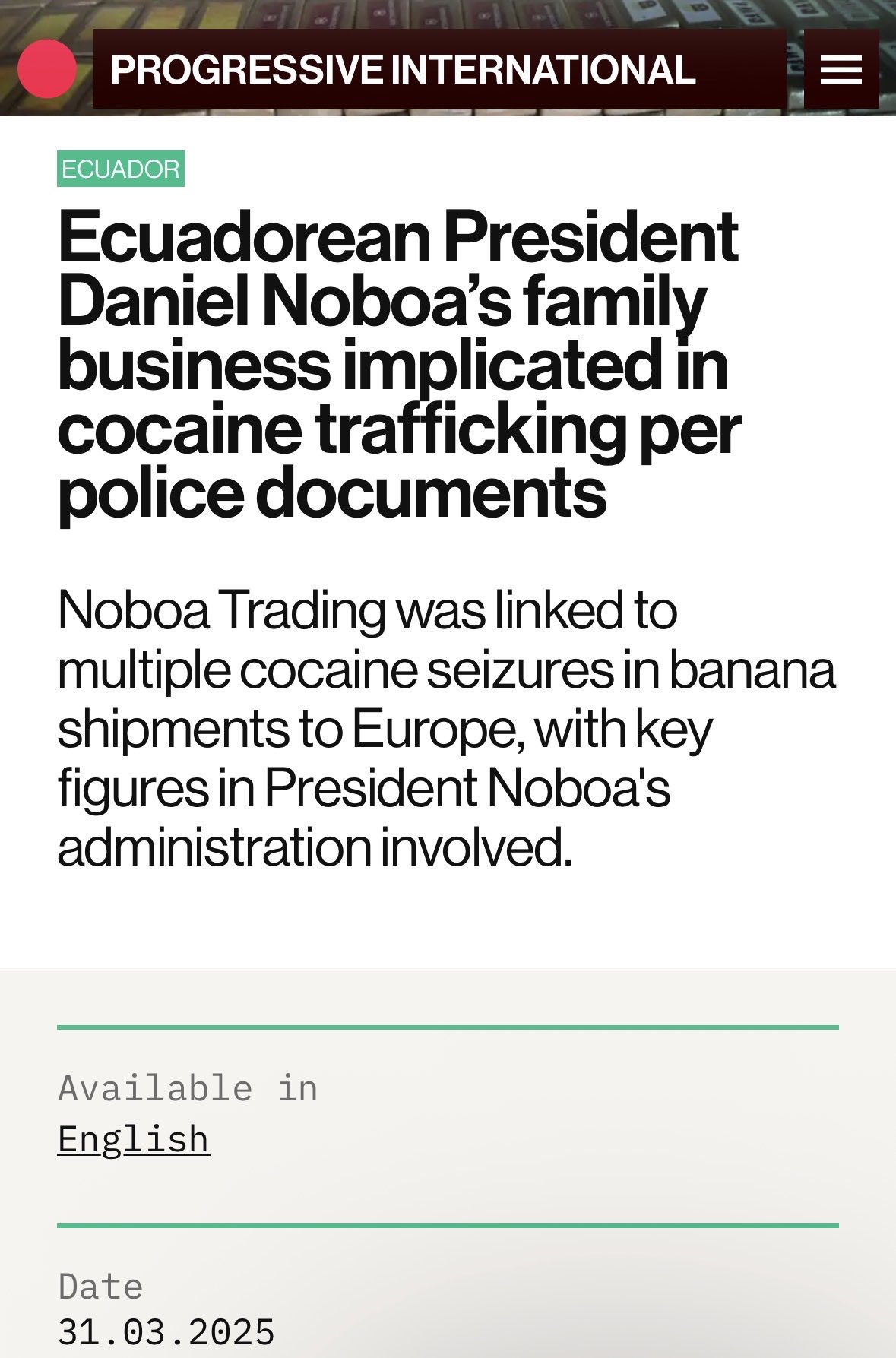
Another reason why this recent deployment of US troops, with the ostensible purpose of bolstering the Noboa government’s fight against the drug cartels, is controversial is that the Noboa family’s banana export business has been repeatedly implicated in cocaine trafficking.
In April last year, the Grayzone’s Oscar Leon interviewed Andres Durán, an Ecuadorian investigative journalist who was forced to flee his country after making allegations that Noboa, his family and their inner circle are intimately involved in the international drug trade. In that interview (featured below), Durán explained that:
Multiple cocaine trafficking scandals have involved Noboa-owned companies (e.g., Noboa Trading, Blasti S.A., Transmabo) and a family farm (San Luis), including shipments intercepted in Europe and 193 kg seized in 2025.
Ecuador is the primary point of departure for cocaine shipments to the US and Europe, with Noboa’s family businesses repeatedly linked to drug seizures
Investigations are allegedly obstructed without thorough probes, no arrests of high-level figures, while cases are dismissed as “contamination” despite Noboa companies controlling the full supply chain
Ecuador’s criminal economy is estimated at a staggering 18-22% of GDP thanks to weak state oversight, dollarization, and documented ties to the Albanian mafia.
Durán also accused Noboa of heading a “criminal economy” enabled by government policies seeking to defund port security, deregulate banana exports, gut financial oversight, and use shell companies for money laundering.
Dark Alliance: key US ally Daniel Noboa linked to S. American drug trade
The Grayzone’s Oscar Leon interviews Andres Durán, an Ecuadoran investigative journalist who has had to flee his country due to his allegations that billionaire, US-allied President Daniel Noboa, the Noboa… pic.twitter.com/OWFIyudL8l
— The Grayzone (@TheGrayzoneNews) December 31, 2025
Allegations of Assassination
It doesn’t end there. In recent days, Noboa has been accused by Wilmer Chavarría, alias “Pipo”, one of the leaders of Ecuador’s most powerful drug trafficking cartel, Los Lobos, of ordering the 2023 assassination of the former journalist and presidential candidate Fernando Villavicencio .
As readers may recall, Villavicencio was one of eight candidates in Ecuador’s 2023 presidential elections, which Noboa ended up winning. Just a week before the first round of elections, Villavicencio was shot three times in the head by Colombian sicarios while boarding his campaign vehicle after a political rally in Quito.
Before his assassination, 59-year old Villavicencio took a particularly hard line on the drug cartels that had made life insufferable for everyday Ecuadorians. “Being silent and hiding in moments that criminals kill citizens and officials is an act of cowardice and complicity,” he said. “I double down on my decision to go on fighting daily to defeat the mafias.”
In his final days, Villavicencio also spoke out against the white collar criminals enabling the drugs trade. In one interview he promised that as president he would reimpose state control of Guayaquil’s 10 privately managed coastal ports, from where most of Ecuador’s cocaine and bananas depart, often in the same containers. The companies managing the ports reportedly include firms tied to Noboa Trading as well as the Albanian and Balkan mafia.
In the two and a half years since Villavicencio’s death, nobody has been charged with ordering the hit even as the list of alleged masterminds has grown. A couple of weeks ago, Chavarria, who is being held in a Spanish prison awaiting an extradition hearing, added Noboa’s name into the mixer. From El País:
According to Pipo’s version,… a person close to the Minister of the Interior, John Reimberg, had informed him that the assassination had been ordered by Noboa out of fear that Villavicencio would win the 2023 elections. In those elections, both Noboa and Villavicencio were disputing the Presidency for the first time.
Neither of the candidates looked like they would qualify for the second round. Noboa… was lagging in last place in the polls and Villavicencio was polling third. The assassination changed the political atmosphere drastically and altered the electoral chessboard. The first debate took place with seven candidates and an empty lectern, and Noboa — unexpectedly — began rising in the polls.
Chavarría… [also] claimed that Reimberg had threatened him through an emissary when he was detained in Malaga… He said he fears for his life if he is extradited to Ecuador, in particular to the maximum security prison known as El Encuentro, which was built in the middle of a protected forest and is often touted by the government as a symbol of its crackdown on organised crime. According to Tito, sending him there would be tantamount to a death sentence.
The Minister of the Interior responded in a message on the social network X, saying that accusations are “absurd” and that the detainees “are terrified of extradition and El Encuentro prison.” He added that they are capable of inventing “the most sordid nonsense” to evade the consequences of their actions, and promised “zero impunity.”
Pipo also insisted that if he were extradited to the United States, the intention of the authorities would be for him to testify against former President Rafael Correa, whom he said he does not know.
This is not hard to imagine. Even Villavicencio’s widow, Verónica Saraúz, has accused Ecuador’s former attorney general, Diana Salazar, of pressuring her to blame her husband’s death on Correa in the crucial days leading up to the 2023 election. In recent days, she has also asked Ecuador’s Prosecutor’s Office to include in its file on her husband’s murder Chavarria’s allegations against Noboa.
They include Chavarría’s claim that before his death, Villavicencio had in his possession an audio recording that implicated Noboa in an act of child sex abuse, according to the Spanish newspaper Heraldo. As most media reports are at pains to emphasise, Chavarría’s allegations are wholly unsubstantiated. Nonetheless, given what is already known about the Noboa family’s illicit activities, they warrant serious attention.
Despite the allegations levelled against him, Noboa is still one of Marco Rubio’s favoured heads of state in Latin America. Rubio even recently touted him as Washington’s “top partner” in the war on drugs. This is hardly surprising. If there’s one consistent thread running through the post-WW2 history of the global narcotics trade, it is the (often behind-the-scenes) involvement of the CIA and the US military.
From the opium trade that funded the early operations of Taiwan’s CIA-backed, anti-communist Kuomintang to the heroin labs run by the Corsican mafia in Marseille, to Air America, Iran Contra and the agency’s ties to Colombian drug lord Pablo Escobar, to the assassination of DEA agent Kiki Camarena in Mexico, and the massive explosion in poppy cultivation during the US’ two-decade occupation of Afghanistan, the CIA’s fingerprints are all over the crime scene.
This data from the UN Office on Drugs and Crime shows how, under the US military occupation, Afghanistan became the world’s top producer of opium (used to make heroin).
After the US withdrew from Afghanistan, opium production suddenly collapsed.
Source: https://t.co/7J5O0H368D https://t.co/G99KXYFQWK pic.twitter.com/uF3NH1RdEh
— Ben Norton (@BenjaminNorton) January 7, 2026
In all the recent media coverage of the violent death of Mexican cartel leader “El Mencho”, one thing that was broadly omitted was the fact that just months earlier a senior DEA agent and former CIA agent had been busted in a $12 million scheme to launder cash and procure drones for Mexico’s Jalisco New Generation “narco-terrorist” cartel.
The Jalisco Cartel’s alleged US co-conspirators:
Paul Campo, former DEA official in charge of fighting money laundering
Robert Sensi, longtime CIA asset who served as a witness to Reagan’s October Surprise
Now let’s bomb some Venezuelan speed boats https://t.co/79bODQaV4y
— Max Blumenthal (@MaxBlumenthal) December 8, 2025
This is all documented history, thanks to the largely unsung work of investigative journalists and authors like Peter Dale Scott, Gary Webb, Robert Parry, Alfred W. McCoy, Michael Parenti, Alexander Cockburn, Jeffrey St. Clair and, most recently, Seth Harp. Yet it plays virtually no part in the public debate on the US-led War on Drugs, even as that same war rapidly escalates across Latin America.
As Maureen Tkacik contends in an article for The American Prospect, Rubio seems hell-bent on creating Iran Contra again.
Rubio’s approval ratings are the highest in the Republican Party, even as he is the architect of what is arguably Trump’s single most cynical policy: the scheme to appoint drug cartel bosses and their cronies atop the governments of every Latin American country, in the name of fighting drug cartels.
In September, Rubio hailed Ecuadoran President Daniel Noboa, who leads a country whose homicide rate has risen eightfold since 2016, as an “incredibly willing partner” who “has done more just in the last couple years to take the fight to these narco-terrorists and these threats to the security and stability of Ecuador than any previous administration.” Just five months earlier, a damning investigation revealed that Noboa’s family fruit business had trafficked 700 kilos of cocaine to Europe in banana crates between 2020 and 2022. Rubio has tirelessly promoted the cause of convicted (alas, just-pardoned) drug trafficker Juan Orlando Hernández. In 2018, Rubio personally and publicly commended Hernández, then president of Honduras, for combating drug traffickers (and supporting Israel), just seven months before his brother was indicted for trafficking 158 tons of cocaine in containers stamped “TH,” for Tony Hernández.
Rubio has raved about the crime-fighting efforts of Salvadoran and Argentine junior strongmen Nayib Bukele and Javier Milei, in spite of the former’s documented alliance with MS-13 and the various Miami cocaine trafficking scandals that enveloped his libertarian political party last fall, as well as both leaders’ slavish devotion to the drug cartels’ single favorite mode of money laundering.
And for at least a decade, Rubio has lauded, strategized with, and viciously condemned the multitude of criminal investigations into former Colombian President Alvaro Uribe, whom some describe as a kind of Kissingerian figure to the former Florida senator. A 1991 Pentagon analysis described Uribe, whom Rubio depicts as a kind of paradigmatic drug warrior, as one of the 100 most important Colombian narco-terrorists, a close personal friend of Pablo Escobar and a political figure “dedicated to collaboration with the Medellín [drug] cartel at high government levels.”
There are few better illustrations of Washington’s schizophrenic approach to its “War on Drugs” than President Trump’s pardon in early December of former Honduran President Juan Orlando Hernández, who had been sentenced to 45 years in prison for smuggling hundreds of tons of drugs into the US. A month later, Trump used his war on the “narco-terrorist” cartels as a pretext for attacking Venezuela and kidnapping its president, Nicolás Maduro, and his wife.
Back in Ecuador, Noboa is clearly happy for his country to be used as a lancehead in the US’ escalating assaults on socialist or left-leaning governments in the region while the drugs keep flowing. In recent days, his government has hiked tariffs on imports of Colombian goods from 30% to 50%, blaming Colombia’s President Gustavo Petro for his own government’s security “failings”.
On Tuesday, the same day the US and Ecuador announced joint troop deployments, Noboa declared Cuba’s ambassador in Quito as “persona non grata” and ordered Cuba’s diplomatic mission to leave the country. The move bore echoes of the armed assault Noboa ordered against the Mexican embassy in 2024, to capture Correa’s former Vice President Jorge Glas, who had sought asylum there, prompting Mexico to sever diplomatic ties with Ecuador.
Cuba’s Foreign Minister Bruno Rodríguez said in a post on X that it seemed like “no coincidence” that Ecuador had expelled Cuba’s diplomatic mission at the same time the US was increasing pressure on Cuba and other left-wing governments in the region, and ahead of a meeting of right-wing Latin American leaders in Miami next week, which Noboa is scheduled to attend.
