


Even though the Iran war continues to be an overly dynamic situation, with both fog of war and fog of propaganda impeding getting solid readings, we’ll focus on some high level issues to help with navigation. Even with that aim, there are also so many good accounts and helpful tidbits that our presentation may not be as tidy as we like. So please bear with up.
We also deeply appreciate the intense engagement and very helpful input and as warranted, corrections and calibration from our esteemed commentariat.
The Iran war is, as predicted, going pear shaped. As we will soon unpack, it is not simply, as the New York Times and Times of Israel reported, that the US and Israel entered into this conflict with only enough armaments to sustain a four-day-intense or perhaps seven-day-less-intense bombing effort. That was never going to come close to subduing Iran. This is a level of operation akin to the 1998 Desert Fox in a much smaller Iraq, which succeeded only in busting up some stuff. There was no way, even if the US attained air superiority, that it could achieve missile suppression.
Iran’s unexpected decision to strike hard at US assets across the region and close the Strait of Hormuz, even though it warned it would do so, on top of attacking Israel, has put the US and Israel very much on the back foot. And even though Israel should have learned its lesson in the 12 Day War, even with drone and missile launches at Israel not coming as fast and furious as some expected, the settler colony is taking major damage already. Importantly, Iran seems to be keeping up a high enough level of strike frequency on Israel so as to force citizens in its major cities to stay much of the time in bunkers, crippling the economy and unnerving them.
The multi-front retaliation is almost certainly depleting US air defense stocks even faster than expected, as attested by a Jerusalem Post story, US considering moving additional THAAD and Patriot air defense systems to Middle East, experts say on how the US is considering raiding its already-understocked defense cupboard in other theaters to bolster Operation Epic Fury.
The US and its allies and innocent bystanders are also suffering economic damage from the impact of suspension of air travel and other disruption across Middle East economies, and the prospect of oil and gas prices staying at their new higher level and perhaps rising further. And the closure of the Strait of Hormuz does not affect only energy cost and availability. Per TASS:
Citing statistical data, [Kirill] Dmitriev [head of the Russian Direct Investment Fund] said that a significant share of global flows of key components for fertilizer production passes through this route. In particular, about 44% of global sulfur trade, around 31% of urea, 18% of ammonia, and 15% of phosphates are linked to logistics through this region.
Again, as we will unpack a bit more, Trump is becoming even more unhinged as he makes wild claims, even by his own hyperbolic standards, about US capabilities and is lashing out hard against perceived turncoats, the latest being Spain and UK Prime Minister Kier Starmer. A sign of desperation is his nutty idea of having the US provide naval escorts to tankers in the Strait, as well as have the US provide what he called political risk, actually war risk, insurance. The convoy scheme makes the Charge of the Light Brigade look like a dandy idea.
It isn’t just Trump that is coming unglued. The New Republic flagged Pete Hegseth’s Crazed, Angry Tirades on Iran Give Dems a Big Opening. Even the normally buttoned-down Marco Rubio has been captured on camera struggling to come up with coherent-seeming answers to not-terribly-difficult media questions.
But citizens in the West are being spared as much as possible a good picture of what is underway. Not that the fantasy of a US/Israel success can be maintained all that long, but the spin-meisters are working overtime. We noticed, for instance, mainstream live blogs taking up almost the same language in their headlines. I wish I had screenshot a series from a few hours ago, but the current Wall Street Journal banner headline, Israeli Strikes Aim at Crippling Iran’s Security Forces, is a close echo.
The headlines were more of the form of “Israel strikes Iran security forces” which serves to imply that Israel and the US are focusing on military targets. My sense is these “security forces” are often actually police stations; but I confess to not knowing if policing is local or under the control of the IRGC.
But as you’ll see from a Janta Ka video below at 5:50, in keeping with the slaughter at a girls’ school and a neonatal hospital, the US and Israel are hitting many if not mainly civilian targets, such as hospitals. This implies that the objective is to terrorize the population to force a regime change, as opposed to prosecute a war and conquer the state.
In keeping, as I was drafting the section above, when I went to the Journal to get a link for the headline, it had been updated to read Israel Is Blowing Up Iran’s Police State to Clear the Way for a Revolt. So at least the Journal has put the regime change objective front and center.
Now to details. Some very good substantiation comes in videos, but they often address multiple observations above, so forgive the fact that what comes next may not be as well ordered as might be ideal
While the Western media has been for the most part averting its eyes from the punishment Israel is taking, Indian mainstream media is providing solid coverage, as the Times of India illustrates below:
And:
Yet another Times of India presentation, Iran BOMBS CIA Facility In Saudi Capital; Drones Hammer American Base In Riyadh As IRGC Goes Nuclear, highlighted that the Iran strike on the US embassy in Saudi Arabia appeared to be targeting a CIA station there.
On the impossibility of the US and Israel achieving their aims via an air campaign, as has been often discussed by experts in independent media, a must-read analysis from Middle East Observer explains in detail why even when the US and Israel obtain air superiority in Iran, which it treats as achievable, it will not be able to suppress missile fire. Iran with its huge stocks of missiles and drone will still be able to pound Israel and US assets.
⚔️ Battlefield Assessment: CENTCOM vs Iranian Strike Capabilities ⚔️
CENTCOM’s objective is clear: destroy Iranian TELs and launch platforms. To do that, they first had to degrade Iranian air defenses with standoff munitions to gain airspace access. That part is working. What… pic.twitter.com/clYwfRXZsF
— Middle East Observer (@ME_Observer_) March 4, 2026
Please click through and read the entire tweet. Key bits:
CENTCOM’s objective is clear: destroy Iranian TELs and launch platforms. To do that, they first had to degrade Iranian air defenses with standoff munitions to gain airspace access. That part is working. What comes next is where it gets complicated.
Iranian launch rates will decrease as U.S. air presence grows. They’ll use decoys, disperse launches across multiple locations, and tighten operational security. But the missiles will keep flying….
The strongest evidence isn’t theoretical. It’s Lebanon 2024. Israel surveilled 4,500 km² of Hezbollah territory for 24 years without interruption, drones, satellites, spies, mapping that geography to the last grain. Hezbollah still generated 100-200 projectiles every single day for 66 straight days through an estimated 8 to 15 actual launch events, made possible by modified systems carrying 20-30 rockets per vehicle. A handful of vehicles. Every day. Total surveillance couldn’t stop them.
That theater was 0.002% of Iran’s total area….
Now add the TEL replaceability problem, and this is where Iranian doctrine is particularly well thought out. The Kheibar Shekan, one of Iran’s most capable solid-fuel MRBMs, is deliberately designed to launch from commercial-style 10-wheel truck chassis that blend into civilian road networks. The Sejjil, Iran’s longest-range solid-fuel system, rides on standard 6×6, 8×8, and 10×10 heavy truck platforms. This was not an engineering compromise. It was a deliberate doctrinal choice. The truck is replaceable from any commercial fleet. What CENTCOM needs to destroy is the missile on top of it, not the launcher itself. This means Iran’s effective TEL inventory is far larger than any satellite count of purpose-built military vehicles would suggest, and attriting the launcher without the missile is a strategically meaningless kill….
After more persuasive detail, it concludes:
Bottom line: CENTCOM can achieve air superiority over Iranian skies. It cannot achieve missile suppression. Those are two completely different objectives and conflating them is a fundamental analytical error that dominates mainstream coverage of this conflict. Iran fires for as long as it chooses to fire. The only military variable is the rate, not the duration.
Chicago professor Robert Pape explains, using historical evidence, why bombing campaigns alone never win wars. From The Air Power Illusion: Why Bombs Break Buildings — Not Regimes (emphasis his):
In international politics, 100 percent patterns are rare. Military outcomes vary. Leaders miscalculate. Technology shifts balances. But here the record is uniform. From Hamburg to Baghdad to Belgrade, strategic bombing has inflicted devastation without producing regime collapse.
That uniformity demands explanation.
For more than a century, air power has carried a seductive promise: strike leadership → cripple infrastructure → paralyze command → trigger political collapse. The machinery evolves; the faith remains…
The record tells a harder story. Strategic bombing has destroyed armies and shattered cities, but it has not by itself toppled a functioning regime. Political collapse happens when ruling coalitions fracture under internal pressure, not when buildings burn.
Bombs can devastate states. They do not, by themselves, disintegrate regimes.
Regimes Fall When Insiders Defect
On the defensive side, Larry Johnson explains why the picture is even worse than the scramble to find more THAADs and Patriots indicates. I am doing Johnson a bit of a disservice by truncating his fine and detailed analysis; please read his post in full. From The US Missile Defense Shortage is Worse than Imagined:
I will now show you conclusively that Trump is gaslighting the public, at least with respect to the PAC-3 MSE missiles. The PAC-3 MSE (Patriot Advanced Capability-3 Missile Segment Enhancement) is effectively the primary missile used in the modern Patriot system for most high-priority threats, particularly in current U.S. Army and allied operations as of 2026….
When the PAC-3 MSE is employed against an incoming threat, a minimum of two are fired….Assuming that the US and Israel have NOT fired any PAC-3 MSE missiles in 2025 and 2026, the US only has 3,773 in its inventory. We know that is ridiculous, but play along with me.
During the 12-day war Iran fired at least 600 ballistic missiles into Israel. In theory, the Patriot system is designed to work against ballistic missiles while Israel’s Iron Dome is designed to defeat short-range counter-rocket, artillery, and mortar (C-RAM) defense, plus capabilities against drones, cruise missiles, precision-guided munitions (PGMs), and some ballistic threats in certain configurations. So let’s assume that the Patriot was fired at 500 of the Iranian missiles — i.e., at least 1,000 PAC-3 MSE missiles were fired. That shrinks the US inventory to 2,773.
In just four days since the start of Epic Fury, Iran has fired an estimated 200 missiles at sites in the Gulf nations and Israel that have Patriot batteries. Conceivably, that means that another 400 PAC-3 MSE missiles have been launched, which shrinks the inventory to 2,373. If Iran fires 60 ballistic missiles per day, and the Patriot system uses 2 interceptors per incoming missile (a common conservative engagement doctrine for high-confidence intercepts against ballistic threats), the inventory would be exhausted after 19 full days, with enough left on the 20th day to handle roughly 46–47 Iranian missiles before depletion…
Note that I am assuming that the entire inventory of US Patriot missiles have been deployed to Israel and US bases in the region. That is a false assumption because there are Patriot missile batteries with a full complement of missiles in other theaters.
Note that the UAE denied a Bloomberg report that it had only four days of air defense missiles left, which as Alexander Mercouris notes, was so vigorously done as to be in “the lady doth protest too much” category. Trump was similarly over-the-top in a Truth Social post:
Latest Trump posting on Truth Social claims he has plenty of munitions to keep going . But reading between the lines he is unhappy with Ucainian clown Zelensky and needs now money for his Iran war not for golden Ucainian toilets pic.twitter.com/Jv8WLWdjSF
— Winfried Eamon Scheidges (@celticarab) March 3, 2026
On other military issues, Trump threatened to cut off all trade with Spain for refusing to allow the US to use its airbases for Iran-related operations, and then later said Spain could not stop the US anyhow. Wellie, they probably won’t but they sure could. All they have to do is cut off the electricity. Similarly, he attacked Kier Starmer three times in one day, the first by declaring him to be no Churchill, over the UK’s similar refusal to let the US operate from its bases.
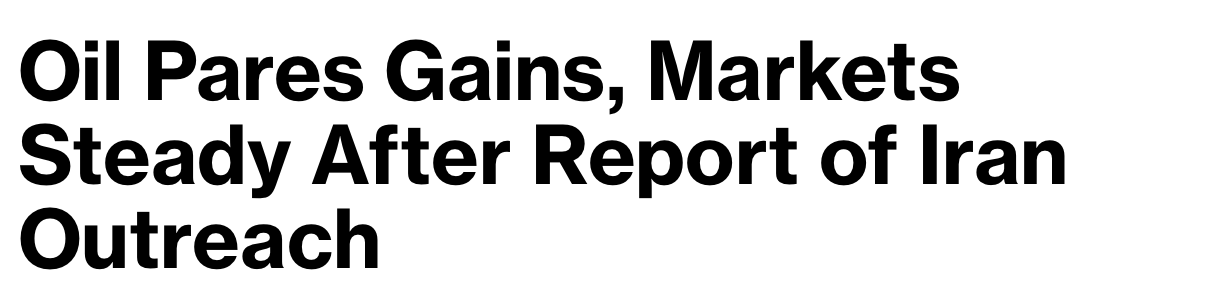
Now to the economic front, where some of the material overlaps with the sightings of Trump’s even-more-erratic-than usual behavior. One of the efforts to manage market action is yet more narrative control. Asian stocks sold off badly yesterday, with South Korea even having to stop trading. It is just about certain that a new report that Iran has attempted to contact Washington but has been rebuffed is fake news to moderate oil prices, as you can see from the headline in the Bloomberg live feed:
The detail is less than convincing:
• European stocks and US futures are trading higher, avoiding an earlier selloff in Asian markets that saw South Korean equities post their biggest one-day crash on record.
• The move up accelerated after a report that Iran had made indirect contact with the US to discuss an end to the war — even if it appears the offer is being brushed off in Washington.
The earlier “calm the markets” move came from Trump, via his scheme to break the closure of the Strait of Hormuz via US naval convoys plus insurance. This is obviously a lame-brained idea from a military perspective and would make it trivial for Iran to sink lots of ships and capture sailors. Daniel Davis was close to beside himself:
While the convoy part is affirmatively self-destructive (not that that is new for this conflict), the insurance part is merely silly. Getting procedures (how to apply for coverage, get approved, and receive legally binding confirmation) and ops (as specs for coding and the code writing on the government side) together for a totally new maritime scheme would take well over a year even if you put a highly competent team on it on a high-intensity work schedule. There is no off the shelf software for this. That is before adding in legislative approval time.
Contrast these considerations with the unduly polite Financial Times coverage:
At least six tankers have been hit in the Gulf since the war began, forcing marine traffic through the strait to a virtual halt…
President Donald Trump on Tuesday said that “if necessary”, the US Navy would escort tankers through the strait “as soon as possible”. The US Development Finance Corporation would also provide risk insurance and guarantees for tankers travelling in the Gulf “at a very reasonable price”.
Oil prices fell slightly after Trump’s announcement, but details of the plans and how they could be executed in time and at the necessary scale to avoid a new energy shock were scant.
Helima Croft, a former CIA analyst now at RBC Capital Markets, dismissed Trump’s proposal as “likely in the concepts-of-a-plan stage”.
Naval warfare experts said the destroyers and jets needed for the escorts would not be available immediately, given their role in the attacks on Iran.
Joshua Tallis, at the Center for Naval Analyses, said it was “unlikely” that the US Navy would be able to defend commercial vessels “over the next seven to 10 days”. Escorts would come “only after the initial phase of major hostilities”, he added, and when more Iranian anti-ship capabilities had been destroyed.
An escort operation would be “hard but doable”, said Mark Montgomery, a former US aircraft carrier strike group commander. He estimated it would take up to two weeks before conditions were favourable and would “cause a reduction in the amount of strike[s] the US could carry out”.
This illustrates that the MSM and too many soi-disant experts are not willing to say that Emperor Trump has no clothes. To spare overloading this post, we will skip over the more realistic Bloomberg commentary on this scheme.
We have mentioned before how many countries are expecting soon to take hits from higher energy prices. CNBC goes through the expected effects across regions in The Strait of Hormuz is facing a blockade. These countries will be most impacted. The ones most at risk:
South Asia would face the most acute disruption, particularly when it comes to supplies of LNG, analysts said.
Qatar and the United Arab Emirates account for 99% of Pakistan’s LNG imports, 72% of Bangladesh’s and 53% of India’s, according to Kpler data.
With limited storage and procurement flexibility, Pakistan and Bangladesh are especially vulnerable. For one, Bangladesh is already running a significant structural gas deficit. According to the Institute for Energy Economics and Financial Analysis, the country is running a shortfall of more than 1,300 million cubic feet per day.
“Pakistan and Bangladesh have limited storage and procurement flexibility, meaning disruption would likely trigger fast power-sector demand destruction rather than aggressive spot bidding,” said Go Katayama principal insight analyst at Kpler.
India faces the largest combined exposure in the region. “More than half of its LNG imports are Gulf-linked, and a significant share is Brent-indexed, so a Hormuz-driven crude spike would simultaneously lift oil import costs and LNG contract prices. That creates a dual physical and financial shock,” he said.
Similarly, about 60% of India’s oil imports come from the Middle East, according to UBP. A sustained blockade would therefore amplify both energy import costs and current account pressures.
By contrast, CNBC deems China to be better positioned:
China: large exposure but sufficient buffer
A Hormuz closure would test China’s energy security, but stockpiles and alternative supply offer some buffer.
Most Anglosphere readers don’t assign much weight to what is happening economically in the Middle East, but both the Strait of Hormuz and airspace closures are devastating blows. The Wall Street Journal reported from a British expat perspective on the considerably diminished attractions of Dubai under the new normal in They Went to Dubai for Sun and Low Taxes. They Wound Up in a War Zone:
For more than two decades, Dubai has sold itself as an expat paradise, a global crossroads between East and West known for its low taxes, high salaries and luxury lifestyle. More recently, it has also emerged as a premier destination for U.K. residents in search of a sunny, uncomplicated alternative to modern Britain.
The emirate, now home to some 240,000 Britons, represented a place to start afresh, far from the rising costs, political upheavals and overbearing class system back home. It also became a magnet for entrepreneurs in the engagement economy spawned by reality TV shows such as “The Only Way Is Essex” and “Love Island.” British influencers are now among its loudest and most visible residents.
And a further sign of the world of hurt in Gulf economies:
Reports from Dubai confirm that banks in the UAE have completely shut down. Only cash is in circulation!
The culprit is Iran’s precision strikes on data centers.
Among the affected facilities are Amazon Web Services (AWS) data centers in the ME-CENTRAL-1 region (UAE),… pic.twitter.com/O1AG6Lfl07
— EMPR.media (@EuromaidanPR) March 3, 2026
And some useful-seeming tweets.
🇮🇷‼️ IRGC informed official: The rumor of an F-35 fighter jet landing at Mehrabad is ridiculous and baseless
Following the spread of rumors on social media about an Israeli regime F-35 fighter jet landing at Mehrabad Airport, an informed official in the Islamic Revolutionary…
— dana (@dana916) March 3, 2026
Hezbollah is not taking the Israeli attacks lying down:
3 heavy rockets were launched from Lebanon toward the center of occupied Palestine, with explosions heard in Tel Aviv and its surrounding areas, while shrapnel fell in occupied Haifa and reports indicate Hezbollah targeted the Jalilot base north of Tel Aviv.
— Thomas Keith (@iwasnevrhere_) March 3, 2026
Channel 12 citing a senior security official: Hezbollah is single-handedly turning Lebanon into a central arena alongside Iran
— barry with the NED (@bonzerbarry) March 3, 2026
Zionist media just reported Hezbollah launched an anti-tank missile targeting an IOF force at the border, casualties were confirmed. Zionist media also reporting a coordinated missile attack launched from Lebanon and Iran toward occupied Palestine. https://t.co/WwEaI3Id7t
— Calla (@CallaWalsh) March 4, 2026
Apologies for not yet considering the prospect of Kurdish involvement. The reactions before it was official suggested this would not come out well for the Kurds:
NEW: Kurdish leader Hassan Sharafi confirmed that the decision has been made to support the United States in operations against Iran. The Kurds, originally from Iran but now based in Iraq, say they plan to move into Iran to fight the regime and ultimately aim to overthrow it.
— GeoInsider (@InsiderGeo) March 4, 2026
And some fresh sightings:
BreakingNews:
Sirens in Israel in over 200 locations. This is the first time in the modern history of Israel where explosions are heard in different locations and incoming missiles are coming from two countries. Loud and strong explosions are registered in different parts of the…
— Elijah J. Magnier 🇪🇺 (@ejmalrai) March 4, 2026
Regional fallout from the joint American–zionist attack on Iran is now hitting Western tech infrastructure. CNBC reports that major U.S. tech firms have begun shutting down their Dubai operations.
Nvidia told staff its Dubai office is closed and all work has shifted to remote…
— Thomas Keith (@iwasnevrhere_) March 4, 2026
See you tomorrow!
