


Despite numerous claims by those who claim to have inside information that a decision was taken to launch an attack on Iran (which, unfortunately, we did not question enough), more or less no such attack has taken place at this time. Larry Johnson and John Kirakow were among those who said they obtained their information from highly relevant sources. In hindsight, both had ties to the CIA and their information may have ultimately come from the same person. 1 Mr. Johnson admits his mistakes, unlike many commentators who play the “if you have to predict, predict often” game and pretend to be consistently right over time, even when they actually change their position. We will soon discuss his latest assessment, which is more carefully calibrated for signs that war is imminent.
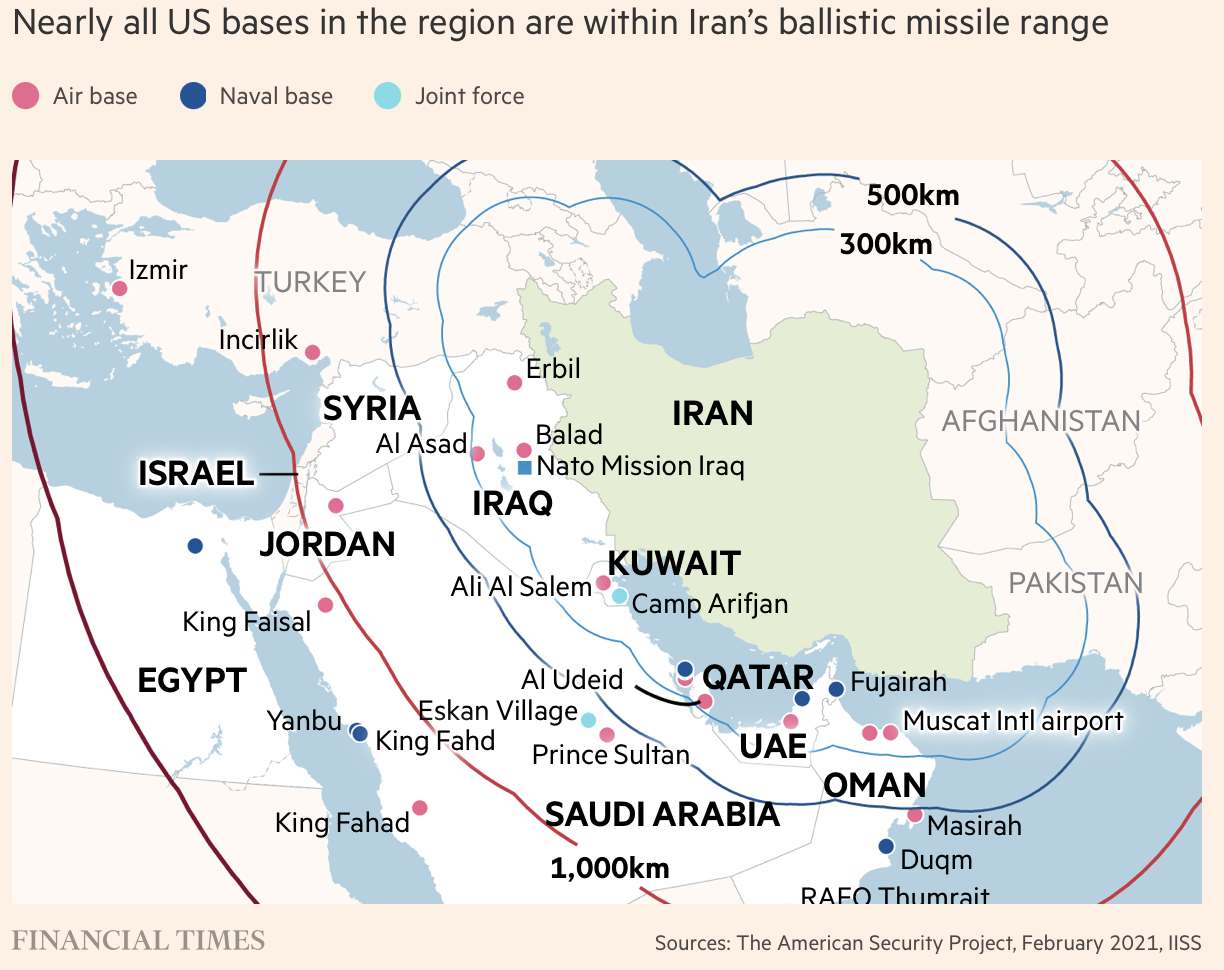
Aside from the immediate question of whether and when President Trump will attack Iran, the media and consensus that President Trump is in an impossible position is closer than we have ever seen. President Trump can either stand down, which is sure to cause great embarrassment and infuriate his Zionist and Christian evangelical supporters, or continue at the risk of the even more disastrous consequences of military failure. Some suspect that Trump has not been briefed on the worst-case scenarios, such as a prolonged closure of the Strait of Hormuz, the loss of an aircraft carrier, or Iran destroying Israel’s infrastructure to near-uninhabitable levels. President Trump would face devastating domestic headwinds if only a few helicopters crashed in Iran, killing or capturing the crew, or if Iran killed dozens of people in an attack on a U.S. military base in the Middle East. A map from the Financial Times shows how well-coordinated these outposts are with Iran’s range.
Ambassador to Israel Mike Huckabee’s inflammatory statement that Israel is willing to take all of the land it considers its Biblical right, and Special Envoy Steve Witkoff’s statement that the president does not understand why Iran has not surrendered, indicate that President Trump, and perhaps the military and CIA, assess Iran as far less powerful than the independent media community believes. The fact that Iran and the US had to negotiate a standoff to end the 12-day war is a kind of proof that Iran still had plenty of firepower that it had yet to unleash. Iran has been building up its stockpile of missiles and drones since that brief conflict, even before Russia and China rushed in additional surveillance and air defense support. In contrast, the United States has overcommitted, a weaponized version of a leaky bathtub, with existing contract commitments directing much, if not all, new production to Project Ukraine.
Whether the United States goes to war with Iran will reveal the true extent of the power of the Zionists and the Christian Gospel. The fact that President Trump has committed so much force and visibility to a potential attack does not preclude a sudden reversal. Trump, more than anyone, could simply and loudly scapegoat others who gave bad advice that he wisely chose to ignore and which saved American lives and property.
What binds President Trump is the devil’s bargain he made with Zionists and Christian evangelicals. Will he remain bought?
And did the weekend’s attempted invasion of Mar-a-Lago remind him that his personal downside extends beyond mere medium-term annihilation, as the Israel lobby not only deserts the Republican Party, but even collaborates against it in an effort to reassert Republican influence?
In a recent interview with George Galloway, Max Blumenthal explained why Israel remains focused on destroying Iran rather than thinking about growing up and acting like a normal country that gets along with its neighbors. Mr. Blumenthal confirmed what we said in a previous post: that Israeli leaders recognize that the deadline for the United States and Israel to take control of Iran is closing and may indeed have passed.
Israel learned during the Twelve Days War that its air defenses could not withstand sustained drone and missile attacks from Iran, so it demanded that Iran bow down and remove almost all arsenals that could reach its settler colonies. Private comments and comments in comment sections by people in contact with Israel suggest that the Israeli public, and perhaps most of its leaders as well, believe that the United States remains dominant, or at least dominant enough to defeat Iran in war. In my opinion, this is class prejudice, but regardless, Israel’s belief in the combined superiority of the United States and Israel is a major factor in the pressure to confront them now.
Other factors arguing for action sooner rather than later include the cost of keeping so many troops in the theater for so long (e.g. stripped of air cover in the Pacific), plus the impending midterm elections, President Trump and President Xi Jinping. Iran’s early April summit (from which President Trump would likely have to withdraw if the conflict escalates), and the possibility that with help from Russia and China, as well as its own efforts, Iran could improve its relative position even after weeks or months of delay. On the latter front, one ominous official claims that the presence of Chinese spy vessels near Iran is a thorn in Israel’s side. Submarines are one of Israel’s primary locations for storing nuclear weapons.
Many experts note that the US Air Force prefers to attack in the dark of the moon, and that window will not arrive again until mid-March. But when it comes to radar, it’s not clear whether that preference should carry as much weight as it used to. It seems unlikely that the United States will be able to manage the stresses of other operations and personnel maintenance in a war-ready manner past the mid-March launch date. But unless President Trump gives himself the illusion that he can attack Iran for a week or two and walk away with no consequences, mid-March will collide with the Xi Jinping summit. So, based on my amateur opinion, if President Trump feels he cannot afford to defy the Zionist faction, attacking within the next day or two seems to be his best option. Trump’s suspension from Congress on Sunday will give him a chance to show war skeptics that victory is not certain, and Israel supporters will likely ramp up pressure on him.
From Israel’s perspective, the midterm elections will create an even greater sense of crisis than President Trump. Republican defeat in the House of Representatives appears to be certain. Trump is expected to face further impeachment. It seems inconceivable that even the selfish Trump would start a war when his authority is so blunted and he has to fight again for political survival.
The aircraft carrier Gerald Ford’s highly embarrassing toilet problem, which is said to have kept sailors queuing for hours, does not appear to be a major hindrance to launching an attack on Iran. In fact, some experts argue that naval displays of force are far more of a burden than an asset to combat operations because they are large targets with limited attack capabilities.
Despite this, Trump continues to insist that he is the decider.
President Trump: “Everything that has been written about a possible war with Iran is written incorrectly and written that way on purpose. I am the one who makes the decision. I would rather have an agreement than not, but if we don’t make a deal, it will be a very bad day for the country, and a very… pic.twitter.com/UrGM9g5i0i
— Aaron Looper (@atrupar) February 23, 2026
Larry Johnson tells how he escaped on skis and what the signs were that the United States was in “war” mode.
…There are two other important indicators that are not yet illuminated that an attack is imminent. This means that NOTAMS and the US Embassy are ordering some or all of their employees to leave the country. As of February 23, only the U.S. Embassy in Beirut has ordered non-essential staff to leave the country, while U.S. embassies in the Gulf remain in place.
A NOTAM (Notice to Air Mission) is an operational document issued by aviation authorities that is constantly updated in real time. Below is a summary of the current NOTAM/airspace warning imagery for the Iranian region, based on the latest information available.
EASA CZIB 2026-02 R1 (issued January 16, 2026, valid until March 31, 2026): Operators should not fly within Iran’s Tehran FIR at any altitude. EASA has raised the possibility that Iran’s air defense system will be put on high alert due to US military action, increasing the possibility of misidentification. The presence of a wide range of weapons and air defense systems, combined with unpredictable state responses and the possibility of SAM activation, creates high risks at all altitudes.
Germany NOTAM B0082/26 (issued February 10, 2026, valid until March 10, 2026): German carriers are advised not to enter the Tehran FIR due to the dangerous situation and potential risks from the escalating conflict and anti-aircraft weapons.
USA SFAR 117 (effective through October 31, 2027): All U.S. airlines, commercial airlines, and FAA certification holders are prohibited from flying over Tehran FIR due to the risk of misidentification and unannounced military activity.
Italy NOTAM E2877/25 (valid until 15 March 2026): Italian airlines have been advised to develop robust risk assessments and contingency plans for all operations in the Tehran FIR.
UK AIP ENR 1.1: Continuing caution for UK carriers.
Canada AIC 21/25: Continued warning dating back to the downing of Ukraine International Airlines Flight 752 in January 2020.
As you can see, only Germany is advising German carriers to stay away from Tehran, rather than warning them.
The US is unlikely to launch an immediate attack due to the lack of embassies with reduced non-essential personnel and the limited number of NOTAMs.
In a new meeting with Johnson, Nima pointed out that the United States had instructed its staff to leave the embassy in Beirut, which Johnson called callous. But having non-essential staff in just one embassy doesn’t seem to be enough.
The State Department on Monday ordered the evacuation of non-emergency staff at the U.S. Embassy in Beirut, as tensions in the region rise over expectations that President Trump may soon order a major airstrike on Iran. https://t.co/KYmZV8VvK1
—Bloomberg (@business) February 23, 2026
I could write much more from various accounts of the White House debate over whether to go to war on Sunday. But the big finding here is that, as with the Iraq war, the military is worried about the downside, contrary to previous reports suggesting more confidence (perhaps cleverly leaked by hawks?).
However, this internal struggle is still ongoing. We will soon find out whether Israel’s influence over US decisions is as great as many fear.
____
1 When I worked as a consultant, I was careful to note the origins of important facts when reading literature searches. A tidbit of weight information, if simply repeated in five separate outputs, tends to be treated as an established quintuple, as an equally important data point taken only once.
