


Trump, whose deal fixation reveals a desire to score wins at others’ expense, instead keeps creating lose-lose outcomes, with tariffs and Iran as the biggest current examples.
We’ll turn to tariffs soon. On the Iran front, we are in the process of seeing Trump create a massive geopolitical and economic train wreck with his escalation. A conflict would severely harm the Islamic Republic but likely even more the stability of the region, the global economy, US pretenses to dominance, and even potentially the survival of Israel. Yet politically, as Max Blumenthal explains persuasively in a new discussion with George Galloway, Israel is not willing to allow Iran to become more powerful in the Middle East, as Iran has been doing despite concerted US pressure. Israel sees a shrinking window of opportunity to reverse that trajectory. Blumenthal contends that Trump is too hostage to Zionist and evangelical political forces to stare them down and somehow find an exit ramp.
On the tariffs front, it is critical to understand how destructive Trump’s bullying has been. Mind you, tariffs could be a useful mechanism as part of industrial policy. But the US in general and Trump in particular lacks the stick-to-it-ivness to pursue any long-term initiative to improve productive capacity. Tariffs are a long-standing Trump fixation, part of his desire to reduce the US to the 1890s, when robber barons ruled, and to exercise personal power.
And these tariffs have hurt US businesses and consumers. Even though the inflation bite was not as bad as predicted, tariff costs have fallen, as just about any economist with an operating brain cell had predicted, on buyers, meaning Americans. A New York Fed study found they bore 90% of tariff costs; the Kiel Institute found they bore 96% of the burden.
Mind you, this framing of who picks up the tab is a bit too anodyne. Small businesses, the traditional US engine of job growth, have been hit hard. For instance:
microcontrollershop.com – MicroController Pros LLC Close of Business Announcement
After 25 years in business, MicroController Pros LLC will close its business operations on December 13th 2025. We would like to express a heart-felt “Thank You” to all our loyal customers and vendors whom we had the pleasure of working with during this time. Goodbye and keep on having fun with programing & designing Embedded Systems.
Our company always had a large product selection from companies around the globe. Unfortunalty, the current, completely unpredictable, US import tariff policy, makes it impossible for us to continue to import products and make a living from it.
We do not have the manpower, nor the patience, lawyers & finances to fight US customs, Fedex, UPS, etc. over mis-classified goods, incorrectly imposed with 30% …50% import taxes. Imports are incorrectly classified, despite the fact that the correct classifications are being listed on all import papers. It is obvious, that the parties involved in handling imports are complety overwhelmed by the current tariff jungle chaos and lack the manpower, training & know-how to handle it – or is it just indifference towards doing the job right, as they do not have to foot the bill for their mistakes?
We all know whom we have to thank for the current situation – so no naming names. Everyone reading this, please draw your own conclusions. We are pretty sure that we are not the only small business impacted this way. You can make a change by voting in the next election. And remember, even if the alternative that you can vote for is also pretty pathetic – it can’t be any worse than what it is now. 😉
Before you try arguing that this closure is just an example of Schumpeterian creative destruction and surely this loss was more than offset by gains elsewhere, Trump’s tariffs have not produced “reshoring” as claimed. Manufacturing employment in 2025 fell by 108,500.
Even though most observers expected the Supreme Court to affirm lower-court rulings against the tariff mechanism to which Trump had become addicted, the International Emergency Economic Powers Act (IEEPA), Trump’s failing about after the 6-3 verdict against them came down indicated he was caught by surprise. He quickly made a whinging statement about the Justices that ruled against him, and scrambled to reassert his tariff macho:
In just 25 hours, the U.S. has had four tariff regimes:
1. Liberation Day Mark_II_re-revised
2. Liberation Day Mark_II_re-revised – IEEPA tariffs
3. Liberation Day Mark_II_re-revised – IEEPA tariffs +10%
4. Liberation Day Mark_II_re-revised – IEEPA tariffs +10% + 5%
— Justin Wolfers (@JustinWolfers) February 22, 2026
G. Elliott Morris explains how Trump is just digging his hole deeper with this reaction:
Hours after the decision, Trump decided that instead of taking the loss and moving on, he would instead “FAFO.” At a press conference, Trump called the majority justices — including three conservatives and two of his own appointees — a “disgrace to our nation” and his appointees “an embarrassment to their families.” The president announced new temporary tariffs of 10% on all imports via an obscure provision of a 1974 law, and then upped the rate to 15% via a post on his social media app. As of writing, a judge has not weighed in on the legality of these new taxes. Trump’s many other uses of emergency powers are in jeopardy, too.
But let’s focus on the narrow analytical question of how this will play with the public. In attacking the Court and doubling down on unpopular tariffs, the president has blundered a major political gift for the sake of ideology and a blind pursuit of his trade war….
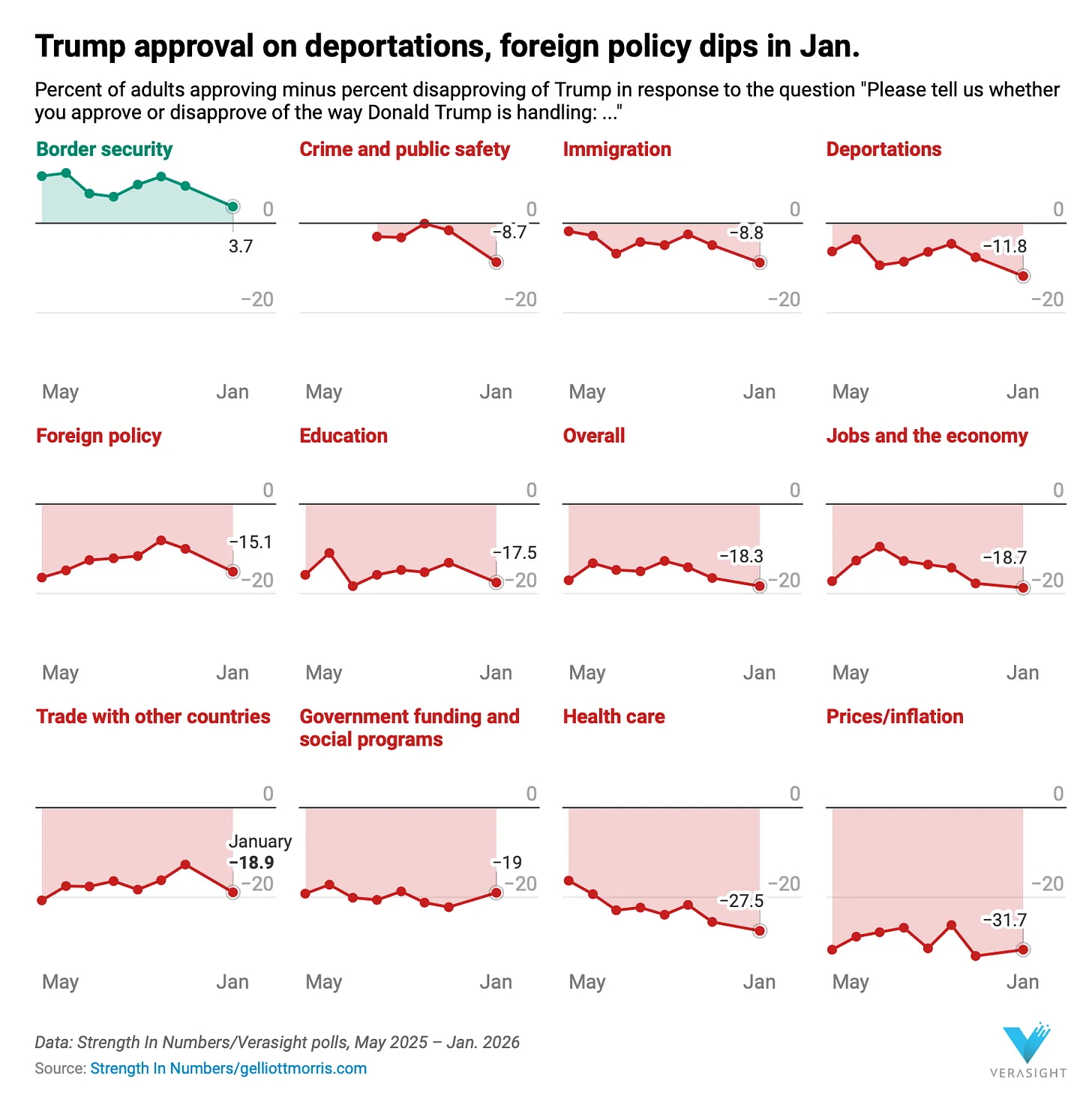
In our Strength In Numbers/Verasight polling, Americans say by a margin of 19 points that they disapprove rather than approve how how he’s handling trade and tariffs. President Trump gets a worse grade on tariffs than he does on handling foreign policy, jobs and the economy, or his job overall….
A -20 margin nationally is pretty devastating electorally. My MRP analysis showed Trump underwater on trade in 40 out of 50 states. These 40 states are worth 80 votes in the Senate and 483 votes in the Electoral College (486 when you count Washington, D.C.)
And it’s not just my polling showing this. A new survey from ABC News/Washington Post/Ipsos found 64% of Americans disapprove of Trump’s tariff handling. CNN/SSRS found 62% disapproval in January….
So by doubling down on tariffs, Trump is doubling down on a policy a supermajority of Americans disapprove of. If “tariff man” were a presidential candidate, he would lose by a larger margin in the Electoral College than Michael Dukakis did in 1988….
Now, consider also the impact of publicly attacking the Supreme Court justices who invalidated his executive orders.
A Marquette Law School national survey, conducted January 21-28, found that 82% of Americans — including 76% of Republicans — said the president must obey Supreme Court rulings. In April 2025, a Pew poll found that 88% of adults said the Trump administration would need to stop an action if the Supreme Court ruled it illegal. That included 82% of Republicans.
The Wall Street Journal focused on the uncertainty of yet more tariff whipsawing in its headline, Tariffs Are a Wild Card for the Economy Again. This is more damning than many might realize. Businesses hate uncertainty. It impedes planning, investment, and hiring, It has the effect of creating additional risks. That in finance terms means a higher risk premium, particularly for concerns exposed to international trade. That also translates into a higher discount rate for financial assets, above all equities.
Keep in mind, first that Trump has only 150 days tops for his 15% global tariffs unless Congress extends them. Given the data on how unpopular they are politically, that is na ga happen. And even these global tariffs could be overturned if challenged:
Section 122 of the 1974 Trade Act, on which Trump’s 10% tariff is based, does not apply in the current macro environment. A balance of payments deficit is not the same thing as a trade deficit. You cannot have a balance of payments if you have a flexible exchange rate, as the US… pic.twitter.com/ZX9pzrGBKa
— Peter Berezin (@PeterBerezinBCA) February 20, 2026
Seems hard for the President to rely on the 15 percent statute (sec 122) when his DOJ in our case told the Court the opposite: “Nor does [122] have any obvious application here, where the concerns the President identified in declaring an emergency arise from trade deficits, which…
— Neal Katyal (@neal_katyal) February 21, 2026
Michael Shedlock provided detail from case history that confirms these readings.1
Trump does have other tariff authorities, as we have described, so even more tariff changes are sure to be coming, given Trump’s love of them. But they are all much less sweeping than what Trump attempted with his “emergency” claim, as in are limited in level and time like Section 122, or require supporting evidence, like Commerce Department findings.
We will put aside the question of refunds. It is certain that the Administration will fight against them. Experts anticipate that it will be years before they will be adjudicated.
The body of the Wall Street Journal article includes estimates of effects:
Trump quickly imposed a 15% global tariff on imports. Accounting for exemptions and other trade deals, the new tariff brings the average effective U.S. tariff rate just slightly lower than where it was before the ruling. The Yale Budget Lab estimates it is now at 13.7%, compared with 16% before the ruling.
By comparison, over the course of 2025, the effective tariff rate soared over 10 percentage points, to levels not seen for decades….
The new tariffs can only stay on for a maximum of 150 days because of the specific law Trump used to impose them. Assuming they end after that time, the Yale Budget Lab estimates the average effective tariff rate will drop to 9.1%. Whether that level sticks is unclear, however, as Trump has vowed to add more duties using other legal means.
Some companies could decide that a floor on tariffs is here to stay and move forward with decisions like raising prices to transfer more of the tariff burden to consumers. Others may continue to put off investment and hiring….
“The whole uncertainty of tariff policy is really not favorable for employment or investment in the real economy,” said Gary Clyde Hufbauer, economist at the Peterson Institute for International Economics. “The temptation to postpone business decisions will be very strong.”…
Now, even with Trump imposing a fresh 15% tariff, estimated revenues will be cut by about half: The Lab estimates that Trump’s tariff regime will raise $1.3 trillion in total if 15% stays in effect for 150 days. In the scenario that the 15% becomes permanent, Trump’s tariff regime would raise $2.2 trillion….
The Trump tariffs before the Supreme Court ruling amounted to an average tax increase per U.S. household of $1,000 in 2025, and would have added an increase of $1,300 in 2026 had Ieepa stayed in place, according to the Tax Foundation. After the recent changes, the average burden per U.S. household will be $700 in 2026, according to a Tax Foundation forecast, about $250 of which will come from the new, temporary 15% tariff.
There is then the question of what this means for US trade partners. The Financial Times points out that the 15% global tariffs, assuming they even stay in place for 15 months, help China and Brazil, two countries particularly disliked by Trump, at the expense of nominal allies:
Donald Trump’s new 15 per cent global tariff will most greatly benefit countries he has singled out for heavy criticism, including China and Brazil, data analysis shows.
An examination of the new regime by independent trade monitoring body Global Trade Alert found that Brazil will enjoy the biggest reduction in average tariff rates — falling by 13.6 percentage points — followed by China, with a 7.1 percentage point reduction.
Long-standing US allies including the UK, the EU and Japan will suffer the largest hit from the new levy…
And that’s before getting to yet another downside of Trump’s practice of using his now-expired tariff authority as a bludgeon, regularly changing the level inflicted on a particular nation at whim. In keeping with that “nothing is final” mode, former US ambassador Chas Freeman pointed out that diplomats (notably Japan) had complained that they would show up for trade negotiations with the Trump team, which was in shakedown mode. They had no proposals at all, and would make demands that the other side make concessions. Freeman also stressed nothing was reduced to writing. One assumes it eventually was since most of these “deals” would be subject to ratification by the counterparty’s legislature
The refusal to formalize understandings much if at all is now going to bite Trump:
Even though many countries may still be too cowed by Trump to clear their throats and say their trade agreement was not ratified, and since Trump is changing terms on his end so they want to reopen those terms, the EU looks like it will do just that. From Bloomberg:
The European Parliament’s trade chief will propose freezing the ratification process of the European Union’s trade deal with the US until they’ve received details from President Donald Trump’s administration on its trade policy.
Bernd Lange, chairman of the parliament’s trade committee, said he’ll propose suspending legislative work on approving the so-called Turnberry Agreement at an emergency meeting on Monday “until we have a comprehensive legal assessment and clear commitments from the US.”
“Pure customs chaos on the part of the US government,” Lange wrote on social media Sunday. “Nobody can make sense of it anymore – only unanswered questions and growing uncertainty for the EU and other US trading partners.”
….
EU Is the Biggest Source of US Imports
Source: US Census BureauNote: Figures are sum of January-May in 2025
The deal struck last summer between Trump and European Commission President Ursula von der Leyen would impose a 15% tariff rate on most EU exports to the US while removing tariffs on American goods heading into the bloc. The US would also continue to impose a 50% tariff on European steel and aluminum imports….
After Friday’s supreme court ruling, Trump said he would institute a 10% global tariff to maintain protective trade measures on the rest of the world. On Saturday, he said he would increase that rate to 15%, stirring up more economic turbulence and uncertainty about US policy.
In other words, the tumult around Trump’s tariffs is even worse than you might imagine, and that will continue to impose all sorts of costs on hapless bystanders. But the intended message is clear: this is Trump’s world and he is going to continue to impose his will on as many as he can, irrespective of whether there is any prospect for good outcomes, even for him.
____
1 From Shedlock:
Please consider Case 2025-1812 Trump vs State of Arizona, Colorado, Illinois, Minnesota, Nevada, etc. Emphasis Mine
Plaintiffs’ attempts to defend the CIT’s actual reasoning—that “regulate … importation” authorizes only some tariffs—likewise fail. Plaintiffs rely on Section 122 of the Trade Act of 1974, but that statute cannot be read to narrow the President’s IEEPA authority. The statutes “coexist harmoniously.” Department of Agric. Rural Dev. Rural Hous. Serv. v. Kirtz, 601 U.S. 42, 63 (2024). Section 122 authorizes measures to address non-emergency balance-of-payments concerns. And IEEPA supplies a distinct, complementary authority to address balance-of-payments concerns and other issues when they constitute emergencies. Congress commonly provides overlapping authorities, especially in this context, and it is particularly clear that Congress intended these two statutes to buttress each other given that Congress enacted IEEPA after Section 122.
Even if Section 122 had been enacted after IEEPA, reading it as “‘displac[ing]’” part of the President’s authority under IEEPA would be improper unless plaintiffs could overcome the “‘strong presumption’” that the statutes “can coexist harmoniously.” Department of Agric. Rural Dev. Rural Hous. Serv. v. Kirtz, 601 U.S. 42, 63 (2024). Plaintiffs cannot carry that “‘heavy burden,’” id. Indeed, Yoshida articulates how the two statutes coexist: Congress “said what may be done with respect to foreseeable events” in various statutes, including Section 122, and “what may be done with respect to unforeseeable events in the TWEA,” 526 F.2d at 578 (emphases added), and now in IEEPA. That is, while Section 122 empowers the President to address non-emergency balance-of-payments concerns, IEEPA supplies a distinct, complementary authority to address emergencies, including but not limited to balance-of-payments concerns.
[The Killer Phrase]
Nor does it have any obvious application here, where the concerns the President identified in declaring an emergency arise from trade deficits, which are conceptually distinct from balance-of-payments deficits. See, e.g., S. Rep. No. 93-1298, at 89 (1974) (Senate report on Section 122, recognizing the possibility of “a large payments surplus” at the same time as “a large trade deficit”).
[Killer Phrase II]
Section 122 fully applies to balance-of-payments tariffs when the President has not declared an emergency and identified an “unusual and extraordinary threat,” 50 U.S.C. § 1701; IEEPA supplies additional power to address balance-of-payments concerns when those preconditions are met, and to address other concerns
TWEA authority had impliedly been limited by the later enactment of Section 122, that is now irrelevant because Congress enacted IEEPA after Section 122 (and Yoshida). As discussed above (at 5-6), it defies credulity to suggest that when Congress enacted IEEPA, using the same language that had been construed to authorize a balance-of-payments surcharge in TWEA, Congress meant to exclude such authority.
Finally, Section 122’s legislative history—which the private plaintiffs invoke, Br. 31—does not help them. Plaintiffs inaccurately paraphrase the Senate committee report on the statute containing Section 122 as saying Congress passed that provision “to provide ‘explicit statutory authority’ to deal with the type of emergency President Nixon declared in 1971.” V.O.S. Br. 31. In fact, the report says that Congress wanted the President “to have explicit statutory authority to impose certain restrictions on imports for balance of payments reasons,” S. Rep. No. 93-1298, at 88—not that Congress meant for the provision to cover “emergenc[ies]” (V.O.S. Br. 31).
