


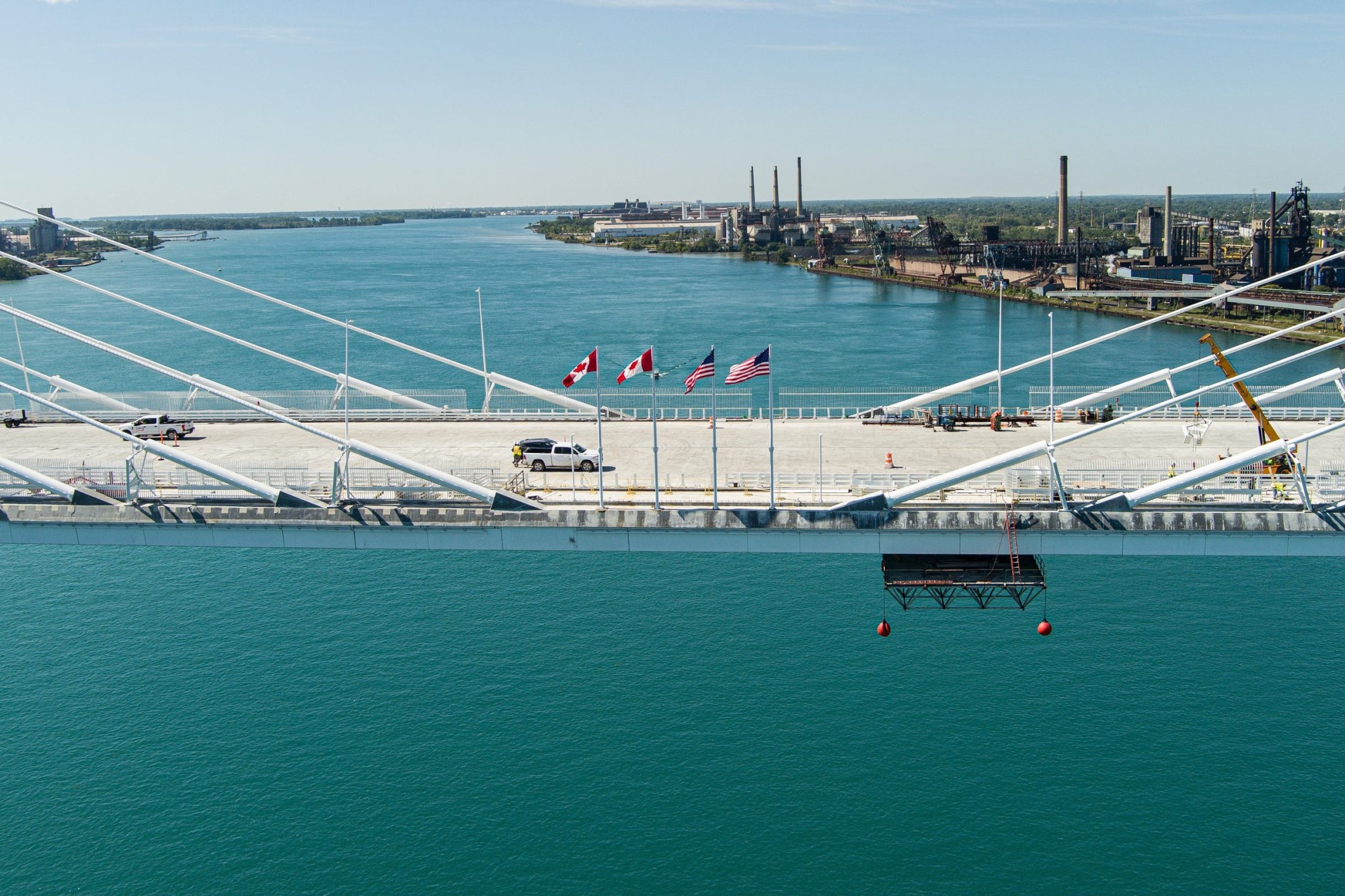
Construction of the Gordie Howe International Bridge took more than 2,000 days of construction, C$6.4 billion, and endless surveys and permits.
Stretching 1.5 miles between Detroit and Windsor, Ontario, this towering cable-stayed bridge replaces the privately owned Ambassador Bridge on one of North America’s busiest land borders, facilitating international traffic and trade. And it wasn’t that long ago that President Donald Trump cheered it on.
Shortly after their 2017 meeting, the man who called himself the “Builders’ President” issued a joint statement with then-Canadian Prime Minister Justin Trudeau, celebrating a shared focus on infrastructure. “In particular, we look forward to the early completion of the Gordie Howe International Bridge, which serves as an important economic link between our two countries,” they said.
The toll bridge was included in President Trump’s list of 50 priority emergency and national security projects for his first term in office. The company that owns the Ambassador Bridge aired a commercial aimed at President Trump in 2018, hoping he would kill the project, which would compete for tolls, but the president took no action. His Canadian ambassador lifted the ceremonial shovel at the groundbreaking ceremony.
And in 2019, President Trump signed a spending bill allocating the first U.S. funding for the project: $15 million for the testing and testing system. (Canada paid the full cost of the bridge project; tolls will be used to recoup that investment.)
But President Trump’s second term broke all kinds of presidential norms, including his own. He is now taking a more hostile stance toward Canada, and the ambassador in Ottawa is following his lead. President Trump no longer talks about “opportunities to build more bridges” with Canadians. Instead, he used the state of emergency to impose aggressive tariffs and reiterated that the country should become the “51st state.”
This week, without warning, President Trump targeted Detroit’s Gordie Howe Bridge, named after the beloved Canadian hockey player.
“We will not allow this bridge to open until America fully compensates us for everything we have given, and importantly, until Canada treats America with the fairness and respect we deserve,” Trump wrote in a lengthy Truth Social post.
It’s unclear how the bridge battle will end, but Michigan, a battleground state and co-owner of the bridge, is once again at the center of Trump’s strategy, potentially hurting the state’s economy.
“Michigan is a car state,” said Brent Pilarski, business manager for the Michigan Workers’ District Council, which oversees unions representing people who worked on bridges and in motor vehicle facilities. Parts are constantly crossing borders, and “they have to arrive on time, otherwise we can’t build the cars,” he said.
So far, there are no signs of cracking in support for Trump among Republican leaders.
Asked about the bridge at a press conference, US Senate candidate Mike Rogers, a Trump supporter, said: “Obviously we want to see the bridge open.” But he said commerce is still going on even without the bridge, and “I hope the president has some leverage to stop thousands of Chinese cars from flooding over that bridge.”
“Canada has tainted our trade relations for decades,” Michigan Sen. Jim Runestad, chairman of the Michigan Republican Party, said in a statement to ProPublica.
“They won’t buy American booze, making it nearly impossible for farmers to sell a lot of their produce in Canada while pandering to Chinese EVs,” Runestad said. “President Trump represents American workers and farmers, and this is clearly the beginning of negotiations that will finally make trade fair with Canada for Americans.”
But the state’s two U.S. senators, both Democrats, pushed back.
“We have wanted this bridge for years because it will benefit our economy,” Sen. Gary Peters said in a statement. “This is another example of the president undermining Michigan businesses and workers.”
“Cancellation of this project will have serious repercussions,” Sen. Elissa Slotkin said in a statement. “It will increase costs for Michigan businesses, make supply chains less secure, and ultimately reduce jobs. With this threat, the president is punishing Michiganders for a trade war he started.”
Former Republican governor Rick Snyder, who was instrumental in building the bridge, also criticized President Trump’s threat. In his column, he wrote that the bridge was “a big deal for America.”
He added that if the bridge’s opening is delayed or canceled, the biggest winners will be the Ambassador Bridge Company and its owners. “Every day they make more money at our expense.”
In his post, President Trump suggested that the bridge is jointly owned by Canada and the state of Michigan, but that Canada owns it solely. He accused former President Barack Obama of allowing the building to be built “virtually without any American materials,” when in fact American materials were used.
The post echoes claims made in a 2018 ad by the company that owns the Ambassador Bridge, part of a bitter decades-long battle against the competing bridge. Hours before Trump’s Feb. 9 post, billionaire owner Matthew Morrone met with U.S. Secretary of Commerce Howard Lutnick, who later discussed the matter with Trump on the phone, according to The New York Times. A message sent by ProPublica to an email linked to Moroun went unanswered. The bridge company had no comment.
Since its opening in 1929, the Ambassador Bridge has remained an important link. However, due to limited highway connectivity, trucks must pass through traffic lights. And as the 2022 Canadian motorcade protests that blocked bridges demonstrated, single corridors for commercial traffic are fragile. (The 95-year-old Detroit Windsor Tunnel is too small for today’s trucks.) The Gordie Howe Bridge not only offers a modern, publicly owned option, but also has direct freeway interchanges on both sides of the border. It is scheduled to open later this year.
A 2018 ad urged President Trump to review the presidential permit issued more than a decade ago that allowed construction of the Gordie Howe Bridge. This week, the administration told reporters that President Trump may do so in the future.
And when asked this week how the bridge’s opening could be hindered, Michigan Rep. Debbie Dingell pointed to the need for staffing by the Department of Homeland Security. DHS Secretary Kristi Noem assured Michigan senators during her confirmation hearing last year that she would not ignore the new bridge. “Our focus is making sure we are properly staffed,” Noem said.
DHS, the White House, and the Department of Commerce did not respond to ProPublica’s inquiries.
In response to Trump’s threat, Canadian Prime Minister Mark Carney told reporters that Trump has asked U.S. Ambassador to Canada Pete Hoekstra to “serve as a facilitator for conversations on and around the bridge.” Hoekstra, a former U.S. congressman from Michigan, has mirrored President Trump’s hostile second-term approach toward Canada during his diplomatic missions.
He has remained silent on the bridge, at least in public. The embassy in Ottawa also declined a request for comment.
