


For more than a decade, Americans have been ceremonially and persistently convinced that the United States fielded the most powerful military in history. This claim is repeated so often that it has acquired the status of self-evident truth. It is invoked to reassure allies, deter adversaries, legitimize global efforts, and calm domestic suspicions. But beneath this triumphalist narrative lies a quieter, less comfortable reality. The U.S. military is steadily shrinking in size, becoming less responsive, bloated at the top, and putting a price on its armament and endurance. What remains is an army optimized for demonstration, security, and bureaucratic self-preservation rather than one optimized for sustained combat with adversaries. Much has been written about individual failures, including procurement failures, talent shortages, and readiness crises. However, a comprehensive examination of the problems in the U.S. defense posture reveals not a temporary mismanagement but a systemic hollowing out of capabilities masked by narrative inflation.
Shrinking power behind expanding claims
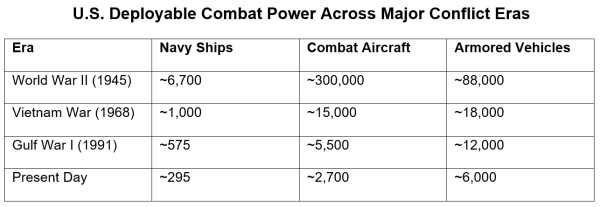
The long-term decline of the US military organization is significant. At the height of World War II, the United States deployed thousands of naval ships, hundreds of thousands of fighter planes, and tens of thousands of armored vehicles. Currently, the U.S. Navy operates fewer ships than before World War I, and the capabilities of its fighter jets and armored forces have fallen to a fraction of what they were during the Cold War.
A common argument is that modern platforms are so capable that fewer platforms are needed. This argument breaks down in wartime. Precision does not eliminate wear and tear, and software does not replace logistics. Also, sophisticated systems fail just as surely as crude ones, and repair or replacement often takes much longer.
World War II B24 bomber production – over 18,000 built
Preparation: harsh reality
Readiness is even worse when total inventory is an issue. Across the Navy, Air Force, and Ground Forces, only about half of the nominal platforms are fully mission capable at any given time. The remainder are partially functional or undeployable due to maintenance backlogs, parts shortages, or postponed depot operations. As a result, the effective operational strength of the U.S. military is much smaller than the stated total strength.
Preparations are increasingly being fueled by cannibalism, overworked crews, and an epic maintenance effort that borrows capabilities from the future to meet present obligations. This is not resilience. It’s vulnerability under stress.
Leadership inflation and accountability decline
As force size and readiness decreased, the density of senior leaders increased. The ratio of flag officers (generals and admirals) to non-commissioned officers more than tripled after World War II. This reflects bureaucratization and risk aversion rather than operational necessity.
The failure of a major weapons program rarely ends a career. Strategic bad decisions are absorbed into process language and rotating command structures, undermining the principle that with authority comes responsibility. In World War II, senior commanders were dismissed or sidelined if their performance did not meet strategic needs. Today, the rise of the generals involved in the U.S. military debacle reflects a system that values adaptability and survival over results.
Cost explosion and mass reduction
Modern US combat systems have become devastatingly expensive. Inflation-adjusted unit costs for ships, aircraft, and armored vehicles have risen explosively over time. As unit costs rise, force size should fall and attrition becomes strategically unacceptable. A military that cannot afford to lose its equipment cannot credibly threaten to go to war.
F-22 stealth fighter – 750 planned, but only 187 built
B-2 stealth bomber – 132 were planned, but only 21 were built.
Nuclear forces and the limits of substitution
Some may argue that nuclear forces diminish the meaning of traditional force structures. This reverses the logic of deterrence. Nuclear weapons deter all-out war precisely because they make conventional miscalculations devastating. They do not replace weakened conventional forces. When these powers are overextended or misrepresented, the risk of error increases. An empty conventional force backed by nuclear weapons is unsafe and more dangerous because it reduces decision-makers’ room for maneuver and increases the cost of mistakes.
Advanced conventional weapons and the fantasy of technological escape
Nor can appeals to conventional advanced technologies such as hypersonic weapons, unmanned systems, artificial intelligence, and next-generation platforms save the prevailing narrative. In many of these areas, the United States has not established a decisive technological advantage and in some cases lags behind its peers in operational development. While hypersonic systems, long-range precision strikes, integrated air defense, and large-scale unmanned warfare are moving from experimental concepts to routine force elements elsewhere, U.S. efforts remain fragmented, delayed, or limited to prototypes. Thus, rather than being a source of advantage, technological sophistication has become a compensatory narrative that further increases unit costs, reduces productivity, and deepens intolerance of loss. The result is not superiority, but a narrowing of actual capabilities masked by claims of future superiority.
What now?
The natural reaction to this diagnosis is to ask what to do. However, this question assumes that the problem is one of policy coordination rather than structural constraints. In reality, there are only three paths you can take, none of which are comfortable.
1. Rebuild at scale.
In theory, the United States could try to rebuild mass and resilience. That means accepting a decline in technological ambitions, canceling prestige programs, investing in industrial capacity, and prioritizing quantity over quality. In practice, this will require decades of sustained political effort, rebuilding industrial capacity, restructuring defense procurement, and a willingness to dismantle entrenched institutional incentives. There are no advocates for such a reset.
2. Reduce commitment to capacity.
The second option is to reduce global efforts to match current force structures. This means reducing forward deployments, explicitly prioritizing theater, and abandoning universal deterrence. This approach makes strategic sense but is politically harmful. It looks like a decline, angers allies accustomed to U.S. guarantees, and contradicts elite identity narratives. But it is the only option that truly harmonizes ends and means.
3. Continue.
The third path is the most likely as it does not require a decision. It is accompanied by increasingly rhetorical inflation, shrinking operational returns, increased escalation risk, and increased reliance on bluffs. It does not end with a sudden collapse, but with the probability of catastrophic miscalculation steadily increasing.
The need for military realism and responsibility
The problems described here are not the result of a single poor program, management, or strategic choice. It is the cumulative result of decades of incentives that reward technical ambition over productivity, the reassurance of narrative over experiential explanation, and career continuity over responsibility. As a result, militaries have been optimized to provide desk deterrence, symbolic posturing, and rhetorical reassurance, and have quietly lost their ability to provide effective defensive and offensive capabilities. The real challenge now is not to rebuild advantage, but to manage risk in a situation of overextension and illusion. This requires not a quick response but a true calculation of force. Realistic prioritization rather than universal promises. Humility towards escalation control. Real responsibilities within military institutions. and suppressing the narrative in place of triumphalist reassurance.
conclusion
The danger of military drawdowns is not just that the United States may lose future wars. It is that decision-makers, allies, and adversaries alike have been conditioned to believe that reserves of strength and resilience exist where they no longer exist. In such an environment, escalation becomes easy, restraint appears unnecessary, and risks are systematically mispriced. Nuclear weapons and advanced technology do not reduce this risk. They magnify the problem by increasing the likelihood of miscalculation while narrowing the scope for recovery. History has little mercy for great powers that replace material preparation with boasting. Military systems that cannot tell the truth run the risk of abuse and operational failure. A country that made the mistake of taking the Electricity Court’s stance on disasters.
