


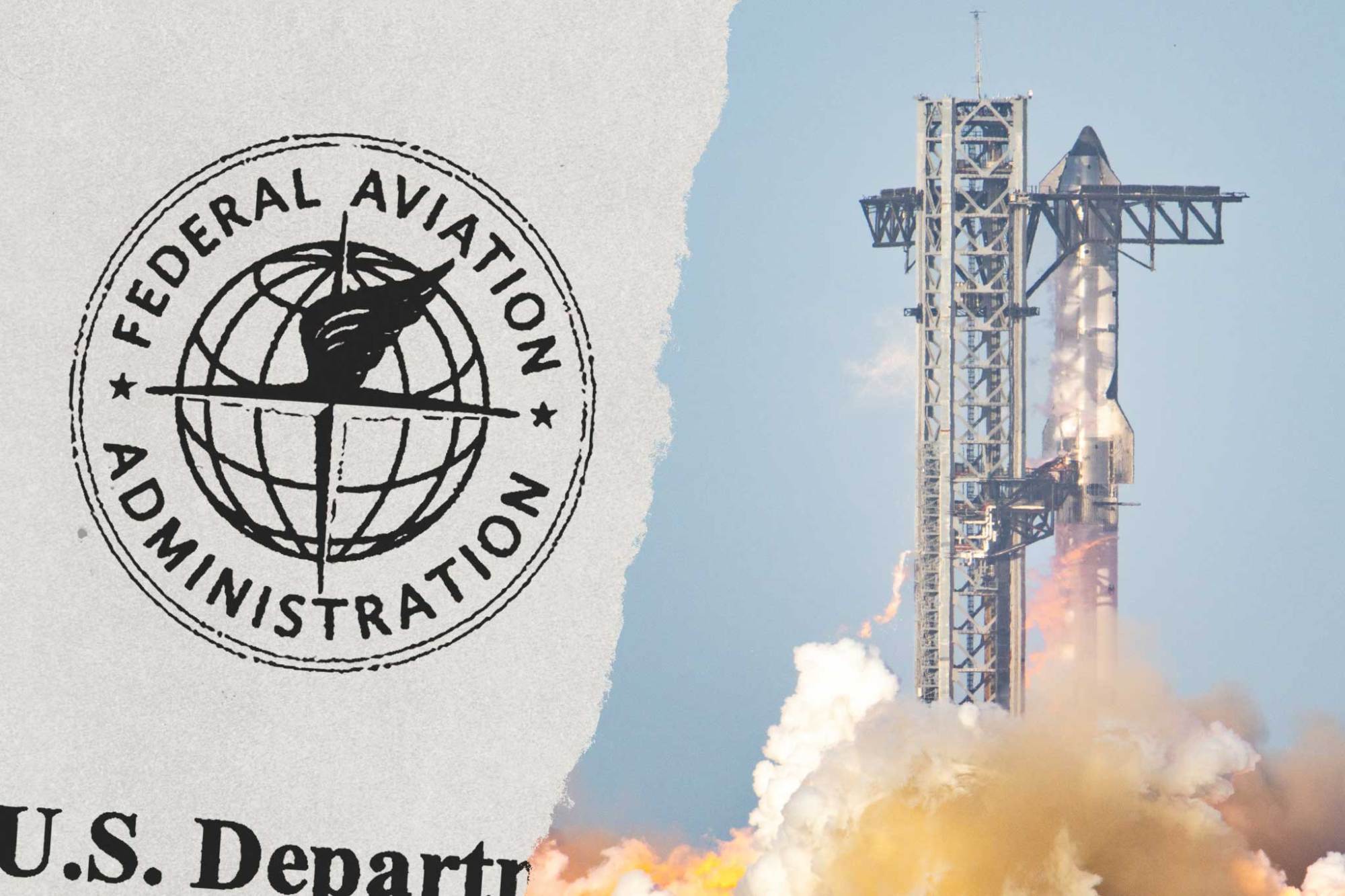
The US Federal Aviation Administration issued a stern warning that rocket launches could “significantly reduce the safety” of aircraft, and urged pilots to prepare for the possibility of a “catastrophic failure” resulting in a dangerous debris field.
The official notice, known as a safety alert to carriers, was dated Jan. 8, the same day ProPublica released an investigation showing how pilots scrambled to avoid debris after two of SpaceX’s Starship giant rockets exploded in crowded airspace last year. The warning was an acknowledgment that travelers were at risk at a time when the FAA suddenly imposed a no-fly zone to force air traffic controllers to steer planes away from falling rocket parts.
The FAA has issued about 245 such safety warnings to the aviation industry over the past 20 years on issues ranging from runway threats to mechanical issues, but last month’s warning was the first to address the dangers to aircraft during rocket launches and atmospheric re-entry, according to the agency’s website.
Companies like SpaceX have ramped up their launches in recent years. Starship, which is scheduled to land on the moon any day now, followed a flight path that would take it over busy commercial airways in the Caribbean Sea.
The FAA previously told ProPublica that it “limits the number of aircraft at risk and the likelihood of a catastrophe is extremely low.” It also said it was taking steps to keep pilots informed and ensure aircraft safety during launches, including establishing emergency no-fly zones known as debris response areas.
These steps were also pointed out in the January warning.
“Past events indicate that in the event of an actual accident, debris falls within or near the DRA, and pilots should use extreme caution near these areas,” the notice reads.
But it warned that debris could fall in areas where the FAA has no-fly zones, such as international airspace over the ocean, where radar cannot reach, and said pilots would need to have “added situational awareness” to avoid debris fields there.
Neither SpaceX nor the FAA have released data showing where debris fell after last year’s Starship explosion.
SpaceX did not respond to a request for comment. The company has previously said it has learned from its mistakes and that Starship’s reliability improves with each test. “SpaceX prioritizes public safety to protect people on the ground, at sea, and in the air, and is committed to using our airspace responsibly during launch and reentry,” the company said on X in December.
Last year, the FAA granted SpaceX permission to launch Starship up to 25 times a year from its base in Texas. However, after repeated setbacks, only five of the giant spacecraft were launched in 2025.
In its warning, the FAA asked aircraft operators to “evaluate the impact of space launch and atmospheric reentry on planned flight routes and take appropriate precautions.” These should include ensuring there is enough fuel in case air traffic controllers place them in a holding pattern, officials said. A ProPublica investigation found that after the January 2025 Starship incident, multiple planes began running low on fuel, and at least one declared an emergency and crossed the no-fly zone to arrive at the airport.
The world’s largest pilots union told the FAA in October that the incidents cast doubt on whether “appropriate processes” are in place to respond to unexpected rocket accidents. “It is likely that debris will strike the aircraft, resulting in catastrophic loss to the aircraft, crew, and passengers,” wrote pilot Steve Jungelis, the group’s aviation safety committee chair.
The FAA adjusted its practices after last year’s failed launch, but is still allowing SpaceX to launch more Starship prototypes in the same airspace, putting further stress on an already taxed air traffic control system, ProPublica reported. The Wall Street Journal reported in December that at least two planes flew so close to each other after the explosion that air traffic controllers had to intervene to prevent a collision.
The FAA did not respond to requests for comment on this story.
Airlines for America, a trade group for major U.S. airlines, said it is “committed to ensuring the safety of all flights, especially as the number of space launches increases.” The association said in a statement that airlines are working with both the federal government and private space companies to ensure airspace safety.
New Jersey Rep. Nellie Powe, ranking Democrat on the House Transportation and Infrastructure Committee’s Aviation Committee, praised the FAA for issuing the warning, saying the Trump administration “must protect American travelers from all threats, including space launches and atmospheric reentry operations.”
“Achieving complete safety requires careful and forward-looking attention to detail by federal agencies and close collaboration with operators,” Pou said. “I’m encouraged that the FAA is demonstrating both here.”
A Jan. 8 article in ProPublica showed how quickly aircraft had to maneuver to clear large areas of airspace after SpaceX’s Starship exploded over the Caribbean Sea in January and March of last year.
Analysis of flight tracking data showed that in each incident, multiple planes were in the expected debris zone at the time of the explosion, and other planes likely had to veer to avoid falling debris. Pilots reported seeing streaks of flame far above the horizon.
Before the third Starship launched last May, the agency decided to take a more conservative approach and proactively close more airspace in advance. This mission also failed, with the rocket’s booster exploding over the Gulf and its upper stage blown up over the Indian Ocean.
SpaceX is currently seeking FAA approval to add new orbits to Starship’s orbit. The plan is for the rocket to fly over land in Florida and Mexico, as well as airspace over Cuba, Jamaica and the Cayman Islands, potentially disrupting hundreds of flights.
The company said it is committed to public safety as it accelerates its launch pace, writing in a post on X: “We continue to work to more efficiently integrate Starship into our airspace while ensuring maximum public safety.”
