


The United States is making the same kind of blunders regarding Iran that led to the Ukraine war. They mistake long-term patience for tolerance in the face of provocations of weakness, elevating aggression to the level of existential threats and provoking conflicts that consume arms, treasure, and prestige.
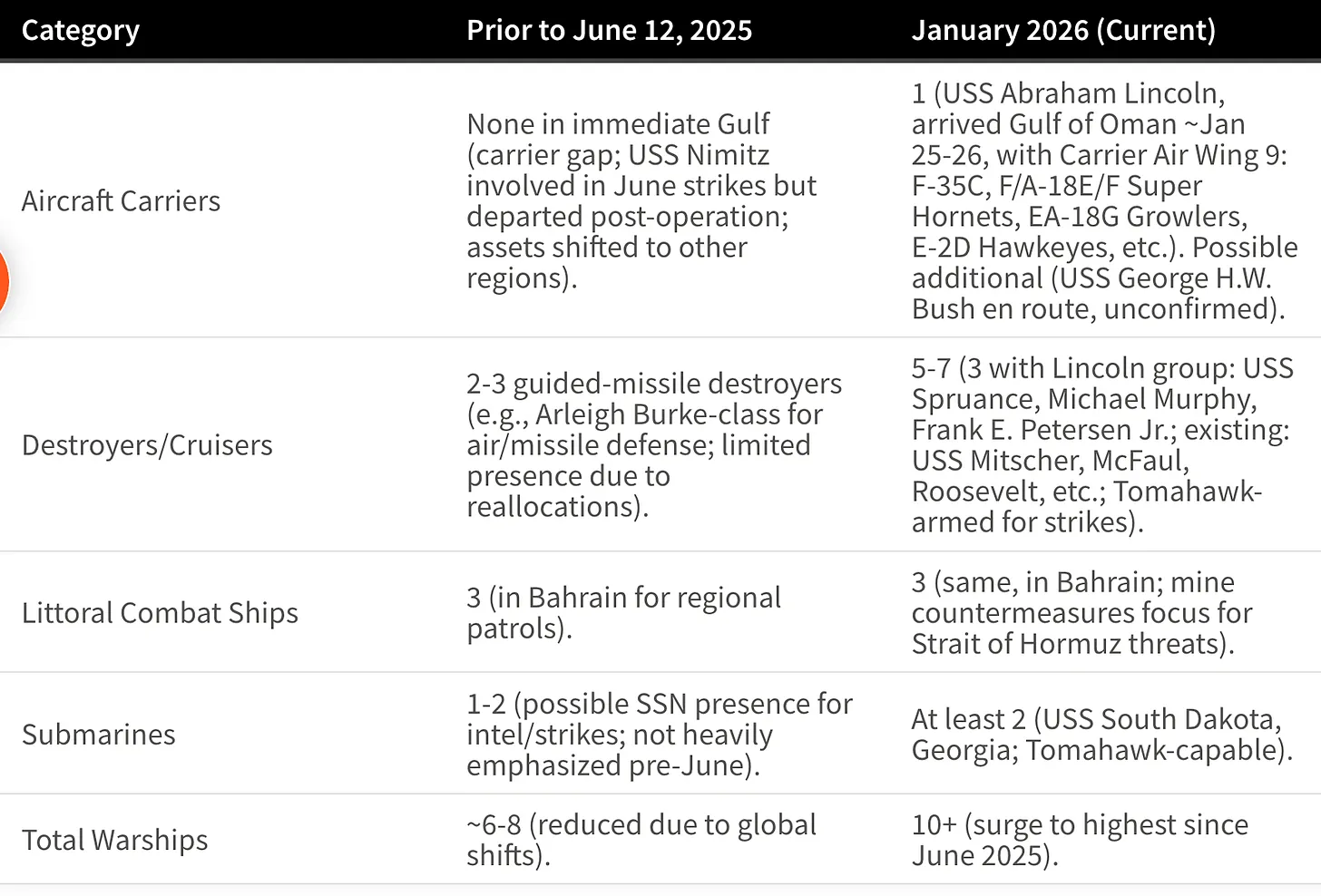
President Trump likes to use TACO to gain fairly small concessions and then make major threats before backing down, but the movement of so much munitions into what is expected to be an Iranian theater of war makes that kind of withdrawal difficult. Larry Johnson provides the following table in his must-read book, Three Scenarios for a U.S. Attack on Iran.
Let me tell you, we saw an earlier variant where Biden was too soft on the Houthis when President Trump claimed he was going to capture them. President Trump more or less turned tail after the fiasco of Operation Guardians of Prosperity.
The small problem here is that the Trump administration is making demands on Iran that amount to an abdication of national sovereignty. Written by Mostafa Najafi:
The United States has set four preconditions that make any compromise impossible: 1. A complete halt to its nuclear program and the delivery of all 3.67%, 20%, and 60% enriched material, 2. Limits on the range and number of ballistic missiles, 3. A commitment not to equip or support resistance forces, and 4. Recognition of Israel!
The conflict between Iran and the United States has passed the stage of negotiation and compromise, and its fate will be determined by war.
This is again similar to the US proxy war against Russia. A negotiated solution is not possible as there is no negotiation overlap between the positions of both parties. Either Trump blinks or the two sides face off.
President Trump’s foray into Iran is based on new intelligence that portrays Iran as more vulnerable than ever. From Monday’s New York Times:
President Trump has received reports from multiple U.S. intelligence agencies showing that the Iranian government’s position is weakening, according to people familiar with the information.
These reports suggest that Iran’s government’s hold on power is at its weakest since the 1979 revolution that toppled the Shah.
The protests that erupted late last year have shocked Iranian officials, particularly in areas of the country that authorities consider to be strongholds of support for Iran’s supreme leader Ayatollah Khamenei, according to reports.
Those who follow independent media have likely seen accounts that vehemently refute the claim (a memo made before the latest information was published) that even those within Iranian society who were unfavorable to the regime are rallying behind the regime in the face of an existential threat to the US/Israel. Massive pro-government rallies in response to widely perceived violent protests instigated by foreign countries support that idea. Scott Bessent even bizarrely railed against the US for its role in the collapse of Iran’s currency, which was the direct cause of the initially peaceful demonstrations. This means that the currency collapse was not due to fundamental factors and that Iran’s prospects are not as dire as the episode suggests.
Independent commentators have also criticized Iran for effectively disabling some 40,000 Starlink terminals, powered by Russian support and smuggled into Iran to coordinate protests. Russia is also reportedly strengthening Iran’s air defenses. But such efforts will take time and may not yet be of much use in the face of an impending U.S. attack. 1
At issue are reports in the Israeli press that Israel is concerned about the possibility of Iran negotiating. From Al-Monitor:
From Israel’s perspective, agreeing to a nuclear deal rather than pursuing regime change could be seen as a missed historic opportunity.
Some Israeli politicians and senior leaders of Israel’s security establishment are becoming increasingly disillusioned with the idea of overthrowing the Iranian leadership…
But this remains a minority view in Israel, especially in the wake of recent threats by pro-Iranian militias in Iraq and Hezbollah in Lebanon, which have warned that a U.S. attack on Iran would set the entire region on fire.
And more specifically, from Israel Hayom:
Israel cannot stand by and let the situation take its course. The United States must do everything in its power to avoid being tempted to engage in negotiations with the Iranian regime. The mere existence of political dialogue provides the regime with a lifeline to the protesting public and suggests the possibility of an agreement to ease conditions.
Political negotiations would seriously undermine prospects for regime change at the very moment the possibility of regime change is taking shape, even before considering the additional benefits that the regime could derive from such negotiations. Past experience provides little reason for optimism about what can be achieved in negotiations with the Iranian regime.
They are trying to achieve their goal of balkanizing Iran. Alastair Crook told Daniel Davis that Israel had even prepared draft constitutions for new regions such as Balochistan in Persia, in the hope that the last wave of Western protests would topple the government.
In fact, the noise coming through Israel’s Channel 14 reporting on last weekend’s CENTCOM-IDF meeting is that the US is not (yet) committed to regime change (click for Google Translate).
और देखेंAnswer: Answer: Answer:
אין מוע
LONDON
יחד עם זאי
האמריקניל רוצים פעולה נקייה, מהירה ולא יקרה
התכלית – התמקדות במי שפגע באזרחים ומפגינים
ah…
— No | No Harrell Bitton Rosen (@BittonRosen) January 25, 2026
But British pranksters are giving Iran hawks in the US even more ammunition.
https://t.co/3wMBCb8CJU
— Jonathan Cook (@Jonathan_K_Cook) January 29, 2026
President Trump is making his usual noises, but here Iran wants a deal, but not one, or at least nothing remotely resembling the terms offered.
❗️Iran’s Foreign Minister Abbas Araghchi said that Iran has not presented any negotiation offer to the United States, noting that various mediators are reaching out and several countries are in contact with Tehran in what they claim to be good faith efforts, but no decisions have been made… pic.twitter.com/yyNO9aOwGo
— Daniela Modos – Cutter -SEN (@DmodosCutter) January 28, 2026
Foreign Minister Araguchi just went to Turkiye. Alastair Crook also noted that Iran has made clear that if the US attacks, it will not only attack US air bases, but also close the Strait of Hormuz to Saudi Arabia and other Gulf states for at least three months. Saudi Arabia said it would not allow the US to use its airspace for any attack against Iran. These states and others are reportedly asking President Trump to negotiate. However, Mr. Trump took a non-negotiable position.
And the Iranians are now publicly refusing to save face for Ford 2.0, another performative U.S. attack.
Our brave military is ready to put its finger on the trigger and respond immediately and forcefully to any invasion of our beloved land, air, or sea.
The valuable lessons learned from the Twelve Days War will help us grow stronger, faster, and… pic.twitter.com/kEuj0dmBaK
— Sayed Abbas Araghchi (@araghchi) January 28, 2026
____
1 Scott Ritter takes a minority view. He claimed on Glenn Deesen’s channel IIRC that the regime change effort that seemed to have failed was actually successful. His contention is that Iran’s crackdown exposed their methods and operations, and that he was specifically involved in those efforts. The problem I have with this view is that opponents of U.S. destabilization argue that 1. Iran has nearly destroyed the network Israel has built over the years, especially through tracking the people who were operating the Starlink terminals, and 2. Iran shutting down Starlink and cutting off the external internet will limit its ability to share information internally, thus giving a good picture of Iranian operations.
