


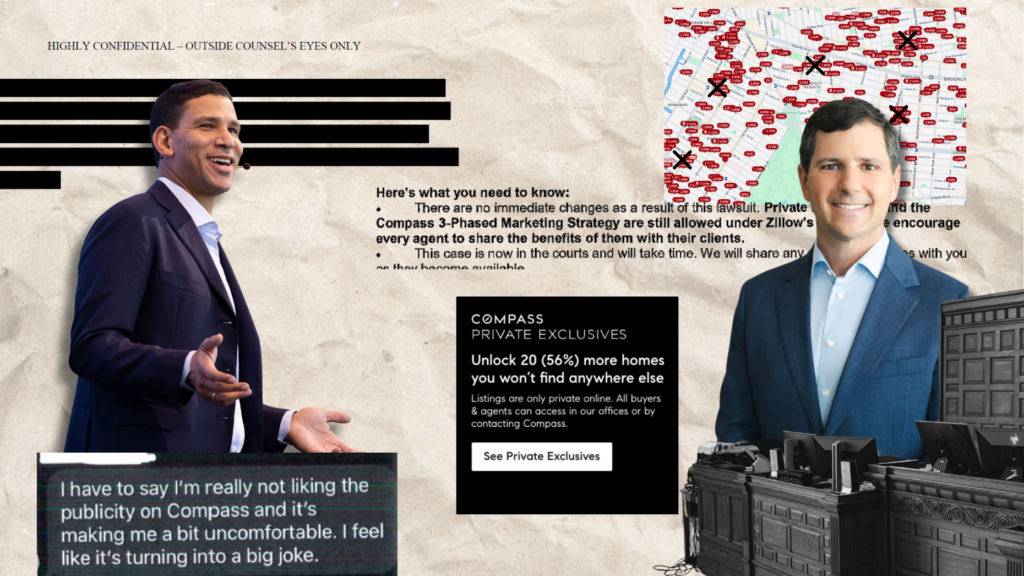

As the battle for supremacy continues in the real estate industry, Compass has set its sights on what it deems “organized real estate.” A huge amount of newly released documents reveals how they prepared to fight.
Internal messages, presentations and depositions were filed in court as part of an ongoing antitrust lawsuit between Compass and Zillow. Compass and Zillow each filed more than 1,000 pages. And internal Compass documents included in Zillow’s filing reveal a never-before-seen look inside the nation’s largest brokerage firm, at a time when it was on the front lines of the industry’s biggest debates.
The documents show, among other things, that Compass defines “organized real estate” as the National Association of Realtors, the multiple listing service, and Zillow. Compass executives said the three companies worked to control the real estate agents’ business operations, and the real estate agents wanted to grow as part of a competitive strategy.
“If we have twice as much market share in all markets, you can no longer bully us,” CEO Robert Refkin said on a May 13 call with Compass sales leaders and established brokers. A record of the call is included in the document.
The documents also highlight initial confusion over whether a brokerage’s listing strategy violated a policy created and enforced by Zillow that prohibits listings from the portal if they are not listed on the MLS and are available on Zillow within 24 hours of marketing.
The policy takes aim at what some at Compass have dubbed the “Compass flywheel,” in which brokerages hire top agents, give them access to services and lead generation tools, and build a stable inventory that sets them apart from competitors.
The documents show that Compass executives are keen to advance the way Compass markets its listings.
Compass declined to comment for this article, citing ongoing litigation.
Compass agents had doubts.
While Compass presents a unified public platform, the document documents internal discussions among Compass agents about the company’s candid stance on listings originating from outside the MLS.
“We are going to file a fair housing lawsuit,” one person wrote in a text thread, referenced in an April email included in the document.
“I would like to know exactly what syncing to Zillow can and cannot do, such as being able to monitor things,” the document shows another agent writing. “None of this is good for a lot of bad press. A client told me yesterday that what he saw on the news made Levkin seem greedy.”
Others, especially brokers of record, defended Levkin as a vocal leader in the industry trying to make change.
Additionally, several members of the Compass agent community noted that they have no plans to utilize the company’s three-tier marketing strategy since May, just before Zillow began enforcing a ban on listings that have been publicly sold for more than a day without being added to the public MLS.
“It’s been portrayed in the media that Compass wants a double end,” one person wrote, “and that’s the problem.”
double end trading
The document also suggests that Compass is indeed benefiting from its three-tier marketing strategy.
In its April slide, Compass cited an assumption by some in the industry that brokerages seek to reap profits from both sides of a trade, a concept known as double endings.
“Yes, for the past two years, as a result of pre-marketing, [transactions] “The compass is on each side,” the slide states. [transactions]Given Compass’ recent focus on three-tier marketing. ”
Compass slides showed that off-market sales were 72% more likely to have double ends than on-market transactions.
Confusion, issues, ChatGPT
In preparation for the April board meeting, Compass was preparing to tell board members that Zillow’s policy “does not affect Compass Private Exclusive.” The company continued to share that message internally, including when it sued Zillow in June.
“Private Exclusive and Compass’ three-tier marketing strategies are still allowed under Zillow’s ban, and we encourage all agents to share their benefits with their clients,” Rory Gorod, president of growth and communications, said in an email to sales leaders, brokers of record and others on June 23, the day Compass sued Zillow to prevent enforcement of the policy.
However, documents show that Compass agents knew for some time that if they started as Compass Private Exclusive, they would be banned from listing on Zillow.
“Zillow says sae” [Private Exclusives] will be prohibited,” a representative in Philadelphia wrote to Compass executives on May 20, the day Zillow revealed what its standards included.
“We were confused at first about what that meant because we don’t market it publicly as a private-only product. So we asked, ‘Does this affect us?’ And Compass said no,” Kelly Carr, a Compass representative in Pennsylvania, said in a deposition with Zillow’s legal team. The deposition is included in the document.
The document also shows Compass developing a strategy that it claims could benefit from not being listed on the nation’s largest real estate search portal.
Compass presentation notes included in the document said, “You don’t have to use Zillow.”
An April 12 email from Levkin to Compass’ then-chief of staff Will Hardy also appears to show him using ChatGPT to compile a list of “reasons why using Zillow isn’t necessarily in their best interest.”
Recognize the power of Zillow
In addition to downplaying Zillow’s power and effectiveness in selling homes, Mr. Levkin took a defiant stance against the portal in internal statements and testimony.
“I am not a slave to Zillow,” Mr. Refkin said in the affidavit.
However, several Compass executives privately acknowledged that few sellers choose to put their homes up for sale at the risk of being banned from the portal.
“Homeowners say, ‘I’m scared,’ and agents say, ‘I’m absolutely terrified of the Zillow ban and how scary it is,’ and they feel like they have a gun to their head and say, ‘If you don’t list your property within 24 hours.'” [and] If you sell it anywhere else, we won’t allow it.” Will they cancel the listing for that? Yes, they are scared,” Levkin also said in his sworn testimony.
Gorod said in an affidavit that most sellers would consider risking a Zillow ban “very harmful.”
“Theoretically it’s possible, but no one would do it, because it would be very harmful for your listing not to be published.” [Zillow] “That’s the way it looks in the eyes of a lot of people, the vast majority of sellers in this country. So the number of sellers who don’t have their home listed on Zillow, even though they might agree to go live soon, is probably close to zero,” Gorod said.
“Black Box”
This document confirms that there has been some room for interpretation. Zillow believes that Compass’ displaying a box indicating the number of private exclusives it has in a particular market is a public service announcement that violates its policies.
Compass, on the other hand, argues that the so-called “black box” must be included to avoid fair housing violations. Mr. Levkin wrote in an April email that he indicated to consumers that the brokerage had more properties available and verified that there were no fair housing violations.
“Has the situation changed now that Zillow has learned that it believes all private and exclusive listings on Compass violate listing access standards because of the black box?” Zillow’s lead attorney asked Carr.
“Yeah,” Kerr said, adding later. “I’m hesitant to put it on a private exclusive show because I’m afraid it won’t be featured on Zillow.”
“How would you feel if you learned that Compass executives have known since at least May that Compass Private Exclusive products violated Zillow’s listing access standards because of the black box?” Tuttle asked.
Email Taylor Anderson
