


Eve is here. This post provides an informative overview of the subsidies provided by the Chinese government not only nationally but also locally. Despite the headline’s focus on industrial subsidies, the authors also show the level of disaster relief and social welfare subsidies, and counterintuitively show that agriculture receives the greatest amount of subsidies in total.
Written by Shuhui Xiang, Xinran Ying, PhD candidate at Geneva Graduate School, and Yuan Zi, assistant professor of economics at Geneva Graduate School. Originally published on VoxEU
China’s industrial policy has become a central flashpoint in global trade debates, but systematic evidence of what China is actually doing remains lacking. This column reveals five key findings from a new database covering China’s WTO subsidy notifications from 2001 to 2022. (1) Direct fiscal support has stabilized at around 0.8% of GDP since 2008. (2) China actively uses subsidies, and the sustainability of its policies is remarkable. (3) FDI-promoting subsidies have decreased, while industry-specific innovation-focused support has increased. (4) Wealthier and more open states provide more local subsidies. (5) Agriculture has an advantage in terms of amount, but subsidies to the manufacturing industry are modest. These patterns reveal how China’s subsidy strategy has evolved from attracting foreign capital to technological independence.
China’s rise as a manufacturing powerhouse has been accompanied by persistent debates about the role of government intervention (e.g., Aghion et al. 2015). Although specific policies such as tariffs and FDI regulations are well documented, systematic evidence on China’s broader industrial subsidy situation remains lacking. This gap is important. Subsidies are one of the most direct and powerful tools governments use to shape economic activity, and understanding China’s approach is essential not only to trade and development policy, but also to discussions about geopolitics, industrial competition, and technological security.
A recent paper (Xiang et al. 2025) addresses this gap by digitizing and analyzing China’s official subsidy notifications to the WTO from 2001 to 2022. This is the first systematic, non-estimated dataset on industrial subsidies in China based on authoritative government sources. This database covers 1,256 unique programs (260 at the central level and 996 at the local level), including direct fiscal expenditures, subsidies, interest discount programs, and tax incentives. After checking the notification against the original domestic documents, we document five findings.
Fact 1: Subsidies have expanded, but direct financial support has remained stable.
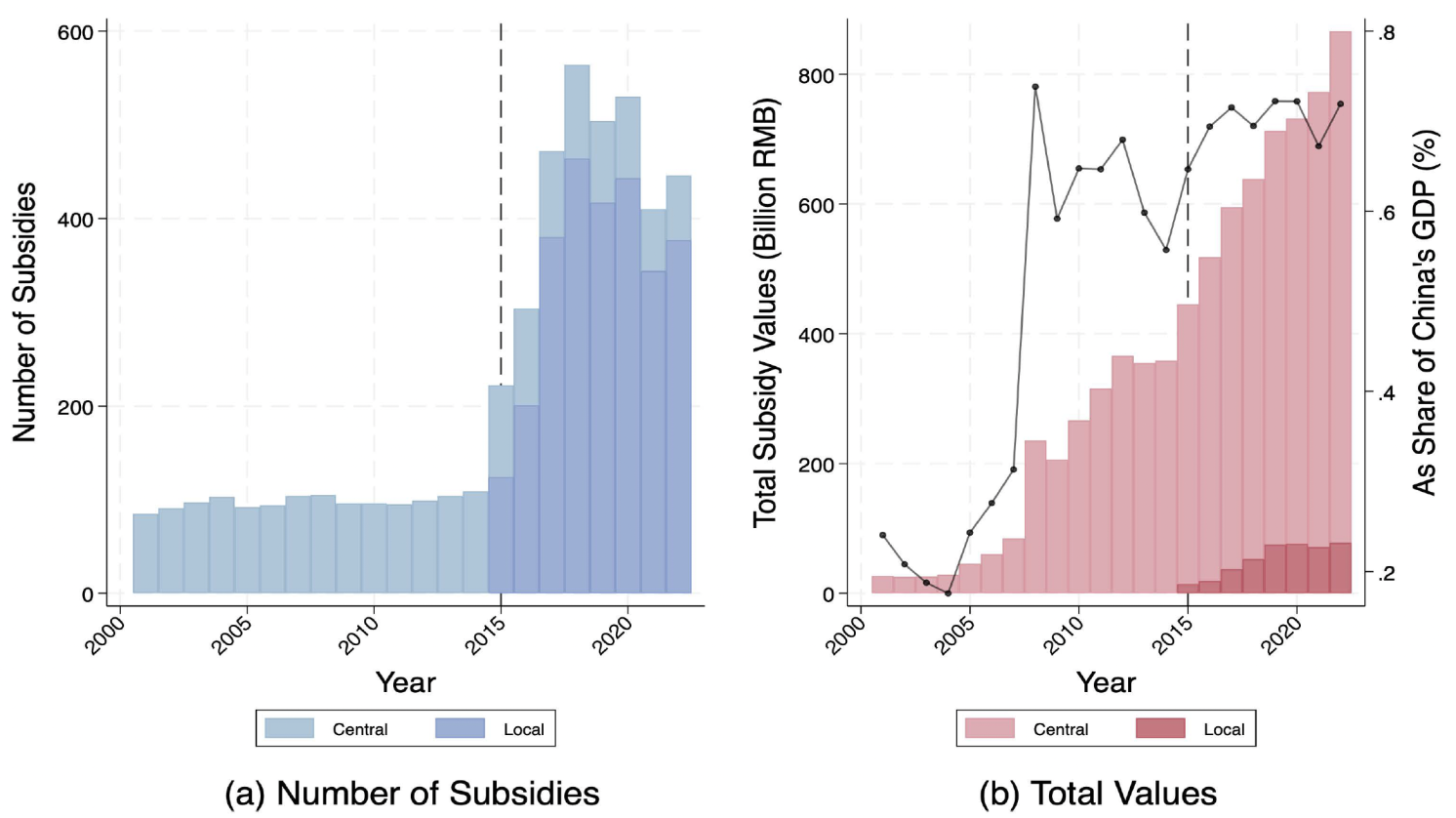
The incidence of subsidies in China has increased over time, with the number of active programs increasing from 85 in 2001 to 446 in 2022. However, the surge since 2015 largely reflects changes in reporting methods. This is because China has started including sub-central programs at the request of the EU. However, local subsidies are only a small part of central government support (Figure 1a).
More important is the evolution of the subsidy value shown in Figure 1b. Direct fiscal support increased sharply after 2004, coinciding with a significant expansion of rural support policies, peaked around 2008, and has stabilized at around 0.8% of GDP since then. This figure is broadly in line with OECD estimates and suggests that while China remains an active user of subsidies, the scale of direct budgetary support has not continued to grow.
Figure 1 Annual trends in subsidies in China
Note: Panel (a) reports the annual number of central and local subsidies since 2015. Panel (b) shows the total amount, and the line graph shows the share of subsidies in GDP (right axis).
Fact 2: China has shown remarkable policy tenacity, subsidizing more than expected given its level of development.
As shown in Figure 2a, a comparison of the subsidy notifications of WTO members reveals notable patterns. Plotting the number of subsidies against per capita GDP in 2019-2020, China (and the United States) have adopted far more programs than their income levels would suggest.
Although some developing countries may be underreporting their subsidy performance, what is even more noteworthy is the sustainability of China’s program, visualized in Figure 2b. On average, central subsidy schemes last more than 10 years, and about 10% last more than 20 years. This durability reflects a long-term strategic approach in which subsidies act as sustained investments rather than temporary interventions, demonstrating strong institutional commitment and policy continuity across political cycles.
Figure 2 Subsidy period and number of grants
Note: Panel (a) plots the number of subsidies against GDP per capita in 2019, with variables shown on a logarithmic scale and axis labels reported in levels. Panel (b) plots the period of China’s central subsidy program implemented from 2001 to 2022.
Fact 3: From FDI promotion to technological independence
The purpose of China’s subsidies has changed significantly over the past 20 years. As shown in Figure 3, programs promoting foreign direct investment accounted for nearly 10% of central government subsidies in 2001, but this has declined to just 3.3% in 2022. Conversely, industry-specific subsidies more than doubled over the same period, from 7.9% to 16.3%. Innovation and technology have consistently been heavily subsidized.
Figure 3 Changes in goals, 2001 and 2022
Note: Panels (a) and (b) report the incidence of central government subsidies in 2001 and 2022, respectively. Percentages indicate each target’s share of total subsidy for a given year and government level.
This redistribution reflects China’s strategic shift from trade and FDI liberalization to technological independence and industrial sovereignty. Seen from this perspective, early openness to foreign investment may have been an intermediate step rather than an end in itself. The timing and scale of this change corresponds with, and also helps explain, escalating trade and technology tensions with the West.
Fact 4: Wealthier, more open states give out more subsidies.
This data also allows us to examine sub-central subsidies reported since 2015. Figure 4 shows that states that are wealthier and more trade-oriented provide significantly more local government support. This pattern suggests that local subsidies may strengthen rather than reduce regional disparities within China. This reflects wide fiscal disparities, as the richest regions spend several times more per capita than the poorest regions.
Figure 4 Number of subsidies and local government indicators
Note: Panel (a) plots the average number of subsidies (2015-2022) against average GDP per capita (2010-2014), and panel (b) plots against trade openness across 31 states. Both variables are displayed on a logarithmic scale with pre-log axis labels.
Fact 5: Agricultural subsidies dominate in terms of amount.
Finally, Figure 5 shows that measuring subsidies by number and amount gives a very different picture. Based on the number of programs, scientific research, agriculture, and manufacturing are the most frequently subsidized sectors. However, the distribution of value is a different story. Agriculture is the overwhelming majority, receiving nearly 40 trillion yuan, or about 47% of the total funding, over 21 years. The construction industry ranks second, reflecting China’s emphasis on infrastructure investment.
Figure 5 Subsidy by sector
Note: Panel (a) reports each sector’s share of total grants, and panel (b) reports each sector’s share of total grants.
In particular, direct manufacturing subsidies are relatively modest, both in aggregate and per program. On average, manufacturing subsidies are less than twice as large as R&D subsidies and less than one-twentieth as large as agricultural subsidies. China’s decentralized and small-scale support for manufacturing stands in contrast to the perception of large-scale “big push” interventions. This pattern is more closely aligned with recent studies that emphasize gradual approaches to technological upgrading (Juhász et al. 2024) and flexible policy toolkits (Bloom et al. 2019).
conclusion
An analysis of China’s official subsidy notices reveals a more nuanced picture than is typically portrayed in policy debates. Although China does make active use of industrial subsidies, direct financial support has remained stable since 2008. The strategic focus has decisively shifted from attracting foreign investment to promoting domestic innovation and technological capabilities. Contrary to popular belief, manufacturing subsidies are relatively modest and decentralized.
These findings have implications for both trade policy and development economics. For trading partners concerned about Chinese subsidies, the data suggests a focus on evolving goals, not just the size of aid. For developing countries looking to China’s experience, the evidence points to a sustained and flexible approach rather than one-off interventions.
We hope that this database and other recent efforts (Juhász et al. 2022, Fang et al. 2025) will enable further research on industrial policy, including comparative analyzes with other countries and systematic evaluation of subsidy effects.
See original post for reference
