


Conor here: A valuable reminder, especially ahead of the holiday gathering season.
By Jeff Masters who worked as a hurricane scientist with the NOAA Hurricane Hunters from 1986-1990.In 1995, he co-founded the Weather Underground, and served as its chief meteorologist and on its Board of Directors until 2012. Originally published at Yale Climate Connections.
Maybe you’ve been sitting in church or listening to a lecture that, though provocative, sends you into a dozing dreamland, despite getting plenty of sleep the night before. Or maybe you’ve fought to stay awake during a long car ride. These experiences often have as their root cause a common factor – poor indoor air quality caused by a buildup of carbon dioxide because of poor ventilation.
In addition to sleepiness, poor indoor air quality has been shown to reduce productivity, negatively affect test scores, and spread disease. Simple ways to improve your indoor air quality, like replacing furnace filters and running air purifiers, can have a huge impact on your health and quality of life.
Poor Air Quality and Ventilation Harm Your Health
Outside air has a carbon dioxide, or CO2, level of about 427 parts per million (ppm), but that percentage can get much higher in closed spaces. As CO2 increases, brain function suffers, with school-age children more vulnerable than adults. At CO2 levels over 1,000 ppm, common effects include sleepiness, reduced productivity, and significant declines in the ability to perform complex cognitive tasks. In one study, adults subjected to CO2 levels of 1,000 ppm saw a 15% drop in test scores; a 44% drop occurred at CO2 levels of 2,500 ppm. High CO2 makes you dumber!
At CO2 levels above 2,000 ppm, we often see headaches, fatigue, poor concentration, increased heart rate, and nausea. So it is important to keep the levels of CO2 in indoor air low through improved ventilation.
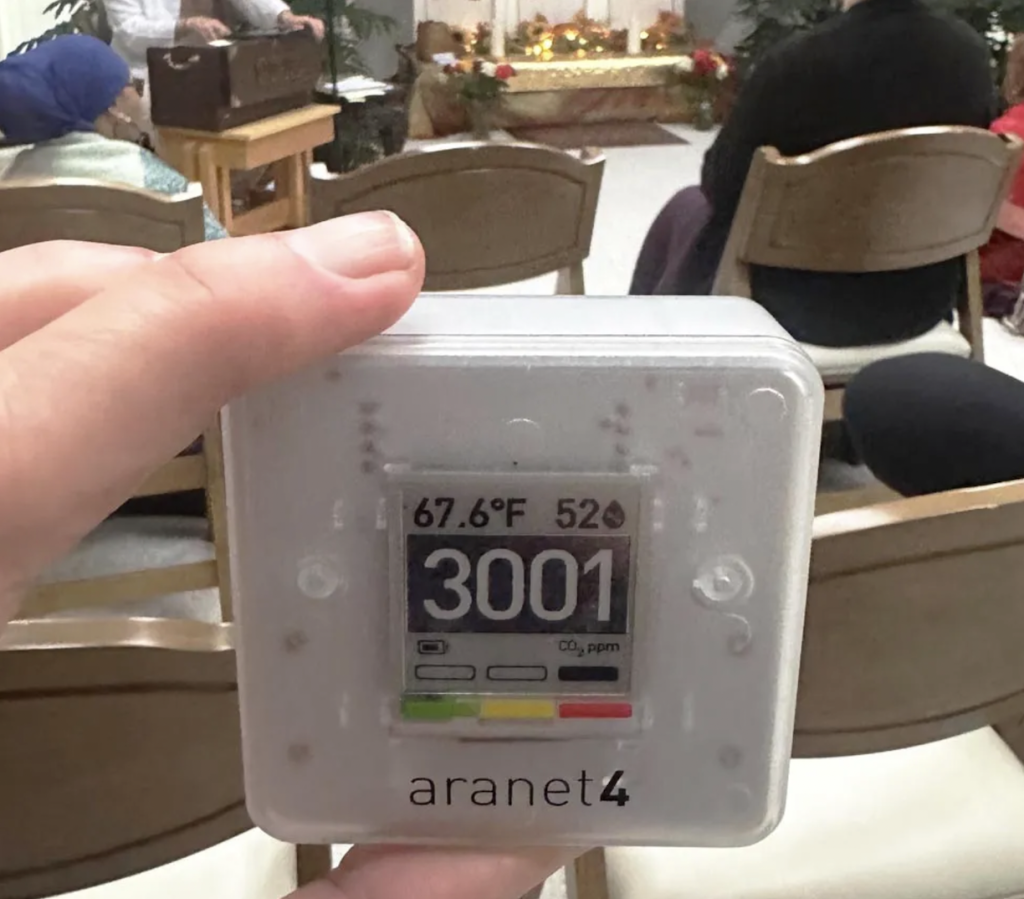
I carry around a portable CO2 monitor to test indoor air quality, and it is shocking to see how many buildings have CO2 levels far in excess of the recommended 500-800 ppm level. I’ve measured CO2 levels of 2,000-3,000 ppm in numerous places, including restaurants, doctor offices, meeting rooms, churches, and airplanes. With climate change likely to drive people to spend more time indoors to escape increasing heat and wildfire smoke, ensuring that we have good indoor air quality is essential.
If you haven’t listened to this yet, I highly recommend it. All your basic questions about indoor air quality — what are the pollutants? what tech can keep them out? what policies do we need? — are answered.
[image or embed]
— David Roberts (@volts.wtf) November 22, 2025 at 9:23 PM
Unfortunately, there are no federal regulations regarding the maximum CO2 level allowed in buildings. According to indoor air quality expert Dr. Georgia Lagoudas of Brown University, the only U.S. requirement for building ventilation is that 80% of building occupants do not complain about odor, but CO2 is both invisible and odorless. Thus, as long as it doesn’t smell bad, indoor air in the U.S. is allowed to have health-damaging levels of CO2 – plus volatile organic carbons (VOCs) such as formaldehyde, and all six of the outdoor pollutants that the EPA regulates: PM2.5 (fine particles less than 2.5 microns in diameter), ozone (O3), carbon monoxide (CO), nitrogen dioxide (NO2), sulfur dioxide (SO2), and lead.
The American Society for Heating, Refrigeration, and Air Conditioning Engineers (ASHRAE) writes building codes (including indoor air quality standards) that are adopted across the world. Still, these standards are optional and are only adopted at the state and city levels. Unfortunately for air quality, during the 1970s energy crisis, many buildings were designed to be more airtight, with less outdoor air ventilation, in order to improve energy efficiency. The result was an increase in “sick building syndrome” – a situation in which the building occupants feel unwell – because of poorly-ventilated buildings with high CO2.
Meanwhile, we know that most respiratory pathogens, such as COVID and flu, are airborne and will spread more easily when there is poor ventilation. CO2 is used as a marker for the portion of air in a space that was exhaled from people’s lungs. At a CO2 of 800 ppm, 1% of the air you breathe in comes from someone else’s breath, and your COVID risk rises dramatically. At 2,000 ppm, the percentage climbs to 4%. At that level, it’s pretty likely that if anyone in a crowded indoor space has a respiratory illness, they will spread it to multiple people.
There has been an increasing push in recent years to improve indoor air quality, since people spend over 90% of their time indoors. There are relatively cost-effective ways to improve indoor air quality that have a huge return on investment. In September, a Global Pledge for Healthy Indoor Air was made at the United Nations, culminating in the formation of the Global Commission on Healthy Indoor Air. This pledge is the first international declaration that clean indoor air is a fundamental human right. In the U.S., the Clean Indoor Air Initiative, led by Brown University, says that cleaner indoor air could cut respiratory disease by 80%, reduce student absences by 13%, boost workplace productivity by 11%, and provide a $23 billion annual benefit to the U.S. economy through a 35% decrease in sick leave.
Monitor CO2 and PM 2.5 to Know Your Hazards
It’s a good idea to invest in a portable CO2 monitor to judge your indoor air quality; Boston public schools monitor every classroom for CO2, CO, and PM2.5. There are many commercially available ones available; one of the ones most widely used by indoor air quality professionals is the Aranet4 (I have one and have been very happy with it). They cost $179 on Amazon.
An excellent low-cost CO2 monitor (under $40) is the INKBIRD PTH-10C (see review here). My wife has also made a cheap homebuilt CO2 sensor for about $30 using Arduino technology (see instructions here) that we plug into a USB battery and carry around. There’s a free app called Sensirion MyAmbience that will show graphs of the data.
Ikea is now selling in Sweden its Alpstuga air quality sensor, which measures CO2, PM2.5, temperature, and humidity for only $32. The company has not announced when it might be available in North America.
Great overview of CO2 monitoring. High CO2 is associated with COVID spread, and causes sleepiness, headaches, fatigue, and lower test scores (15% drop at 1000 ppm; 44% drop at 2500 ppm). I’ve found 2000-3000 ppm in restaurants, doctor offices, meeting rooms, churches, and airplanes.
[image or embed]
— Dr. Jeff Masters (@drjeffmasters.bsky.social) December 5, 2025 at 12:52 AM
Similarly, it’s important to monitor and reduce your indoor PM2.5 levels. Globally, more than 4 million deaths per year are estimated to be triggered by outdoor PM2.5 air pollution, according to the World Health Organization.
But the toll could be much higher. A 2019 study concluded that outdoor air pollution from PM2.5 and ozone causes about 8.8 million premature deaths globally each year, with the large majority of the deaths from PM2.5. A 2021 study found that PM2.5 pollution from burning fossil fuels kills 8 million people per year. An additional 3.2 million deaths per year occur globally because of indoor PM2.5 pollution, primarily from burning dirty fuels for cooking. A premature air pollution-related death typically occurs about 12 years earlier than it otherwise might have.
According to a 2018 study done by the Health Effects Institute, a U.S. nonprofit corporation funded by EPA and the auto industry, PM2.5 pollution in the U.S. contributes to approximately 87,000 premature deaths per year from a wide range of causes, such as cardiovascular disease, cerebrovascular disease, lung cancer, and dementia. But other research has put the number higher: A 2019 study estimated that PM2.5 killed 197,000 people per year in the U.S., and a 2018 study estimated the toll was 230,000-300,000 deaths, with 40-60% of that total potentially from exposure indoors, primarily from outdoor air that had high PM2.5 levels being brought indoors and not properly filtered.
HEPA filtration is very effective at removing PM2.5, and I highly recommend that you make sure you have enough air filtration occurring to reduce indoor PM2.5 levels below an AQI of 50. Thus, you should buy a PM2.5 monitor to check your indoor PM2.5 levels. Breathesafeair.com is a great source of reviews, and you should also check out the performance tests done by the South Coast Air Quality Management District of California. They have an extensive database showing how well the most popular home monitoring devices perform compared to expensive official units. I have a portable Temtop PM2.5 sensor (which is now sold for $60 on Amazon with the capability to also measure VOC and formaldehyde). My 3-year-old Temtop has been valuable in letting me know when to run extra HEPA indoors, but I’ve been unhappy with the random spurious spikes of a factor of three in AQI lasting one to two minutes that it often gives. For outdoor PM2.5, I highly recommend the PurpleAir sensor, which I’ve had for over 10 years (see review here).
Monitor your indoor PM 2.5 levels to understand your filtration and ventilation needs. The South Coast AQMD tests how well the most popular home monitoring devices perform compared to expensive official units: www.aqmd.gov/aq-spec/sens…. And this site has some super-detailed reviews:
[image or embed]
— Dr. Jeff Masters (@drjeffmasters.bsky.social) December 11, 2025 at 12:14 AM
Five Ways You Can Improve the Safety of Indoor Air
1. Replace your furnace filter
Furnace filters will remove small particles (including viruses) but will not reduce your CO2 levels. Consult with your HVAC maintenance person to make sure furnace filters in all buildings are changed regularly. When our area gets one of those nasty Canadian wildfire smoke episodes, we have to change the filters even more frequently than usual, since the smoke makes the filters fail faster than regular air gunk does.
The efficiency with which filters remove particles in the air is given by the Minimum Efficiency Reporting Value, or MERV, scale. The higher the MERV number of the filter, the better it is. ASHRAE recommends using a minimum MERV-13 filter, which is at least 85% efficient at capturing particles in the 1 to 3 micron (µm) size range, which includes fine dust, wildfire smoke, pollen, mold spores, bacteria, and the respiratory aerosols that harbor COVID and flu viruses. A MERV-14 filter is at least 90% efficient at capturing those same particles.
In contrast, a typical MERV-8 filter is only around 20% efficient in the 1-3 µm size range. One study found a 42% lower chance of getting COVID in a space using MERV-13 filtration compared to MERV-8 filtration. However, older ventilation systems are often limited to using a MERV-8 filter, since their fans have trouble forcing enough air through the MERV-13 filter. Using a MERV-13 filter might damage these older systems.
Tip: An easy way to reduce your COVID risk is to run your ceiling fan. It will mix the air around and fling virus particles into the walls, where they are likely to get absorbed and removed from the air.
2. Get an air purifier (or several!)
One of the easiest ways to improve indoor air quality is to use a plug-in air purifier.
I stay away from units that use UV light to treat the air, since UV light creates ozone, which causes lung damage. Well-designed UV air purifiers (with 254 nm lamps, proper sealing, no corona/ionizer/ESP elements) – when used appropriately – can minimize ozone generation and remove harmful viruses and small particles from the air. But because of the lack of standardized independent testing of consumer UV purifiers under real-world conditions, I think it is better to stay away from UV purification entirely. You’re better off sticking with the most common and effective air purifiers – “high efficiency particulate air” (HEPA) units, which have pleated filters attached to a fan. HEPA filtration makes a huge difference in reducing COVID risk, as well as the poor health impacts of PM2.5 when there is a wildfire smoke episode. Always run it at the highest level that you can tolerate the noise of, since air mixing is important.
HEPA units typically have a black prefilter with activated charcoal (replace every three months if you want the best performance to remove VOCs like formaldehyde) and a pleated white main filter (replace every 6-12 months). You can brush the gunk accumulated on the black prefilter to extend its life. You will need to modify the filter replacement time interval depending upon how much you run the fan, the fan speed, and the amount of gunk in the air. If you have a pet that sheds, it’s good to get a HEPA unit with a prefilter that you can periodically brush off. Note: HEPA filtration will not decrease a space’s carbon dioxide level – just reduce the number of particles (including viruses) in the air.
If you don’t want to pay $150-$900 for a commercial HEPA unit, make your own using a box fan, duct tape, and MERV-13 filters. These make a really effective HEPA unit, and are called Corsi-Rosenthal boxes. The EPA and a bunch of universities have been testing these and have found that the ones using four filters are on par with commercial $900 HEPA units.
My wife has built a four-filter Corsi-Rosenthal box for about $75 using a 20-inch Lasko Windmachine fan ($49 on Amazon) and a four-pack of 3M Filtrete MERV-13 or MERV-14 filters ($52 at Costco, but they regularly have good sales). She’s also built a two-filter Corsi-Rosenthal box using a nine-inch Black and Decker fan ($18 on Amazon) and some battery-powered portable ones using a 12-volt computer fan (Amazon has a five-pack for $32, or a single fan for about $10) for our tent for when wildfire smoke moves in. Homebuilt Corsi-Rosenthal boxes should be good to run continuously for about a year; at that time, check to see if the filters look visibly dirty. If so, it’s time to discard them (but keep the fan and buy new filters to make a replacement unit). Cleanaircrew.org and UConn Indoor Air Quality Initiative have instructions on how to make Corsi-Rosenthal boxes. Tip: Don’t skip making the cardboard shroud, as it makes the system more efficient.
Figure 2. I measured a CO2 concentration of 3,001 ppm in this church – a level high enough to cause headaches and significant spread of respiratory illnesses. The church was running one HEPA until with a clean air delivery rate of about 100 cubic feet per second. Using the CADR calculator for a room with that level of CO2 and 35 people singing, we find that a CADR of 3,600 cubic ft/s would be needed for adequate infection control, according to ASHRAE Standard 241-2023. Thus, an additional 35 HEPA units of that kind would be needed, or four large four-filter Corsi-Rosenthal boxes (but they would make a lot of noise). The additional HEPA filtration would do nothing to reduce the CO2 level, though. This church badly needs to revamp its ventilation system and install an energy recovery ventilator.
To figure out how many HEPA or Corsi-Rosenthal units are needed to purify a room with a given CO2 level, you’ll want to calculate the clean air delivery rate, or CADR, of the units. My wife created a CADR calculator that tells you how much filtration you’ll need to achieve adequate infection control, as outlined in ASHRAE Standard 241-2023. The CADR calculator has a CADR HEPA spreadsheet for the U.S., and indicates that an excellent HEPA unit that we own, the Coway Airmega AP-1512-HH “mighty” ($230 on Amazon), running on the highest level (fan speed 3), has a CADR of 253 cubic feet/minute, but is a bit loud (64 dBA). An AirFanta 3Pro has a CADR of 413 cubic feet per minute, puts out 59 dBA of noise, and is $160 at Amazon (see detailed review here). A homebuilt four-filter Corsi-Rosenthal HEPA unit can deliver a CADR of 900 cubic feet/minute on medium speed (but is louder and takes up a lot of space).
If you’re using a four-filter Corsi-Rosenthal box, you can consult the chart below from the Corsi-Rosenthal Foundation to assess your filtration needs, based on the square footage of your space.
How many CR Boxes do you need for a particular space?
Check out our new handy charts to help gauge your needs for:
– school settings
– residential settings
*Notice the guidance is different based on your goals:
– mitigating wildfire smoke
– mitigating bioaerosols
[image or embed]
— Corsi-Rosenthal Foundation (US) (@crfoundationus.bsky.social) October 9, 2025 at 5:22 PM
3. Get an Energy Recovery Ventilator
Improve your ventilation by buying an Energy Recovery Ventilator, or ERV, unit. A professionally installed one will cost $2,000 and up for a home, but the investment pays off over time through improved air quality and energy savings. ERVs suck in fresh air from the outside and expel stale air from inside, using the heat from the stale air to heat the incoming air before it is expelled. CDC recommends at least five air exchanges per hour to minimize COVID risk. There are ERVs that one can buy that can be installed without a professional’s help.
4. Get rid of your gas stove
Gas stoves are seriously bad for indoor air quality and are a public health concern, according to the American Public Health Association. The American Medical Association warns that cooking with a gas stove increases the risk of childhood asthma, and a 2023 study found that gas stoves were responsible for almost 13% of all childhood asthma in the United States. Gas stoves emit harmful levels of three pollutants regulated by EPA: CO, NO2, and PM2.5; they also emit cancer-causing benzene. A study published earlier this year suggests that high gas stove usage without proper ventilation increases the risk of cancer due to emissions of benzene. Gas stoves can also emit harmful amounts of CO2 in excess of 1,000 ppm. (Although this CO2 will not lead to increased COVID risk, it will contribute to headaches and lowered brain function.)
A 2024 study of emissions from a home gas stove found that the U.S. EPA’s Air Quality Index “safe” limit of 100 for CO, NO2, and PM2.5 (Unhealthy for Sensitive Groups) was exceeded for an average of 99 minutes per day. The NO2 emissions from gas stoves are particularly bad. If you do use a gas stove, make sure the overhead ventilation fan is on and open windows in the kitchen to improve ventilation.
If you are running a gas- or propane-powered stove in the kitchen (38% of all U.S. homes do), consider buying a single-burner induction stove to reduce the amount of cooking you do on your gas stove (cost: about $70, though you will also need steel or cast iron pans to cook with). According to Rewiring America, a full four-burner induction stove/oven costs about $1,300. Like electric stoves, they require a dedicated 240-volt outlet connected to a 40- to 50-amp circuit breaker, and you may need to install high-capacity wiring, a new outlet, and upgrade your electrical panel. There are some induction stoves coming out that use a high-capacity battery to power them (cost: $6,000-$7,000), which would eliminate the need to do an expensive electrical system upgrade, though.
Gas stoves play an outsized role in Americans’ exposure to harmful nitrogen dioxide pollution, a new study finds.
[image or embed]
— Inside Climate News (@insideclimatenews.org) December 10, 2025 at 6:45 PM
5. Wear an N95 mask and test for COVID
Since former President Joe Biden declared the COVID pandemic over in September 2022, the U.S. has seen several hundred thousand COVID deaths. My father was one of them last year.
The long-term costs of COVID to society are going to be astronomical when you tally up the deaths, health costs of long COVID, and the likely unknown health costs. The casual way we treat COVID in our society is bananas, on par with how we treat the climate crisis.
I continue to take the COVID threat seriously, and since the beginning of the pandemic have unashamedly worn a well-fitting N95 mask at all indoor gatherings – even when eating out (it’s not hard to slip one’s mask aside for a few seconds and eat a bite of food without breathing in). I have yet to contract COVID. It’s not a big deal to wear a piece of fabric over your face that protects you very effectively from one of the great scourges of modern civilization. Experimental studies have shown that wearing a mask does not appreciably increase the CO2 level of the air that you breathe – it’s equivalent to extending the length of your airway a few centimeters, which doesn’t have much of an impact.
The only reasonably sure way to have a COVID-free indoor gathering is to have everyone wearing an N95 mask. My favorite is the 3M VFlex 9105 ($42 for a pack of 50 from Amazon.com), which I’ve worn for 12 hours straight on cross-continent airplane flight days without serious discomfort. But surgical masks are about 80% effective in stopping the virus and are more comfortable. Put a box of free masks out in your indoor space and encourage everyone to wear one. Some above-average surgical masks that have a wire at the bottom and top so they can conform to most faces are available on Amazon at a cost of just 17 cents each if you buy 400. We’ve also found that Korean KF94 masks are comfortable (KF94s are better than surgical masks, but not as good as N95s).
COVID testing is something I continue to do regularly. My wife and I were at a wedding three years ago where everyone tested (70 people), and it worked great. Nobody tested positive, and nobody got sick. But we were at a wedding last year where this strategy was discussed but not enacted, and the wedding turned out to be a superspreader event where more than 30 people got sick. My wife was one of them, despite wearing an N95 mask indoors and being fully vaccinated. Her downfall appeared to be an outdoor party with light winds that we attended without masks. Near-field (aka spitting distance) is still a risk for transmission even with excellent ventilation and filtration. My wife now suffers from COVID-induced heart failure.
Hear how frequent illness and poor air quality posed major problems for students at Red Rock Elementary, and how Corsi-Rosenthal Boxes boosted their health and ability to learn.
Learn more at:
CleanAirK12.com
CorsiRosenthalFoundation.org
#CRBox #CleanAirK12
Full Video:
youtu.be/dUYLPUfkv0g
[image or embed]
— Corsi-Rosenthal Foundation (US) (@crfoundationus.bsky.social) February 25, 2025 at 12:25 AM
Other air quality resources on Yale Climate Connections
15 sources of wildfire smoke forecasts for North America (2025)
Wildfire smoke getting into your home? Build a DIY Corsi-Rosenthal air filter (2023)
Air pollution made Alejandro Daly sick. Now he fights for clean air (2023)
As threats to air quality rise, communities deploy low-cost air monitoring networks (2024)
Gas stoves are even worse for our health than previously known, new study finds (2023)
Silent calamity: The health impacts of wildfire smoke (2021)
