


Mr. Connor: The type of community discussed in the following article certainly looks like it has the potential for a better quality of life than a 100% car-dependent suburb, but is there a limit to the number of places that can change under the current layout like Columbus, Ohio? The city has an area of approximately 570 square kilometers and a population of 933,263. For comparison, Madrid has an area of 605 square kilometers and a population of 3.5 million people.
And if we’re talking about cutting emissions, it’s probably worth remembering that the world’s richest 10 per cent are responsible for more than two-thirds of global warming since 1990, and that the 50 richest billionaires emit more carbon emissions in less than three hours than the average Briton does in a lifetime. But focusing on Ohio’s suburbs would reduce billionaires’ control over capital allocation, and perhaps we’d see more public transit and projects like the ones featured in the next article.
Written by Sarah Wesseler, a writer and editor with over 10 years of experience covering climate change and the built environment. Originally published at Yale Climate Connections.
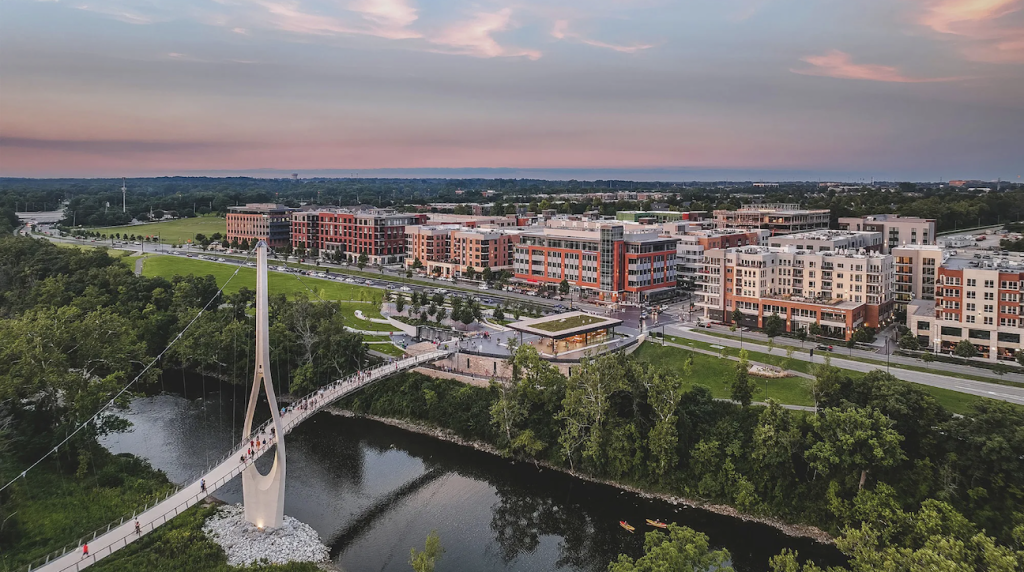
Bridge Park Development in Dublin, Ohio. 9Image credit: City of Dublin)
Like many American communities, Dublin, Ohio grew from a small rural town in the 19th century to a sprawling suburb in the 20th century. It now embraces walkability, a 21st century development trend.
About 50,000 people live in Dublin, an affluent suburb of Columbus, Ohio’s capital. In recent years, the local government has led the development of a new walkable neighborhood, Bridge Park, and built an attractive pedestrian bridge connecting it to the historic town centre. Building on the success of this development, the city council announced another ambitious project in 2024 to transform the 1980s office park into a walkable neighborhood with housing, shops, restaurants, public spaces and workplaces.
Projects aimed at transforming traditional suburban environments are becoming increasingly common in the United States. Ellen Dunham-Jones and June Williamson, architecture professors at the Georgia Institute of Technology and the City University of New York, have been writing about a similar effort, which they call suburban retrofit, for nearly two decades. In that time, both the number of these projects and their level of ambition have increased significantly, driven by innovative strategies that address issues such as public health, population aging, equity, jobs, and climate change while reducing dependence on cars.
“As of today, we have well over 2,500 projects in our database, and this is just the tip of the iceberg,” said Dunham-Jones. “I honestly can’t keep track of them all.”
Martin Zogran, an urban designer involved in the Metro Center project, said his company Sasaki is working on similar projects in other parts of the country.
“Office parks like Metrocenter are now being revisited frequently by cities and communities across the country,” he says. “We just won a new project in Philadelphia that revisits a very similar ’70s and ’80s office park.”
Reduced driving, reduced emissions
Such efforts have an important impact on climate change. Transportation is the largest source of emissions in the United States, primarily from the vehicles people use to get around every day. Electric vehicles can help reduce these emissions, but they cannot completely eliminate them. People also need to drive less.
But for many Americans, driving less seems unrealistic. Walkable neighborhoods make up a small portion of developed land in major U.S. cities, and this, combined with high demand for walkability, makes these communities more expensive than car-dependent suburbs. As a result, many people who want a walkable lifestyle cannot afford it.
In the greater Columbus area, like most American communities, the infrastructure and land use patterns emphasize driving.
“It’s very difficult to overstate how dependent the Columbus area is on cars,” said Matthew Adair, an urban planner and researcher who grew up in Dublin. “If you don’t have a car, there’s probably something wrong with you.”
As awareness of the downsides of car dependence grows, walking advocates across the country are working to give people more transportation options. In Columbus, a two-mile downtown pedestrian street and a new bus rapid transit system are planned, providing an example of the innovations large municipalities and community organizations can achieve. But as the work in Dublin shows, governments in smaller cities also have to make an important contribution.
Rendering of Metro Center. (Image provided by: Sasaki)
motivation for change
Local authority urban planner Chris Will said Dublin City’s push to build Bridge Park and Metrocentre was driven by input from residents. Municipalities update their community plans once or twice every 10 years and conduct extensive outreach to understand what local residents want for their area.
“What we’re hearing is that residents want Dublin to be more walkable and easier to cycle. Not just for recreational purposes, but perhaps to go to work or to go to shopping or restaurants,” he said. “People love the opportunity to get out of their cars.”
These projects were also shaped by the need for Dublin to maintain its status as an attractive destination for workers and residents for decades to come.
“Growing, affluent communities like Dublin already have a good employment base and are often able to attract developers to invest the money needed for major redevelopments like Bridge Park and Metrocentre,” Dunham-Jones said.
This doesn’t mean only wealthy areas are implementing creative suburban redevelopment projects. Projects tend to take different forms elsewhere.
“Communities with weaker economies are more likely to green up underused parking lots or repurpose aging buildings with social infrastructure,” she said.
Bridge Park was built on land that previously housed an underused strip mall and a closed golf driving range. Not the most strategic use for land located directly across the river from the historic town centre.
“As the city changes over time, so do the retail stores, so this project was aimed at repositioning that area to make it more competitive,” Will said. “The idea for Bridge Park was to combine offices, condos, apartments, hotels, restaurants, shopping and entertainment options, all in the heart of an urban walkable street network.”
Similarly, the City of Dublin Government believes that the Metro Centre, which is an important source of income tax for the city, also needs refurbishment in order to remain an attractive facility for companies seeking office space.
Currently, the site is “predominantly surface parking,” Zogram said. “Disposable office buildings and a series of hotels are scattered at considerable distance from each other. This is completely inconsistent with modern expectations for office workers, and even for people staying in hotels.”
Possibilities for change
The scale and ambition of these projects has made the city a model for the region, Will said. At a recent city planning conference, several representatives from other central Ohio communities said Dublin’s accomplishments have made them think more ambitiously about their own development opportunities.
Rachel Dorothy, the city council president in Worthington, another Columbus suburb, agrees. Bridge Park and Metro Center are “definitely unique and noteworthy” in the area, she said. In particular, she said the city of Dublin’s decision to allow mixed-use development, which brings living, working and shopping together rather than separating them in adjacent spaces, as most zoning regulations in the U.S. require, is forward-thinking, she said.
“Mixed-use development was the status quo for most of humanity until the urban planning laws that started 100 years ago,” she says. “This zoning law hasn’t served our city very well. Now we need to get back to the mixed-use development that’s been done for the rest of our history.”
Zogran is similarly passionate about helping Ohioans enjoy the benefits of a lifestyle that has been out of reach in many American communities for decades.
“This project will introduce people to patterns that were very common in the past: being able to walk to buy a gallon of milk, take your child to the park, or go for a walk or bike ride without getting in the car,” he said.
Challenges and opportunities for building walkable communities
Building walkable communities in the United States is difficult, and the teams behind Bridge Park and Metro Center had to overcome many challenges. Zogran said the most difficult part is parking.
“Cities are becoming very progressive in requiring less parking, which is great,” he says. “But there are other challenges, and some of them need to be done in collaboration with developers.”
Developers need to generate revenue from office, retail, and residential properties, and prospective tenants often expect a certain number of parking spaces. This often requires a significant amount of parking, but surface parking takes up a large percentage of the available land, making it impossible to build dense, walkable neighborhoods. However, the alternative parking towers and underground garages are expensive to construct, putting pressure on developers’ profits.
“Finding ways to create a compact urban form while delivering the value developers need is one of the biggest challenges in the projects I work on,” says Zoglan.
Community buy-in is also a challenge. When the city began building Bridge Park, not everyone was convinced that a dense, high-rise development was right for the community. “To overcome doubts, Dublin City Council and developer Crawford Hoying have invested in meetings with residents, workers and other stakeholders.
“That developer has spent a lot of time with the city providing input and advocacy to make the public aware of what they want to do and feel comfortable doing it,” Dorothy said.
Will said Dublin has also been working with community members to understand their thoughts and concerns about Metrocenter. We also invested in high-quality graphics to convey the vision of the project.
However, this round doesn’t require much convincing.
“We were able to point to Bridge Park as a success story, so Metro Center became less of an uphill battle,” he says. “People really love Bridge Park.”
