


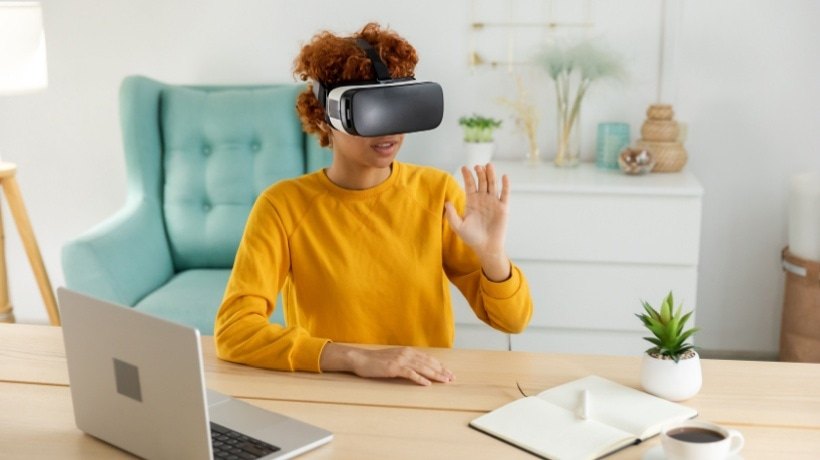
When learning finally feels like living the experience
A while ago, my training manager told me this story. She said, “We spent weeks preparing onboarding materials, but new employees still asked the same questions. They didn’t feel connected to this place.” It wasn’t a question of quality of content. It was the way content was delivered.
Many learners don’t want more information. They want to experience the environment, understand the workflow, and get a feel for the culture. This is where VR secretly becomes a powerful partner. Rather than telling your employees what to expect, VR allows them to step into the experience.
Over the years, I have seen learners smile, react and express genuine curiosity inside VR modules. Some even forget they are in a training session. That’s the difference VR makes. It turns passive viewing into active participation.
Why VR is becoming the preferred option for modern L&D teams
VR allows learners to enter a fully designed environment and interact in a way that feels natural. You can open panels, walk around, operate machines, and observe the process as if you were there. This level of immersion increases focus and excitement. There’s no temptation to multitask or wander.
A leader at a global manufacturing company once told me that VR has re-engaged his most reluctant employees. These employees typically avoided training, but were eager to try VR. This natural engagement is one of the biggest benefits of VR.
VR also creates a safe space. Employees can perform dangerous tasks without fear. You can try as many times as you like until you master the steps. Mistakes become part of learning and are not something to be avoided.
VR Today: Practical, Scalable, and Incredibly Accessible
A few years ago, VR felt like the preserve of game studios and high-budget labs. Today it has become practical and accessible. VR headsets are lightweight and affordable. Development tools are now faster. Many organizations are surprised that VR is no longer a scary investment.
VR is currently commonly used for:
Onboarding Safety training Emergency response training Equipment handling Customer service practices Leadership and behavioral training Logistics and warehouse simulation
What was once a novelty has become a necessary part of the modern learning ecosystem. Trainers and L&D leaders appreciate VR’s ability to deliver consistent training across multiple locations. Learners are grateful that the training is finally meaningful to them.
How VR enhances your training ROI
1. Reduction of ordinary costs
Traditional training often requires travel, instructors, scheduling, and downtime. VR reduces most of these expenses. Build modules to train thousands of learners with no additional effort.
2. Shorter learning cycle
Because VR is immersive and experiential, employees can understand concepts faster. They remember the steps more clearly. There is less need for review. This reduces the amount of time employees spend away from work, increasing productivity.
3. Strong safety benefits
VR offers a way to train for dangerous or sensitive tasks without any real danger. Learners can practice emergency response, equipment handling, or chemical procedures in a safe environment.
4. Increase engagement and recall
VR naturally attracts attention. When learners feel included in the scenario, they process information more deeply. Many L&D teams report that VR has resulted in retention rates unlike anything they’ve seen before.
5. Scaling without compromise
Whether your employees are in Bangalore or Berlin, VR provides exactly the same learning experience. This solves one of the biggest challenges facing global organizations: maintaining consistency.
Where VR will have the biggest impact: True stories from the field
VR shines when the work environment is high-risk, complex, or difficult to recreate. It is also effective in situations where human behavior is important.
I remember watching a group of warehouse workers practice an emergency evacuation in VR. Their reactions felt genuine. They were careful, involved, and invested in making the right choices. Then, when the actual training took place, they answered with confidence because they had already experienced it once.
Insurance teams are using VR to better understand the impact of disasters. Machine operators used VR to practice assembly techniques without touching expensive equipment. Customer-facing teams are rehearsing conversations in VR to boost confidence.
The scope of possibilities continues to expand as organizations realize how practical VR has become.
Case study: The VR onboarding experience that changed first impressions
One of the most memorable projects we worked on involved a large technology company that wanted to redesign onboarding for its AI research department. They wanted new hires to experience the environment, culture, and energy of the team. Traditional onboarding couldn’t accomplish this.
We created a VR experience that starts with a futuristic lobby. New employees can also explore the room, interact with panels, watch short clips, and complete small challenges related to AI concepts. They walked through virtual corridors leading to laboratories, innovation hubs, and collaboration zones.
One new employee told a client, “I felt like I was walking into the future. I was immediately excited about my role.”
Organizations have found that because new employees already feel connected to the space, they adapt faster, feel more welcome, and are more comfortable asking questions.
Moments like this remind us that learning is more than just instruction. It’s about helping people feel prepared and confident about the path ahead.
conclusion
VR is about more than just creating impressive visuals. It’s about giving employees the opportunity to learn in a way that reflects real life. It helps you practice with confidence, make better decisions, and feel more connected to your role. Most importantly, VR helps organizations build truly effective learning.
At Tesseract Learning, we believe in creating training experiences that change behavior, improve performance, and support organizational goals. Through our framework and platform, we design VR solutions that do more than just inform. they transform. And when employees learn through real-life experiences, organizations see the results in productivity, confidence, and long-term capability.
If you want to bring your learning to life and improve your training outcomes, we at Tesseract Learning would be happy to help.
Tesseract Learning Pvt Ltd
Tesseract Learning works with global organizations to improve employee performance through a variety of digital learning solutions. Solutions include eLearning, mobile learning, microlearning, game-based learning, AR/VR, adaptive learning, and more.
