


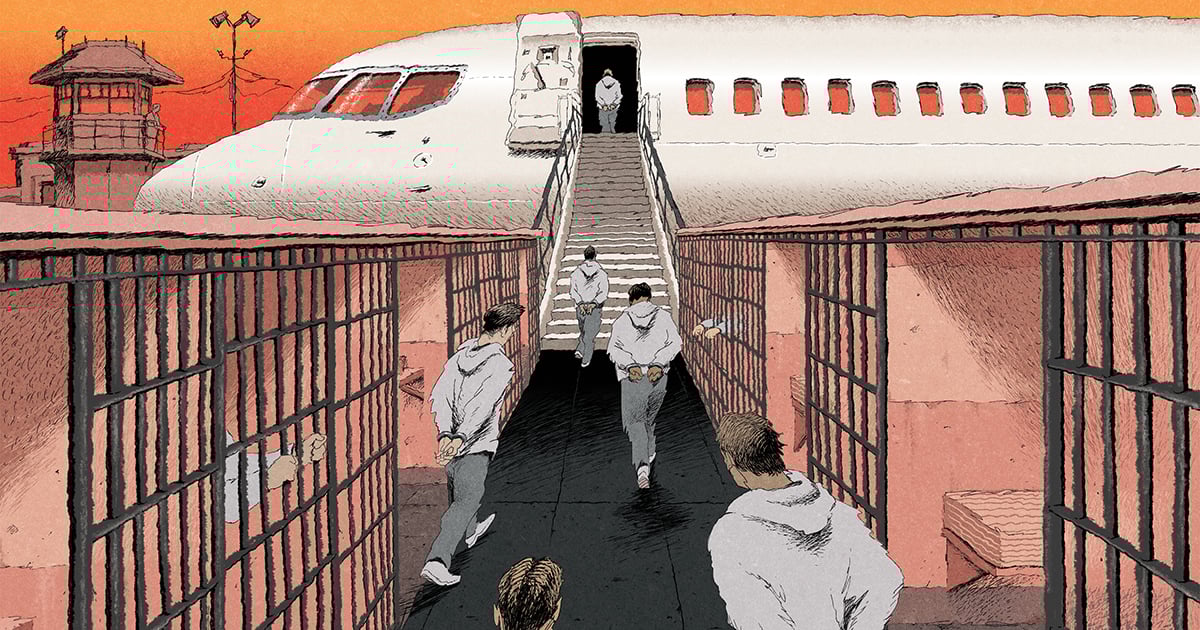
One by one, the prisoners, all immigrants, appeared briefly by video before a special panel of the Louisiana Parole Board.
The August hearing was unusual in a state where early release has become increasingly difficult for most inmates under Republican Gov. Jeff Landry.
Unlike regular parole hearings, the board did not question parolees for crimes ranging from auto theft to auto murder to gauge their remorse. Nor did it examine their disciplinary records to determine whether they posed a threat to public safety. And there was no one present to represent the victims or speak on their behalf.
In fact, most of the nine men, who wore either black-and-white striped jumpsuits or plain orange jumpsuits, said nothing except their names and inmate numbers. Only one was even eligible for parole.
But in each case, the three-member committee unanimously voted to release them after just a few minutes of deliberation.
“Today, you have been released on parole,” Board Chairman Steve Prater said at the end of each hearing, “and you are now going straight to an ICE facility for deportation from the United States.”
Some thanked the board. Others sat expressionless or simply nodded.
These days, a 100% grant rate is unheard of for the Louisiana Parole Board. Previously, the annual parole rate was about 50%, but in the two years since Landry became governor, fewer than a quarter of those eligible have been released on parole.
Landry, a former police officer and deputy sheriff who served as Louisiana’s attorney general until 2024, blasted the early release program as an insult to crime victims and argued that everyone convicted of a crime in Louisiana should serve their entire sentence. He called on Republican lawmakers to completely eliminate parole for people arrested after August 1, 2024, and to impose strict eligibility requirements for those already in prison.
But this year, that same Congress put all that aside for one category of prisoners: immigrants without legal status. Mass deportation is a key policy priority of President Donald Trump, and Republican-led state and local governments are taking aggressive steps to make it a reality. Landry signed an order in May that aims to “crack down on criminal illegal aliens” by authorizing the Louisiana Department of Public Safety and Corrections and other state agencies to perform certain Immigration and Customs Enforcement tasks. In June, the Louisiana Legislature created an expedited “alien removal process” through a special parole board, which passed with little notice during the last legislative session.
“They have the ability to parole a lot of people, but they choose to do so only to this particular group because it’s politically popular,” said Bridget Geraghty, senior counsel at the MacArthur Justice Center, a Chicago-based legal nonprofit focused on prison reform.
At least two other Republican-led states recently introduced similar efforts to parole and deport prisoners without legal status. South Dakota paroled 10 immigrant prisoners scheduled for deportation over the summer. In Oklahoma, Republican Gov. Kevin Stitt announced in February that the state had identified about 525 prisoners eligible for deportation.
Since the Aug. 27 hearing in Louisiana, at least two of the nine paroled men have been deported, and two others from Vietnam are being held in a newly designated immigration detention facility on the grounds of a Louisiana state prison in Angola, ICE announced. Neither ICE nor the Landry administration responded to questions about the location of the other five parolees or whether they will be deported to their home countries of Honduras, Mexico or Nicaragua.
On September 21, the ICE regional office in New Orleans posted a photo of one of the parolees, Samuel Lara Garcia, handcuffed in front of the stairs leading to the plane. The agency confirmed that Garcia is a Honduran national.
“Murder banished!” The X-post rang out.
Garcia, 36, had previously pleaded guilty to manslaughter and obstruction of justice in the 2022 shooting after an altercation at a house party in Baton Rouge. He was sentenced to 13 years in prison in 2024, but served less than two years before being eligible for parole.
Immigration and Customs Enforcement in New Orleans posted a photo of Samuel Lara Garcia. He pleaded guilty to negligent homicide and obstruction of justice and was sentenced to 13 years in prison in 2024, but served less than two years before being eligible for parole. Screenshot by Verite News
Today, Americans convicted of the same crime, or any crime, in Louisiana would not be eligible for release under the new parole law championed by Landry.
ICE declined a request for an interview with Madison Sheehan, a former Landry administration official who signed the agency’s partnership agreement with the Department of Corrections as ICE deputy director. Landry’s administration did not respond to questions about the new parole board or the governor’s sweeping executive order, dubbed “Operation Joe.”
One of the members of the task force is Keith Conley, the police chief in Kenner, a suburb of New Orleans. Kenner was one of the first Louisiana cities to formally partner with federal immigration authorities during President Trump’s second term. He praised the bill that created the Deportation Commission in a recent interview. Conley said paroling and deporting prisoners who are in the U.S. illegally would free up prison space and save taxpayers money, “so it seems like a win, win.”
Under the new law, deportation boards will operate without the restrictions and responsibilities imposed on normal parole proceedings. Parole boards are typically tasked with deciding whether an inmate is ready for release based on a variety of factors, including their behavior in prison, their efforts toward rehabilitation, whether they pose a danger to the public, and the opinions of victims.
However, the August hearing did not require the board to abide by eligibility restrictions imposed by Congress last year, such as the requirement that inmates have at least a three-year clean disciplinary history and a low-risk score as determined by an algorithm.
“Parole granted for deportation purposes is fundamentally different from discretionary parole, which is granted to individuals who have demonstrated a willingness to undergo community supervision,” Frances Abbott, executive director of the Parole Board, told Vérité News and ProPublica. “In these cases, the individuals are in the United States illegally and have been convicted of criminal offenses.”
To be eligible to appear before the new commission, inmates must have a federal notice of deportation and have not been convicted of a sex crime or a violent crime punishable by more than 10 years in prison. (Under Louisiana law, negligent homicide is not considered a violent crime.)
Christopher Walters, the Landry administration’s deputy administrative adviser, said during a May legislative hearing that the state had identified about 390 inmates who could be eligible for parole and deportation. The Department of Corrections does not verify or update that number.
“Determining the eligibility of this particular bill is an ongoing process,” Derrick Ellis, the department’s deputy secretary, said in a recent interview.
No further hearings are scheduled for the rest of the year, according to the parole board.
Unlike regular parolees, who are required to check in with parole officials regularly and are prohibited from unauthorized travel, parolees who are deported are not under any supervision. If you are deported, you will be released on the condition that you do not return to the United States.
Under Louisiana law, the returnee will be forced to serve the remainder of his sentence. But that alone may not be enough of a deterrent. First Assistant District Attorney Margaret Hay of the Jefferson Parish District Attorney’s Office, who prosecuted one of the deported men, said prosecutors are concerned that parolees convicted of violent crimes “might come right back to this country.”
Ms Hay said she supported the effort, although she said there was “no guarantee that the border will remain as secure as I think it is at this point”.
ProPublica and Verite News reached out to embassies and consulates in Mexico, Nicaragua, Honduras and Vietnam to learn how those countries are managing the repatriation of deportees who have had their U.S. sentences reduced. No one answered multiple phone calls and emails.
Another issue at issue is that Louisiana law requires parole boards to notify victims of upcoming parole hearings if they are enrolled in the Louisiana Victim Assistance Program, a state initiative that provides support services. Many crime victims, especially undocumented immigrants, are not registered or aware of state programs. The parole board said there were no registered victims in the nine cases that appeared before the deportation board in August.
Local prosecutors said they had tried to contact the families of six victims killed by four paroled men, three of whom were charged with vehicular homicide, but were unable to reach them. ProPublica and Verite News were unable to reach the victims or the families of the deceased victims in the incident involving the nine men.
Landry is an ally of President Trump and a longtime immigration hardliner. During Trump’s eight years as attorney general, which began a year before his first presidential term, Louisiana’s immigration capacity expanded from two facilities in 2016 to eight facilities. This makes the state a key partner in President Trump’s mass deportation plan during his second term in office.
Homeland Security Secretary Kristi Noem (center) and Louisiana Governor Jeff Landry (left) tour a facility housing immigrant detainees at the Louisiana State Penitentiary in Angola in September. Gerald Herbert/Associated Press
In September, Landry and Homeland Security Secretary Kristi Noem unveiled a ninth immigrant detention facility known as Louisiana Lockup, located in the former cell block of the Louisiana State Penitentiary in Angola. That’s where Hoang Hui Pham, one of nine men released on parole in August, is awaiting deportation to Vietnam. Hoang Huy Pham fled as a child refugee during the Vietnam War, his family said.
Pham’s daughter Teresa, who works for the federal government and asked to be referred to by her first name for fear of retaliation, said her father called her in June to tell her that she was scheduled to be released on parole at the end of August after spending 20 years in prison for a long history of auto theft. Teresa recalled that he told her he was going to live in a half-house until he returned to his family in Baton Rouge. She said her elderly grandfather, Pham’s father, was looking forward to him finally getting out of prison and helping take care of her.
Then, in September, Teresa received another call from her father. This time he told her he had been transferred to Angola to await deportation. That five-minute phone call was the last time Teresa said she heard from him.
“I finally got outside, but I guess I went somewhere I wasn’t supposed to be,” Teresa said. “That’s false hope.”
Harvin Pineda was the only inmate to tell the parole board in August that he wanted to be deported. He told the board through an interpreter that he wanted to return to Nicaragua to care for his sick, elderly mother in her final moments.
Mr. Pineda was previously deported while on probation and served less than one year of a seven-year sentence for cocaine possession.
Nevertheless, the board granted his request.
“You’re a full-fledged drug dealer,” Prator, the panel chairman, told him. “We don’t want you to come back.”
ICE took him into federal custody the same day and deported him to Nicaragua on September 12.
