


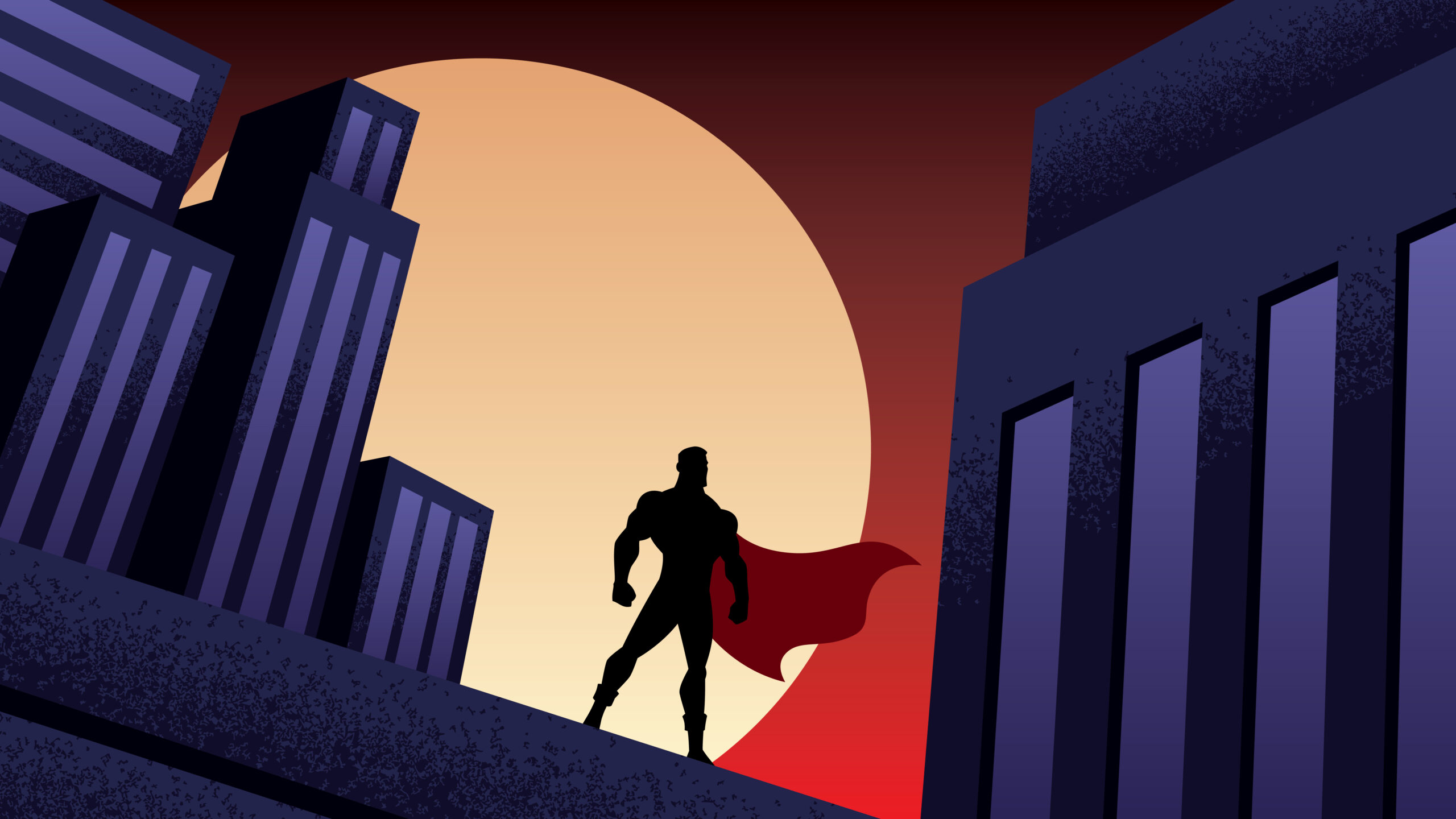
Over the past few years, I’ve had a hard time watching superhero movies. Not because it lacks quality (although that’s probably true), but because it relies on bad economics. To justify this claim, I propose an answer to the eponymous question of why superheroes don’t exist.
gotham problems
Imagine you live in crime-ridden Gotham City. This constant bad behavior is not only normatively bad, but also leads to a decline in real estate prices. Then Batman shows up and reduces crime. Will the people of Gotham celebrate? Probably! After all, Batman made the city safer (and increased the value of their homes). We can assume that the Gotham Police Department has done its best, but barely enough cop salaries won’t increase property values enough to hire them.
With the introduction of the Caped Crusader, the “optimal” level of crime has changed from “A mafia boss running around every city” to “Avoiding planned crimes at night.” If Batman can achieve these higher real estate prices at a lower cost than the profits he bequeathed to the city, we can only conclude that Batman is the GCPD’s most desired recruit, but that he is simply refusing a salary. Batman’s actions have created value, but the public has not responded proportionately to the effort he puts into fighting crime. This means that asset values are discounted by the uncertainty that everyone faces, as Batman remains anonymous and his incentives are unclear.
In a sense, there is a market failure. The people of Gotham would be willing to pay Batman to provide his services, but since Batman refuses to pay, he is artificially lowering the value of the services provided, even though he would provide the same services if paid.
Benjamin Klein and Keith Loeffler’s excellent paper “The Role of Market Forces in Guaranteing Contract Performance” implicitly argues that the introduction of transaction costs requires an investment in host capital by producers and the payment of a price premium by consumers (assuming that neither supply nor demand is perfectly elastic/inelastic). For example, Gucci sells a “high quality” shirt, so you want it. But for the price they charge, you want to know you’re getting something really high quality. Elements of mistrust can hinder sales as a transaction cost. To solve this problem, Gucci invests capital (the brand name), but capital only has value if the shirt performs well. The expense of establishing a brand only pays off if the product is actually what it claims to be. We call this “hostage capital.” Because Gucci is holding it hostage: the brand name.
But producers and consumers bear costs (here, as a refresher, we treat taxes as costs). Consumers “absorb” the costs of distrust in transactions by increasing the prices they pay to encourage producers to provide the correct service. If consumers cannot rely on the goodwill (hostage capital) of providers, they will have to pay higher prices to maximize their trade gains.
Great power comes with great fiduciary responsibility?
Let’s get back to superheroes. Not getting paid for Spider-Man would result in very subpar results with no increase in New York home values. Because no one can really believe that Spider-Man will fight crime forever and at the same level. We often imagine a hero as someone who doesn’t get paid, but perhaps good people don’t “do it for the money.” But people still need to pay to get the most value out of Spider-Man’s crime-fighting. The only way a consumer could maximize the value of Spider-Man’s gift is if Spider-Man loves fighting crime so much that his entire transaction cost was covered by his investment in hostage capital (in other words, Spider-Man has a perfectly inelastic supply curve).
This is why we should not assume that superheroes exist, even if people with superpowers do exist. Because neither bystanders nor superheroes are making the most of their superpowers by wearing masks and fighting crime for free.
Uncle Ben’s famous words of wisdom to Spider-Man, “With great power comes great responsibility,” may be canonically true. Still, innocent bystanders (you and me) are supposed to want Spider-Man to have a fiduciary responsibility, not just a moral one. If Spider-Man neglects his duties, he will not feel any physical cost, but his neglect of duty will cost his constituents dearly. Unless bystanders can be absolutely sure that Spider-Man never shirks his duties (which he has done several times), we should always want Spider-Man to make money.
But my answer here is a bit tongue-in-cheek. I said superheroes don’t exist because fighting for free doesn’t maximize the value of their work. While many superpowers obviously don’t exist (thus making things like Spider-Man impossible by default), there are people with extraordinary mental and financial abilities. But in a world where superheroes aren’t paid, why would we expect them to be?Frankly, I would only allow myself to be bitten by a radioactive spider if there was a clear financial benefit.
Superpowers aside, why hasn’t Elon Musk become Batman? Simply put, in the real world, that’s not his “superpower.” The value he can offer the world is not maximized by fighting crime, even if he can afford the Batcave. Rather, he provides value from other industrial pursuits. What this should suggest is that the marginal benefits of reducing crime aren’t really that high, and that if Bruce Wayne were real, he might consider running Amazon as his contribution to the world. Maybe Elon Musk isn’t interested in making money, but we’re still paying him to have a fiduciary responsibility to properly maximize the value of his contributions.
In conclusion, my eponymous question may have been a trick. “Superheroes” do exist, but they (1) get paid and (2) crime doesn’t decrease. Because the market tells them that the marginal returns to doing so are very low.
Not only do we already have powerless superheroes, but superpowered superheroes as depicted in comics inevitably create a world state in which no one even has an incentive to have superpowers (or at least use them for “good”). So every superhero movie implicitly assumes that the market won’t clear. If superheroes aren’t actually making money, it’s more likely to suggest that they aren’t doing anything worth paying for.
