


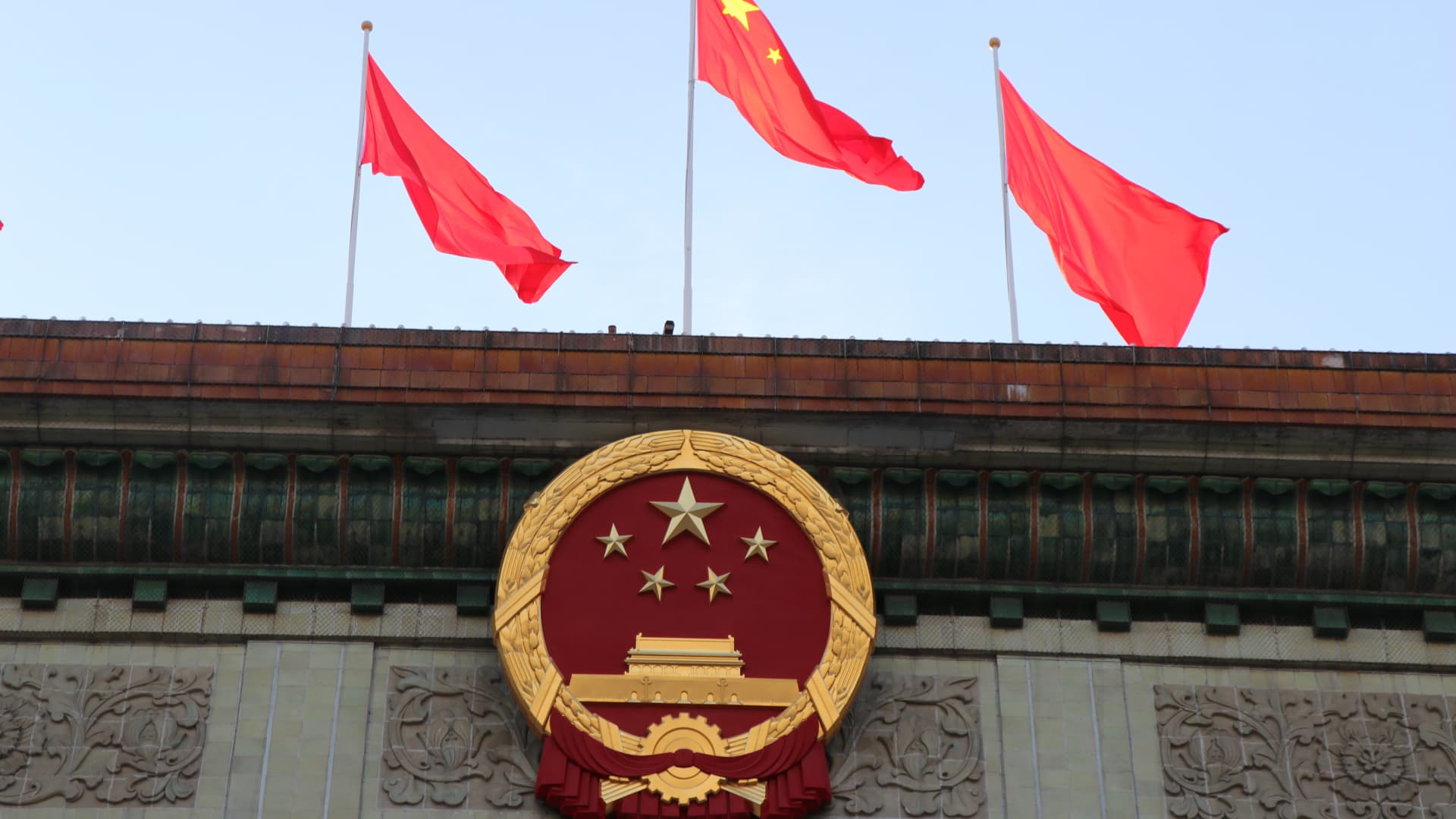
This photo shows the Great Hall of the People in Beijing, China, ahead of the 76th anniversary of the founding of the People’s Republic of China on September 30, 2025.
Anadolu | Anadolu | Getty Images
BEIJING—China’s leaders on Thursday underscored their determination to boost domestic consumption over the next five years, in addition to widely anticipated plans to boost domestic technology.
This was revealed by state media reading out the highlights of the “fourth plenary session” to set five-year development goals. China also confirmed on Thursday that Vice Premier He Lifeng, who attended the plenary session, will visit Malaysia from Friday to Monday for U.S. trade negotiations – amid heightened hopes for a potential U.S.-China presidential meeting later this month.
Despite widespread calls to strengthen China’s international influence and “protect the multilateral trading system,” the statement did not mention any major countries by name as the conference focused primarily on domestic developments.
China needs to “strongly expand consumption,” the meeting’s reading said, according to CNBC’s Chinese translation. The leaders elaborated on the need for consumption and called for a balance between “effective investment” and “adhering to the strategic point of growing domestic demand.”
“New demand creates new supply, and new supply creates new demand,” the report states. The leaders also called for “special action” to effectively implement policies to support businesses and boost consumption.
Zhong Liang, a former chief researcher at the Bank of China, said this tone shows that Chinese policymakers are watching the economy’s supply-demand relationship more closely than in past years.
This change is not taken lightly in China’s ideologically driven government, but it still has not given the green light to cash transfers. Despite retail sales slumping since the pandemic, the Chinese government has avoided giving money directly to consumers, in contrast to the U.S. economic stimulus package after the coronavirus.
Yue Su, chief China economist at the Beijing-based Economist Intelligence Unit, said in a note that the announcement “suggests a continued emphasis on investment, this time as a means to stimulate consumption, rather than a bold and direct push to expand consumption itself.”
“Therefore, we expect investment to be more concentrated in consumption-related sectors and activities, such as improved urban planning, public services and elderly care,” he said. Su noted that over the past decade, China has relied heavily on investment for growth, raising concerns about overinvestment.
Over the past two years, China has sought to boost consumption with subsidies targeting home appliances and certain other consumer goods. The country is also encouraging local governments to hold sporting events and other entertainment to increase spending.
The report did not call for a “significant increase in revenues,” making Eurasia Group China director Dan Wang more cautious about the Chinese government’s spending plans.
“That’s just an aspirational goal,” she said. “I don’t see a financial commitment to this.”
The announcement emphasized achieving a growth target of approximately 5% in 2025 and other previously shared targets for 2027 and 2035.
All of this means an annual growth rate of 4.6% until 2035, Wang said, noting that it would be “very expensive” to achieve. He predicts that with deflationary pressures remaining strong, resources will ultimately be concentrated in high-tech and emerging industries, with little improvement on the demand side.
For example, China’s previous policy goal of becoming a world leader in electric vehicles has been criticized for encouraging companies to flock to subsidy-supported industries, thereby creating a race to the bottom that squeezes other countries’ industries.
A “giant leap forward” in technology
The Chinese government has sought to address some of the excessive competition this year. At the same time, however, the United States has tightened restrictions on China’s access to advanced technology, forcing the country to step up its technological development.
Chinese leaders on Thursday called for improved technological independence. “We will strive to achieve a great leap forward for the world over the next five years.” [China’s] “By 2035, our economic strength, scientific and technological capabilities, national defense capabilities, overall national power, and international influence will increase,” the statement said.
Weekly analysis and insights from Asia’s largest economy delivered to your inbox
Subscribe now
It also called for the development of a “strong agricultural state” and “acceleration of the establishment of a strong manufacturing state,” noting the need to maintain a “reasonable” share of domestic manufacturing.
The only reference to the ongoing real estate recession was a call for “high-quality development” of real estate. The Chinese government also said it would work towards its previously announced carbon emissions reduction plan.
Senior officials are scheduled to share more details about the country’s goals for the next five years at a press conference Friday morning, but a more comprehensive report is expected in the coming days. China typically does not release detailed, full five-year targets until Congress in March.
