


There are so many amazing facts about Valentine’s Day! Do you believe the first Valentine was given in the 15th century or that chocolate was once prescribed by doctors? Check out this list of fun facts about Valentine’s Day and more. Perfect to share with your students.
Plus, by clicking the button below, you’ll receive a free Google Slideshow with all the facts you can share with your classroom (or a loved one!).
43 interesting facts about Valentine’s Day
The first Valentine’s Day celebration took place in France.
Although it’s difficult to pinpoint the exact first celebration, the first official Valentine’s Day celebration of love was probably in Paris in the 1400s. In England and France, mid-February was associated with the mating season for birds and was considered a good time to celebrate romance.
145 million greeting cards are exchanged each year on Valentine’s Day.
Hallmark says it’s only in the US. According to this video from Homeschool Pop, over 1 billion valentines have been sent around the world.
Approximately 25% of pet owners give their pets a Valentine’s Day gift.
Valentine’s Day is not only fun for humans, but also for dogs, cats, rabbits, birds, and other pets.
Pet owners in the United States will spend more than $2 billion on Valentine’s Day gifts for their pets in 2024.
Not only do a quarter of pet owners buy Valentines for their furry friends, Americans collectively spend more than $2 billion in the process.
The inventor of Candy Hearts started by making medicated lozenges.
In the 1800s, Boston pharmacist Oliver Chase invented a machine that simplified the lozenge manufacturing process. The machine was then used to make heart-shaped candies with printed messages. Watch this video to learn more about how to make sweethearts.
Eight billion conversation hearts are manufactured each year.
Lots of conversation hearts! Candies include classic romantic phrases such as “Be Mine,” “Cutie Pie,” and “I’m Yours.” In 2019, the company that made Sweethearts was sold, leaving billions of candy hearts out of production, resulting in a Valentine’s Day without conversation.
Consumers buy more than 58 million pounds of chocolate and candy on Valentine’s Day.
Heart-shaped chocolate boxes account for about 10% of Valentine’s Day candy sales.
Chocolate boxes have been around for over 150 years.
In the mid-1800s, Cadbury took advantage of lower import costs to create the first chocolate box. Then, in the 1860s, the first heart-shaped chocolate boxes were created.
Lovebirds are real birds.
The term “lovebird” refers to a couple who are in love with each other. It is also the common name for a bird called Agapornis.
The first Valentine was sent from prison.
The Duke of Orléans wrote the first Valentine while imprisoned in the early 15th century. He wrote a poem and sent it to his second wife, but of course, because he was in prison, he never saw her reaction to the poem he sent.
Every year, thousands of people send letters to Juliet (from Romeo and Juliet).
People write letters to Juliet, the doomed lover from Shakespeare’s Romeo and Juliet, and send them to Verona, Italy. The Juliet Club is a volunteer group in Verona that responds to letters.
Many countries around the world celebrate Valentine’s Day.
The United States, United Kingdom, Canada, Australia, Argentina, France, Mexico, South Korea, and the Philippines all celebrate the Day of Love.
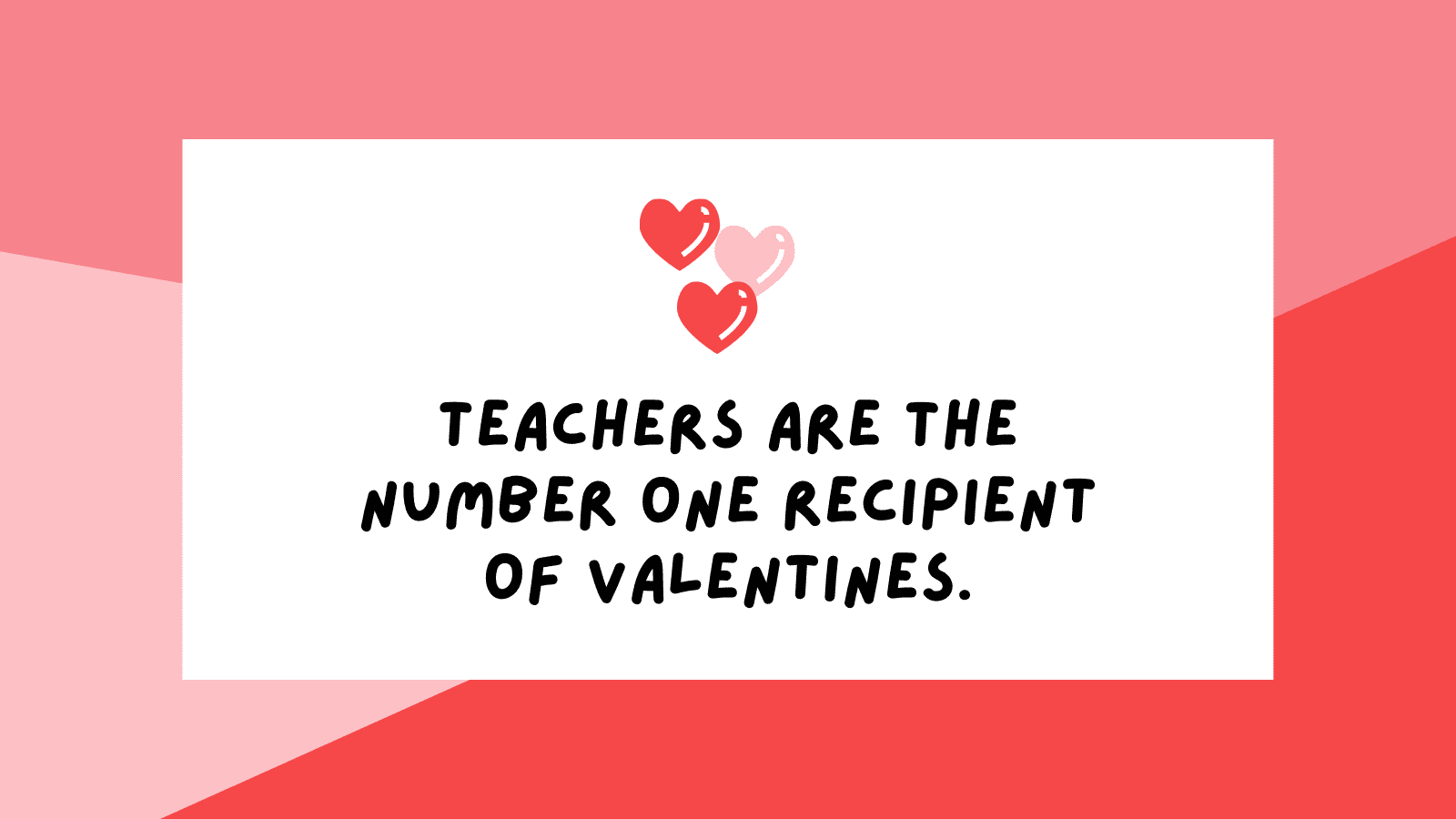
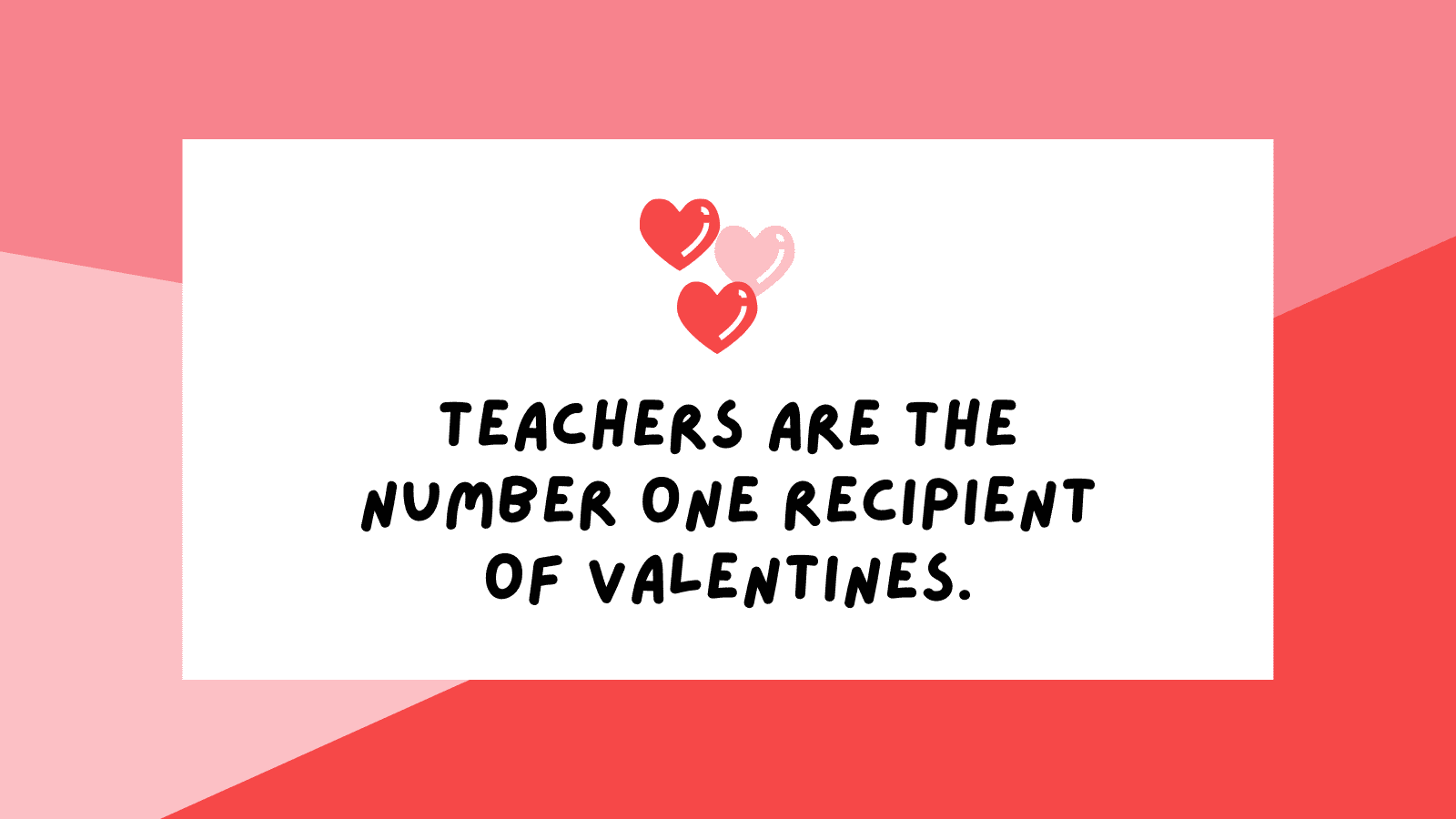
Teachers receive more Valentines than anyone else.
This is one Valentine’s Day fact that doesn’t come as a surprise to us because we also appreciate our teachers. Teachers receive more Valentines than children, wives, and mothers.
250 million roses are grown just for Valentine’s Day.
Venus, the Roman goddess of love, loves red roses, and red roses symbolize romance and love.
A doctor once prescribed chocolate to cure a broken heart.
This may be one of the most surprising facts about Valentine’s Day. In the past, doctors recommended chocolate to people who were suffering from a breakup or who were reminiscing about the aftermath of a breakup.
Most Americans buy gifts, cards, or candy on Valentine’s Day.
Approximately 80% of U.S. consumers plan to shop on Valentine’s Day, making Americans unique in the field of Valentine’s Day shopping. sweet!
Hallmark prints over 500 Valentine’s Day card designs.
Hallmark offers over 500 Valentine’s Day card options, so there’s literally something for everyone.
Valentine’s Day is one of the biggest holidays to give flowers.
If you’re giving flowers this Valentine’s Day, you’re in good company. Another holiday to give flowers is Mother’s Day.
Victorians used Valentine’s Day to deter suitors.
In Victorian times, people who didn’t want attention sent “Vinegar Valentines” and “Penny Dreadfuls.” They were intended as an insult to unwanted admirers.
Men spend more money on Valentine’s Day than women.
In fact, men spend about 25% more on Valentine’s Day than women.
Esther Howland sold the first mass-produced valentines in the 19th century.
In the 1840s, Esther Howland of Massachusetts sold the first mass-produced Valentine’s Day cards. Howland’s father owned a stationery store, and she used the opportunity to sell fancy greeting cards.
Historians credit the British poet Geoffrey Chaucer with associating romance with Valentine’s Day.
Chaucer, also the author of The Canterbury Tales, wrote about Valentine’s Day in The Parliament of Farle.
Hallmark was the first greeting card company to go national.
Hallmark founder Joyce Clyde Hall was the first to promote greeting cards nationally. He placed ads in the Ladies’ Home Journal and sponsored radio ads.
There are many movies based on Valentine’s Day.
Several movies are set on or around Valentine’s Day, or even have the holiday in their titles. Surprisingly, many of these movies are horror movies.
First Lady Jacqueline Kennedy toured the White House on Valentine’s Day.
On Valentine’s Day 1962, CBS broadcast a special tour of the White House’s renovated public rooms hosted by popular First Lady Jackie Kennedy. 56 million viewers tuned in from home.
California is the state with the most chocolatiers.
The state has 128 chocolate manufacturers, followed by Pennsylvania with 113.
The League of Women Voters was officially formed on February 14, 1920.
The League was formed in Chicago just six months before the 19th Amendment granted women the right to vote.
Saint Valentine was not alone.
The Catholic Church recognizes three different St. Valentines (or Valentines). Each St. Valentine was martyred and may have inspired this holiday.
Pope Gelasius banned the celebration of Lupercalia.
In the 5th century, Pope Gelasius banned the celebration of Lupercalia. Some say he replaced it with “St.” Valentine’s Day,” but no one knows the exact origins of this holiday.
Each flower color has a meaning.
Red roses symbolize love, but other flower colors also have meanings. Dark pink symbolizes happiness, purple = nobility, and white = honesty.
The name Valentine was most popular in 1922.
Social Security’s official website has tracked the top 1,000 baby names each year since the early 1900s. The popular boy name “Valentine” hasn’t been in the top 1,000 since 1955. The name’s popularity peaked in 1922, when 132 babies were named Valentine.
Many famous singers have covered the show tune “My Funny Valentine”, including Frank Sinatra.
This famous song is from the 1937 musical Babes in Arms. Elvis Costello, Miles Davis, Ella Fitzgerald, and many others have covered this song.
Four states in the United States have cities named Valentine.
You can live in a town named Valentine in Arizona, Nebraska, Texas, or Virginia (it’s actually “Valentine” in Virginia).
Mass weddings are a Valentine’s Day tradition in the Philippines.
Mass weddings are government-funded, so apart from registering the marriage, they are free for couples.
In Japan, women give chocolates to men on Valentine’s Day.
In Japan, women give chocolates to men, but some people object to this tradition, saying it is too obligatory.
February 14th is the 63rd most common birthday out of 365 birthdays.
Being born on Valentine’s Day is surprisingly common.
Oregon and Arizona both became states on Valentine’s Day.
Oregon (1859) and Arizona (1912) became states on Valentine’s Day.
Alexander Graham Bell filed for a patent for the telephone on Valentine’s Day.
Alexander Graham Bell filed a document with the Patent Office on February 14, 1876. The patent was granted on March 7, 1876.
63% of us text on Valentine’s Day.
Text messages are the new Valentine’s Day cards. Most people say they text their loved ones on Valentine’s Day.
Valentine’s Day has its origins in a Roman holiday.
In February of the 6th century BC, the Romans celebrated the festival of Lupercalia with animal sacrifices and other rituals.
Cupid was a Greek god.
Although we know him as a chubby baby who shoots arrows, Cupid is actually a handsome Greek god from mythology whose magical arrows can make mortals fall into love or hate. I was able to do that. He became the face of Valentine’s Day in the 19th century.
The red heart was one of the most used emojis in 2024.
The red heart is a classic emoji, and in 2024, “crying while laughing” and “heart eyes” were in the top three emojis.
Valentine’s Day has become much simpler than before.
The 19th century saw the heyday of Valentine’s Day cards. People decorated their Valentines with everything from peacock feathers to lace to jewelry.
Get our Valentine’s Day fact slides for free!
If you would like to share these Valentine’s Day facts with your classroom, click the button below to receive a copy of a Google Slideshow containing all of the facts listed above.
