


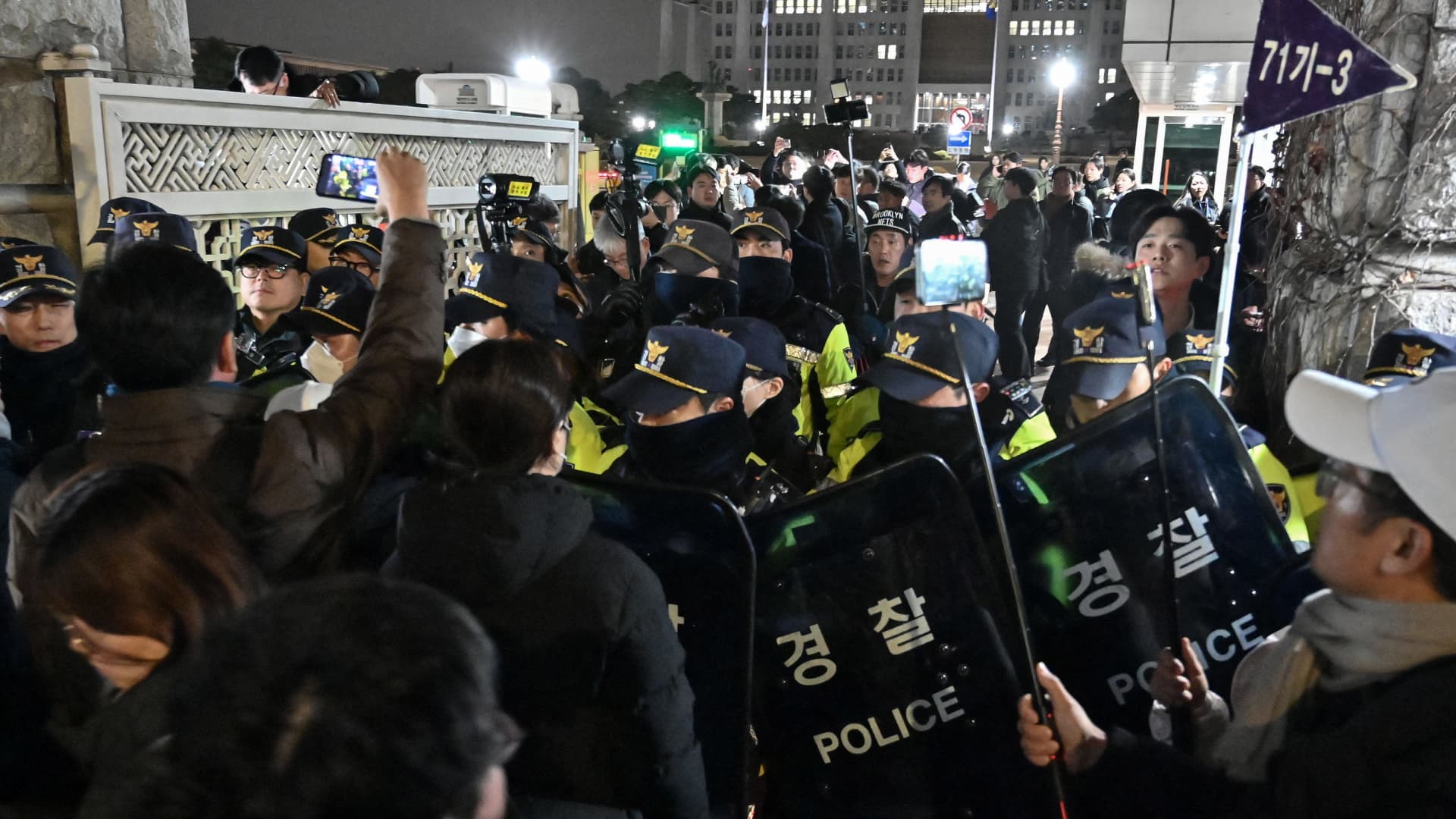
On December 3, 2024, police stand guard in front of the main gate of the National Assembly in Seoul after South Korean President Yun Seok-Yeol declared emergency martial law. South Korean President Yoon declared emergency martial law on Dec. 3, amidst a dispute in Congress over a budget bill, saying the measures were necessary to protect the country from “communist forces.”
Jung Young Jae | AFP | Getty Images
South Korean stocks fell in the United States on Tuesday after President Yun Seok-Yeol invoked emergency powers and declared martial law, raising concerns about instability in the world’s 13th-largest economy.
The iShares MSCI Korea ETF, which tracks more than 90 large and mid-sized Korean companies, fell 6% to a 52-week low.
Korean Electric Power Co.’s American Depositary Receipts (ADRs) fell 5%, while South Korean e-commerce giant Coupang fell 6%. KT Corporation (formerly Korea Telecom) stock price fell 3%. South Korean steelmaker Posco fell more than 6%.
The president accused the opposition of sympathizing with North Korea and controlling Congress. Yun did not say how martial law (temporary rule imposed by military authorities in times of emergency) would affect the country’s governance and democracy.
Under martial law, all political activities and acts that “incite social disorder” are prohibited. This is the first time a South Korean leader has declared martial law since 1980.
According to local media reports, the Korea Exchange said it would hold an emergency meeting “to prepare countermeasures” and then decide on Wednesday whether to open the market.
On Tuesday, the US dollar rose 1.9% against the South Korean won.
