


Synopsis
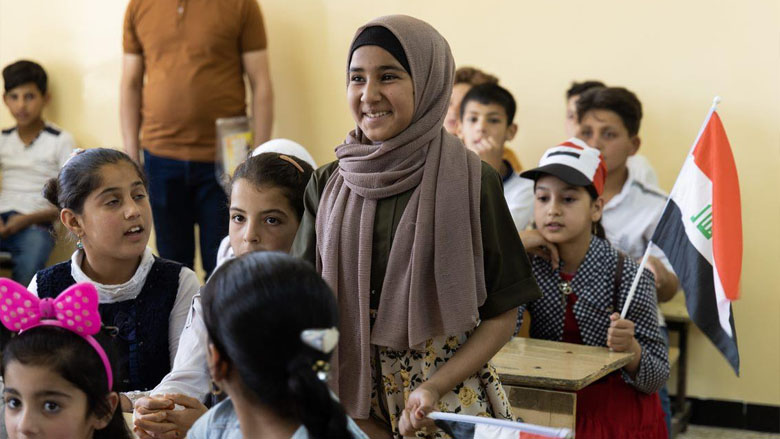
With funding from the World Bank under the Iraq Emergency Development Project (EODP), the Ministry of Education rebuilt 26 schools between 2020 and 2023, providing new learning spaces for more than 10,000 children. Additionally, more than 5,000 teachers and counselors have been trained in basic literacy and numeracy skills and psychosocial support using an innovative cascade training model. As of 2023, this novel teacher training program is being implemented in eight states and is being evaluated for national scale-up. Finally, the project will also help the Ministry of Education build digital infrastructure and streamline education data collection, which will improve the monitoring and evaluation of the education system. Overall, an estimated 135,000 students and more than 5,000 educators benefited from the project’s activities.
Beneficiary Estimate
“Rebuilding the school will help students continue their education and support returnees. We would like to express our sincere gratitude to everyone involved for their efforts in rebuilding the school.”
Anonymous local community member benefited from Baghdad’s rebuilt Al Said School
challenge
Due to years of conflict and disruption to service delivery, Iraq faces many challenges in providing quality education services that foster learning and skill building. These structural inefficiencies have led to a learning crisis and a human capital crisis in Iraq. The World Bank’s Human Capital Index estimates that a child born in Iraq today will achieve about 41 percent of their potential productivity by the time they reach adulthood.
A significant lack of educational infrastructure poses a significant challenge to improving Iraq’s education sector and learning. Due to the destruction caused by years of war and conflict, many schools had to accept students from neighboring schools. As a result, many students attend school in two or three shifts, resulting in very limited study time, in some cases as little as four hours a day, which can impact student performance. According to Iraq’s Ministry of Education, 10,000 more school buildings are needed to address infrastructure deficits and ensure a place for all children to learn.
We also need better equipped teaching staff to strengthen our education system and foster better student learning. Opportunities for professional development remain highly unequal in Iraq. Many teachers receive little training during and before their service, but the quality and extent of this training varies widely.
More comprehensive monitoring and evaluation (M&E) systems are also needed to adequately inform education sector planning. Years of conflict have weakened institutional functioning, effectiveness, and governance across Iraq, leaving M&E systems inadequate and fragmented.
approach
The activities of the EODP education project will be an important starting point to support the restoration of educational services in conflict-affected and recently liberated areas of Iraq, while laying the foundation for further development of the education sector. There were three main activities in this project. First, the project worked to expand the educational infrastructure and provide students with more conducive spaces for learning. The project supported the construction and equipping of 26 new schools on state-owned land in eight of Iraq’s 18 governorates.
The project also supported the development and implementation of an innovative cascade model for teacher training by the Ministry of Education. The model works by initially training 95 master trainers, who then train over 5,000 educators (including teachers and counselors) in basic Arabic/literacy and numeracy skills, as well as psychosocial Provided support training.
Finally, the project supported the Ministry of Education in developing digital infrastructure and educational information systems to strengthen educational planning and M&E at the central level.
result
Through this project, the Iraqi Ministry of Education provided support to more than 135,000 students, 5,000 educators, and 50 Iraqi employees of the Ministry of Education, who benefited from the project’s activities.
The project supported the construction of 26 schools in Iraq’s poorest areas. The newly built school will provide learning space for students who previously had to frequently travel long distances to attend school. These new schools have helped alleviate these challenges and created additional learning space for more than 10,000 students.
The project enabled the training of 5,000 teachers and educational counselors across Iraq in basic literacy, numeracy, and social-emotional skills. The model was initially planned to be implemented in eight prefectures and then expanded nationwide.
The project also helped establish a more robust digital infrastructure within the Ministry of Education to improve M&E in the education sector. This includes upgrades to digital infrastructure as well as support for mobile data collection platforms to build capacity for large-scale education management system implementation.
Banking group’s contribution
The World Bank provided $35 million for the education project component as part of a $750 million loan dedicated to the Iraq Emergency Development Project (EODP).
partner
The World Bank provided technical assistance to the Ministry of Education and the Ministry of Finance, in addition to coordinating and complementing activities from other partners such as UNICEF and UNESCO.
For the future
The EODP education component provided urgently needed crisis support. But Iraq requires even greater investment and broader support to improve learning for all children. Recently, Iraq approved a new education sector strategy 2022-2031. The strategy includes ambitious targets for increased access and higher quality learning for all children. The World Bank is supporting the Government of Iraq in implementing this national education sector strategy to improve learning outcomes in the coming years.
